
Downloads are flat. Spending is not. Read the gap.
The mobile app economy sent a confusing signal in 2025. Global app downloads landed at roughly 106.9 billion, down about 2.7% year over year Appfigures, while Sensor Tower's broader count reached about 150 billion, up a slimmer 0.8% Sensor Tower. Either way, download growth has stalled. Meanwhile consumer spending inside apps hit $155.8 billion, up 21.6% Appfigures. Spending grew roughly 27 times faster than installs. Users are not installing more apps. They are spending more inside the few they already have.
Attention is a winner-takes-most game
Concentration explains the spending. The top five apps alone capture about 49% of all mobile time; the top 25 capture 69% RealityMine / Global Statistics. TikTok leads at 16.4%, followed by Facebook at 10.4%, YouTube at 8.7%, Instagram at 7.1%, and Chrome at 6.2%. When two-thirds of all mobile attention lives in 25 apps, a new app's organic discovery is effectively closed. Game downloads fell 8.6% even as non-game downloads eked out 1.1% growth Appfigures — and in the US, total downloads dropped 4.2% Sensor Tower.
This is the quiet crisis of mobile: the storefront that was supposed to democratize distribution has become a walled lottery. You can build a great app and still never be found.
Why users stopped installing
Three forces stack against the install:
- Storage and data anxiety. On the billions of low-end Android phones that make up the next wave of users, storage is scarce and mobile data is expensive. Every install is a calculated cost.
- Permission fatigue. Years of aggressive tracking and notifications have trained users to reject prompts. An install that asks for contacts, location, and notifications is met with a reflex no.
- The discovery tax. App Store search rewards incumbents and paid placement. A bootstrapped app with no UA budget is invisible.
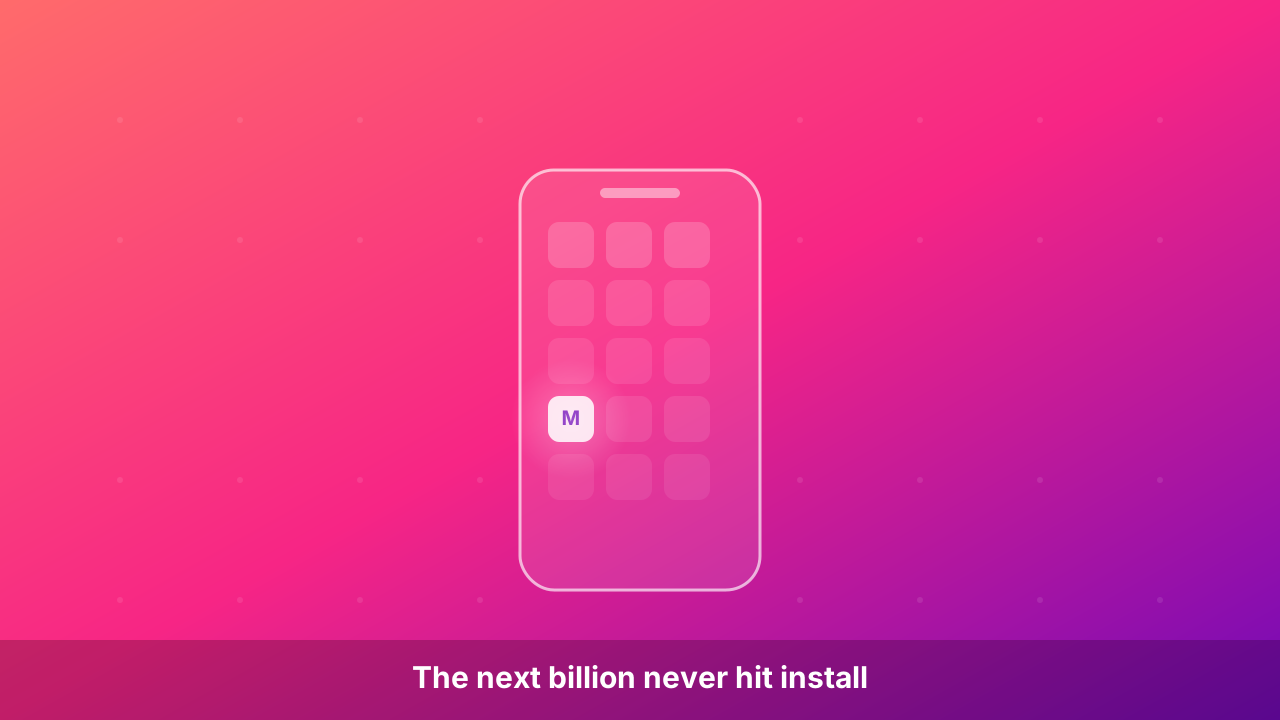
The result: the average user installs almost nothing new month to month. The next billion users are not waiting in the App Store. They are already inside something else.
The next billion live inside apps, not app stores
Look at where growth actually happens. In Latin America, users reach services through WhatsApp and super-apps rather than a folder of separate installs. In India and Southeast Asia, the entry point is a familiar chat or payment app. These users do not experience "the app store" as a destination — they experience a host app, and the services inside it. When a ride, a bill payment, or a government form appears as a tap inside an app they already trust, the install barrier simply disappears.
That is the mini-program model, and it is no longer a China-only story. A governed, lightweight unit of experience that runs inside a host — sharing its identity and payments — is the distribution mechanism for the next billion. No install, no review queue, no storage cost.
What this means for builders
If your growth plan assumes users will find and install your app, 2026 is the year to rewrite it. The leverage has moved from the home screen to the in-app surface:
- Meet users where they are. Embed your experience inside the apps and super-apps they already open, instead of competing for a home-screen slot.
- Ship a bounded, governed unit. Hosts will only embed what they can trust and scope. A mini-program — not a full native app — is the unit they accept.
- Localize for low-bandwidth, low-storage reality. The next billion often arrive on cheap Android with patchy data. Lightweight, instant experiences win.
Where Cross Mini App fits
Cross Mini App is the runtime for the post-install era. A single cross-app runtime plus an open catalog means you build a mini-program once and drop it into every host your users already trust — a super-app, a bank, a messaging platform, a merchant. Pre-compliant, sandboxed, localized mini-programs reach users without asking them to install anything. Developers stop fighting the App Store lottery. Hosts get vetted experiences they can embed in one line. The next billion users get the service inside the app they already have open.
The install is the exception now, not the rule
For two decades "build an app and ship it to the store" was the default. In 2026 that path still works for the incumbents who already own attention — and almost no one else. The growth is on the in-app surface, delivered as a governed mini-program through a cross-app runtime. Cross Mini App is building the shelf so the next billion users never have to install to be reached.