

Blog
Insights on cross-app distribution, mini programs, and the H5 ecosystem.
Tap a trade button and nothing happens for a second? WebView runs JS, layout, paint, and input on one main thread; a mini-program separates logic from render. Here is how the two models break mobile's responsiveness ceiling.
An H5 page pays the network tax on every cold start; a mini-program arrives pre-loaded. Here is why the first second of a transactional flow looks so different, and what it costs in conversion.
H5 offline depends on a service worker that may never register; a mini-program treats offline as a designed-in capability. Here is how the two models behave when the network drops on a transactional flow.
On a subway or a stadium, H5 re-fetches everything and white-screens; a mini-program keeps its shell local and only its data requests cross the wire. Here is how the two models behave when the signal drops.
In a real browser, the password manager offers the saved credential the instant a login field appears. Inside a WebView the field stays empty — iOS WebViews don't surface Safari Keychain passwords for web content, and Android WebView autofill is off by default and gated behind hints, context, and a system service. A host-owned runtime bridges a native credential provider so one login fills everywhere.
On the open web, tapping a Universal Link gives the OS a chance to open your app; an App Link on Android does the same. Inside a WebView that handoff dies. When a WebView loads a URL itself, the operating system is never asked which app should handle it, so the association files your app published are never consulted. For a fintech app, that means the redirect that should push the user into their bank's app for 3DS / SCA strong-customer-authentication, or into a wallet app to confirm a payment, silently lands back on a web page — or nowhere. A host-owned runtime bridges native app-opening so the handoff works on every engine.
On the open web navigator.geolocation resolves to a coordinate. Inside a WebView it silently fails — Android disables the Geolocation API by default and requires a host callback plus runtime permission and HTTPS, and iOS routes every request through a WKUIDelegate the app must implement. A host-owned runtime bridges native location so KYC, branch finders, and geofences work on every engine.
On the open web the Payment Request sheet, Apple Pay, and Google Pay appear at checkout. Inside a WebView they silently disappear — Apple Pay is unsupported in WKWebView, and Android disables the Payment Request API by default. A host-owned runtime bridges native payment SDKs so one checkout works on every engine.
On the open web Canvas and WebGL drive smooth K-line charts, order books, and 3D positions. Inside a WebView they stutter or die — Android's WebView falls back to software rendering unless hardware acceleration is enabled at the window level, and iOS quietly kills the WebKit GPU process without firing webglcontextlost. A host-owned runtime bridges native rendering so charts stay at 60fps on every engine.
On the open web the Web Speech API gives pages text-to-speech and voice input. Inside a WebView it fails in two opposite ways: Android WebView never implements speechSynthesis, and iOS WKWebView exposes webkitSpeechRecognition but never prompts. A host-owned runtime bridges native speech so voice features actually work.
On the open web, env(safe-area-inset-*) keeps your buttons clear of the iPhone notch, Dynamic Island, and home indicator. Inside a WebView the same variables can resolve to zero, the first paint can ignore them, and the bottom action bar — the order button, the trade confirm, the connect-wallet button — slides under the home swipe bar where taps never register. For a trading app, that means the control users most need is the one they cannot reach. A host-owned runtime surfaces native safe-area insets so every engine respects the hardware.
On the open web a page can pair a Bluetooth Low Energy device through navigator.bluetooth. Inside a WebView that object is undefined — Android WebView never exposes it and iOS WebKit never implemented it. A host-owned runtime bridges native BLE so hardware wallets, security keys, and terminals pair on every engine.
On the open web, clicking a PDF, CSV, or APK downloads it. Inside a WebView the same link does nothing — Android needs the host to wire setDownloadListener, and iOS WKWebView has no download manager at all. A host-owned runtime bridges downloads so one save action works on every engine.
On the mobile web, window.print() opens a print sheet and the browser can save to PDF. Inside a WebView it is a silent no-op, Android needs the host to wire createPrintDocumentAdapter plus PrintManager, and iOS WKWebView ignores the call entirely. A host-owned runtime bridges print and PDF export so one button works on every engine.
Live audio and video over WebRTC is first-class on the mobile web until it runs inside a WebView. Android pushes the getUserMedia permission decision to the host through onPermissionRequest, and iOS WKWebView ships media capture disabled by default, so most in-app browsers never connect a call. A host-owned runtime bridges real-time media, one API for camera, mic, and peer connection on every engine. This is about live two-way streams and peer connections, not the one-shot camera capture of post 38 or the permission double-gate of post 39.
Passkeys and WebAuthn assume a real browser with a platform authenticator and your domain. An embedded WebView gives you neither — Android's System WebView and iOS WKWebView don't reliably expose WebAuthn, and passkeys are scoped to the host app, not your site. A host-owned runtime bridges the device's native authenticator so passwordless login works everywhere.
A web app leans on timers, polling, and sync to stay alive — chat ticks, dashboards refresh, uploads finish, tokens renew. Inside a WebView that contract breaks the instant the app goes to the background. Android pauses JavaScript; iOS WKWebView freezes by design. There is no Background Fetch, no Background Sync. A host-owned runtime provides a real background task bridge.
Inside a WebView the page's secure transport is whatever the embedding app configured, and the defaults are hostile: Android blocks mixed content since Pie but ships no certificate pinning and a default onReceivedSslError that aborts silently, while countless apps fix it by calling handler.proceed and trusting every certificate (which Google Play rejects and MITM defeats). iOS WKWebView leans on App Transport Security yet exposes no clean per-request pinning API. A host-owned runtime ships one transport policy: enforce HTTPS, pin certificates, fail closed, and surface a real explainable error.
A native app shares one credential store with its network stack. Inside a WebView that store is walled off: the cookie jar is separate from the system browser and from native HTTP, cross-site cookies are dropped by SameSite rules, and every credentialed fetch needs a CORS handshake the page cannot fully control. A host-owned runtime provides a credential tunnel — one authenticated channel across web and native.
DeviceMotion, DeviceOrientation, and Vibration are first-class on the mobile web — until they run inside a WebView. Android System WebView left the Device Orientation API disabled until v55 and still returns all-zero acceleration on many builds unless the right flags and permissions are set; Vibration needs an explicit VIBRATE permission. On iOS, WKWebView does not even expose requestPermission(), so the gesture-gated iOS 13+ flow never starts. A host-owned runtime bridges the sensor layer — one API that reads the real hardware on every engine.
A file picker that opens instantly in Chrome stays inert inside a WebView. Android's WebView cancels every file request by default unless the app implements WebChromeClient.onShowFileChooser (and the legacy openFileChooser on older versions); miss the callback, the runtime permission, or the activity result, and the tap does nothing — no error, no picker. On iOS, WKWebView silently downgrades capture=camera to the photo library inside in-app browsers, and a long-standing WebKit behavior resets the FileList to one item on every camera capture. These are app-side features, not web-side ones, so upload works is a property of the wrapper, not the page. A host-owned runtime ships one unified file and camera pipeline that behaves identically on every device and OS version.
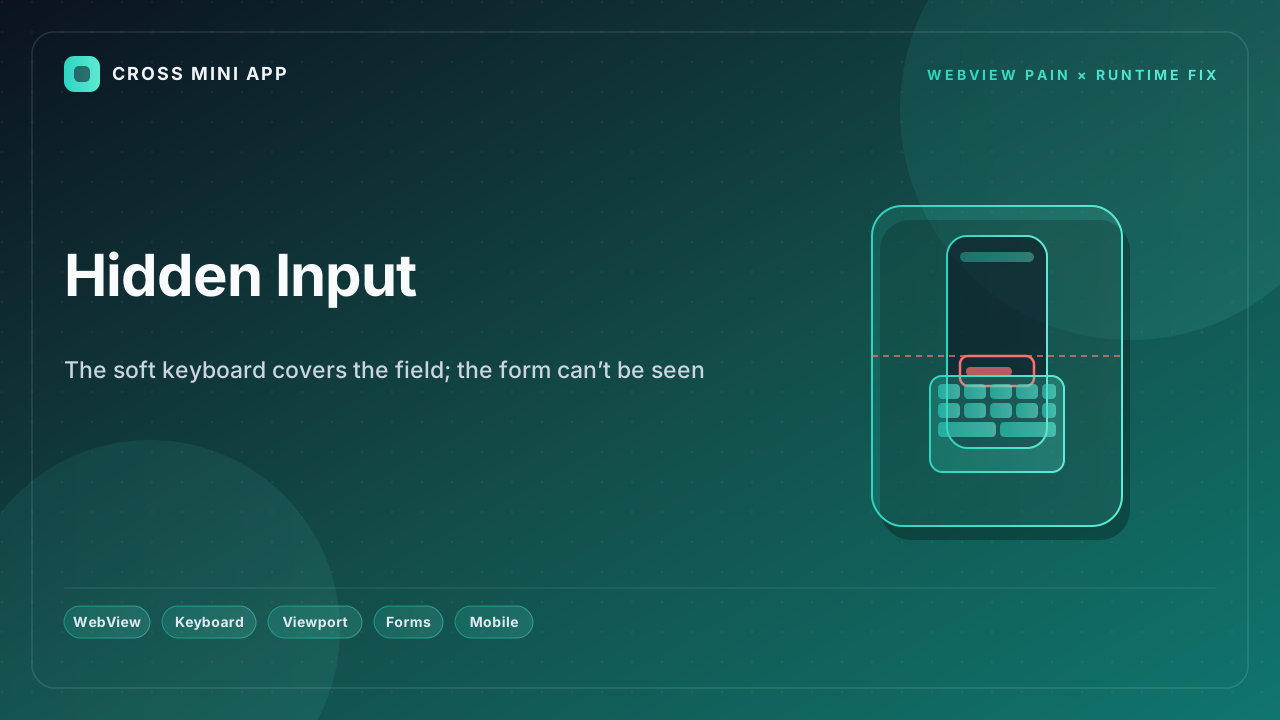
A native app ships a keyboard-aware layout: when the soft keyboard appears, the focused field scrolls into view and nothing is hidden. Inside a WebView that guarantee is gone. WebView does not resize the visual viewport on the IME; the page cannot see the keyboard geometry; on Android and iOS the field you type into is routinely covered. Login and payment forms become a blind box. A host-owned runtime provides a keyboard-aware bridge.
A native app controls its own media: fullscreen, autoplay, and background audio all behave. Inside a WebView that control is gone. Fullscreen needs a custom native view; autoplay is blocked unless the host flips two hidden flags; background audio dies when the app backgrounds. A host-owned runtime provides a media bridge — one predictable playback surface across every device.
Inside a WebView, a web page asking for the camera or location must pass two separate gates — the OS permission and the WebView permission — and on Android the default is to deny the second one if the app does not implement the callback. Worse, Android's WebView gives the embedding app full control over web permission handling with no per-site consent like a real browser: once the OS grant exists, the app can share location or camera with any page in the WebView without another prompt. On iOS, WKWebView adds a second prompt on top of the app's, and in-app browsers like TikTok and Instagram are officially unsupported. A host-owned runtime ships one permission broker that maps native and web consent, enforces per-origin grants, requires a secure context, and shows one consistent prompt.
A progressive web app relies on the Web Push API and a Service Worker to re-engage users with notifications — cart reminders, breaking news, ride alerts. Inside a WebView that pipeline does not exist: Android WebView has no Push API and no background wake-up, and Apple's own engineers confirm Web Push will not work in any app that uses WKWebView. The permission prompt never appears, the subscription silently fails, and every re-engagement message the H5 was supposed to send is gone. A host-owned runtime restores it with a native push bridge — FCM or APNs on the device, a JS bridge to register the token, and one handoff that looks exactly like the web standard to the page.
On Android System WebView the Web Share API simply does not exist: navigator.share is undefined. On iOS it exists only behind a user gesture, a secure context, and a feature policy that embedded browsers routinely strip. The page cannot open the OS share sheet, so the share button either errors out or silently falls back to a copy-link. A host-owned runtime exposes a real native share bridge — one sheet, every engine, every embedded browser.
A web app caches user data, offline catalogs, and draft state in localStorage and IndexedDB, treating the browser as a database of record. Inside a WebView that assumption breaks: storage is best-effort, never guaranteed. On storage pressure the browser evicts an entire origin at once (LRU); Safari deletes script-writable storage after seven days without interaction; app updates and reinstalls wipe the WebView data directory; and content embedded in another app's WKWebView is capped at roughly 15 percent of total disk. A host-owned runtime provides controlled persistence — a server-synced store, versioned migrations, and a durability guarantee the page can actually rely on.
A link or window.open inside a WebView does not open a new tab — it does nothing, silently. On Android the default is setSupportMultipleWindows(false), which ignores every request to open a new window; to make it work the app must enable multiple windows and implement onCreateWindow and onCloseWindow, and most never do. On iOS, WKWebView's createWebViewWithConfiguration delegate returns nil by default, so target=_blank is silently dropped unless the app implements WKUIDelegate, and when developers do, they often spawn a second WebView whose back and forward history is disconnected from the first. A host-owned runtime ships one window manager that maps popups to in-app tabs or a consistent external handoff, keeps navigation history intact, and never lets a link die silently.
The system clipboard is a global, cross-app channel, and a WebView page can read everything your user copied — payment cards, passwords, one-time passcodes. On Android the clipboard was readable by any background app before Android 10 and only gained an access toast and a sensitive-data flag in Android 12 (per Android Developers and OWASP MASVS-CODE). On iOS the general pasteboard is system-wide, persists across restarts, and syncs across devices via Universal Clipboard; iOS 14 added a read notification and iOS 16 a paste prompt (OWASP MASTG). But the web read path inside a WebView is untouched by those native mitigations: a page with clipboard access and a user gesture can harvest credentials the app just copied for the user. A host-owned runtime mediates the clipboard at the native layer — marks sensitive items localOnly with expiration, and gates web reads behind explicit user intent.
A WebView is not a view; it is a browser engine that has to boot before it can draw. The first time your app creates one, the whole Chromium stack — native library, V8, renderer process, network stack — initializes on the UI thread, blocking input and risking an ANR. On Android that first init runs 200–500 ms; on iOS the WebContent process launch alone can stall two seconds on a cold device. And because the engine is a system component updated independently through the Play Store, a pending WebView update can quietly break your startup. A host-owned runtime warms, pools, and version-manages the engine instead of letting the OS surprise you.
WebView typography is not governed by web standards but by the underlying OS. iOS draws with San Francisco and PingFang SC, which support the full 100–900 weight range; Android draws with Roboto and Noto, where older builds expose only 400/500/700 and 500 is quietly downgraded to 400. Font fallback diverges — Noto Color Emoji on Android versus Apple Color Emoji on iOS — and vendor kernels such as Tencent X5 disable non-whitelisted font fallback entirely. System text zoom overrides CSS: Android WebSettings.setTextZoom and iOS UIContentSizeCategory silently multiply every px, rem, and em, breaking layouts. The result is brand typography that looks right on one engine and broken on the next — tofu emoji, collapsed weights, and layout overflow. A host-owned runtime locks typography: a controlled font stack, capped system zoom, guaranteed fallback fonts, and consistent weight mapping the page cannot drift from.
A WebView's default navigation policy is wrong in both directions. Leave it alone and every link — including the bank's payment page and the phishing clone — opens inside your own WebView, leaking your referrer, your session cookie, and in real CVEs your auth token in the URL bar. Touch it and you ship ERR_UNKNOWN_URL_SCHEME crashes the first time a user taps a phone number. And with no host allowlist by default, a single unguarded bridge call becomes silent account takeover. A host-owned runtime decides, per link and per origin, what leaves and what stays.
The host app cannot control the WebView's network stack. On iOS, WKWebView cannot intercept HTTPS at all — Apple documents that registering a WKURLSchemeHandler for http or https raises NSInvalidArgumentException, and NSURLProtocol interception of http/https is unsupported. On Android, shouldInterceptRequest is partial: redirect hops, blob:, and javascript: never fire. That means no host-enforced certificate pinning, no transparent auth, no connection reuse, and no request policy — every page re-establishes TLS and exfiltration to an unknown host is invisible. A host-owned runtime mediates the network at the native layer: pinning, signed auth, allowlist, and unified telemetry the page can never bypass.
A WebView runs web content with the full privileges of the host app, and the JavaScript bridge is a privilege-escalation surface with no walls. On Android, addJavascriptInterface injects a Java object into every frame including iframes with no way to verify the caller origin; before Android 4.2 it was outright remote code execution, and today a broad bridge plus reflected content is still cross-site scripting that runs native code with your app permissions. web.dev confirms WebView has no real site isolation and hands the embedding app your cookies and DOM. In 2026, CVE-2026-103922 (Capacitor, CVSS 9.6) showed the same-origin boundary failing in a shipped hybrid app. A host-owned runtime draws the wall: least-privilege, origin-scoped, capability-gated.
A WebView screen looks like a web page, but for a screen-reader user it does not behave like one. iOS WKWebView drops assertive live-region announcements that Safari honors; web content does not inherit the host app's font scaling, bold text, or dark mode; assistive-tech focus gets lost at the native boundary. For a traffic app whose catalog is other people's pages, that gap is now a legal one — the EU Accessibility Act has been enforceable since June 28, 2025, and its bar is WCAG 2.1 AA. A host-owned runtime bridges the accessibility tree instead of leaving it to chance.
Inside a hybrid app, every WebView can sit in its own cookie and storage partition. Apple's ITP partitions third-party storage per first party, an ephemeral WKWebView keeps nothing on disk at all, and on Android the cookie jar is process-wide with no honest way to isolate one view. The result is an identity that drifts per session and per view — so the same real customer looks like a different device to your fraud and KYC stack, and your false-decline rate climbs. A host-owned runtime issues one stable, signed, consent-gated device identity instead of gambling on partitioned browser storage.
The form is where money is made, and a WebView is where forms break. On iOS, WKWebView does not fire window.resize when the keyboard opens, so position:fixed bars hide under it; focus auto-scroll targets the wrong element and the field jumps off-screen. On Android, Chinese, Japanese, and Korean input composition drops characters and freezes the cursor inside WebView. Password autofill silently disappears unless the app wires up Associated Domains and the default data store. A traffic app whose checkout is someone else's HTML is shipping a form its own platform cannot guarantee. A host-owned runtime supplies a first-party input layer instead of betting on the engine.
A WebView promises the web's instant-update model, but its cache is a black box split across two platforms. On iOS there is no offline and no Service Worker; on Android the cache quietly ignores your Cache-Control. The result is a page that shows last week's JS under this week's HTML — a white screen you cannot explain. A host-owned runtime serves version-pinned, deterministic assets instead of gambling on opaque browser caching.
The web layer inside a hybrid app can update over the air in seconds, but it is tethered to the native binary it runs on. The page calls native bridges whose contracts only exist in a specific app version, and a large slice of your users sit on old binaries for weeks or months. So a web fix that needs a new native capability cannot ship without a store round trip, and a bad web bundle cannot be rolled back independently of the native side. A host-owned runtime gives you a controlled, per-version, per-user release channel instead of a split you cannot steer.
The page a merchant ships into your WebView is not their code alone — it is a cargo of third-party analytics, ads, social, consent, and tag-manager scripts they neither fully control nor fully understand. On a WebView there is no native content blocker and no tracker protection, so every one of those scripts fires, competes for the single JavaScript thread, exfiltrates data, and widens the attack surface. The 2024 Web Almanac measured 375 KB of third-party JavaScript on the median mobile page versus 168 KB first-party — 2.2×. A host-owned runtime intercepts resource loads and governs third parties at the WebView layer instead of hoping the page behaves.
The entry point is moving from your launcher icon to an AI agent. Apps that trap their core flows in WebView remote documents can't be driven by agents — and risk being skipped entirely by the zero-click era.
A checkout in a WebView is fine until the feature needs a real device — Bluetooth, NFC, a push that actually wakes the phone, a background task. The web platform covers a fraction of what mobile OSes expose, and the parts it does cover are split by engine. The usual fix, a private JS bridge, is fragile and ungoverned. A host-owned runtime gives mini-programs a standardized, reviewed set of native capabilities instead.
You ship a fix for a WebView vulnerability the same way you ship any other fix — except you don't. The Chromium engine inside WebView is updated by Android and the Play Store, not by you. That means the security of your in-app checkout, login, and forms is decided by a component whose version you neither control nor can pin.
Putting a checkout or intake form inside a WebView feels fast — until you realize the user's name, payment details, and health data are traveling through a document fetched from your server and often onward to third parties. That drift collides with GDPR data minimization and data-residency rules, and with the cloud-AI default of training on whatever crosses the network.
A WebView problem is usually an invisible problem. The screen is blank with no error, the layout is wrong only on iOS, the request fails silently — and in production you have no DevTools, no breakpoints, no source maps, nothing to attach. Debugging is disabled by default on both platforms for security, and the renderer lives in a separate sandboxed process the app profiler cannot see. A host-owned runtime turns the embedded web into a governed, reproducible surface instead of a black box.
Shipping a feature through a WebView feels like a loophole: change the H5 on your server, and the feature updates without an App Store review. That loophole is a landmine. The moment the H5 changes what the app does — or bridges to native in a way the store never reviewed — both Apple and Google can pull the app, and repeat offenders can lose their developer account. The speed teams wanted becomes the risk that takes the whole app down.
A user logs in natively, then hits a WebView screen and is asked to log in again. A cart filled in WebView disappears back in the native shell. The border between native and remote document silently drops identity and state — and third-party-cookie deprecation makes it worse.
A WebView is not a view; it is a browser. On Android each instance rides on a separate Chromium renderer process; on iOS each WKWebView spins up its own WebContent process. A blank page already costs 50-80 MB, a real e-commerce screen 120-200 MB, and there are no economies of scale — ten warm WebViews can get a phone jetsammed within a second. A traffic app that opens one WebView per hosted mini-program is quietly budgeting its own crash. A host-owned runtime pools and caps that footprint instead.
Native crashes arrive with stack traces and symbolicated reports. The failures hiding inside your WebView remote documents show up as vague «the app is broken» tickets — because the hybrid layer is a monitoring blind spot by default.
A WebView loads your core screens from a server that leans on third-party services which can reprice, shut down, or change policy overnight. Without an escape hatch, one rug pull can take your product offline.
When your most valuable screens live in an in-app WebView, every handoff from web, social, or push into the app drops context — and your conversion funnel leaks exactly where it should close.
Locking articles, listings, and product pages inside an in-app WebView makes them invisible to search engines and breaks social share cards — forfeiting the two cheapest growth channels.
When core flows run in a WebView loading remote documents, every server-side change hits 100% of users at once — no canary, no staged rollout, no kill switch, and a version matrix you don't control.
A WebView is not a light view — it is a Chromium browser engine running on top of your native shell. On the low-end devices that carry your traffic app, that second engine quietly taxes RAM, battery, and frame rate.
When login, payment, and profile live inside a WebView loading remote documents, you inherit the entire web's attack surface — and lose the app-level controls that should protect it.
A senior operator's view on why app-store commissions, review queues, and forced in-app billing constrain growth, and how decoupling the service layer via a mini-program runtime changes the economics.
A senior operator's view on why traffic apps that run their core journey inside a WebView end up with distorted attribution — split sessions, stripped referrers, blocked cookies — and how a host-owned runtime restores clean, first-party measurement.
A senior operator's view on why the card-based WebView checkout collapses in emerging markets, and how a host-owned runtime that plugs into local rails (Pix, UPI, M-Pesa, GCash) recovers conversion and ownership.
A senior operator's view on why embedding third-party H5 puts an unauditable code surface and compliance liability on the host, and how a sandboxed, reviewed runtime makes it controllable.
A senior operator's view on why embedded H5 inside an app reads as «someone else's product» — rendering, loading, and capability gaps — and how a host-owned runtime makes services feel native.

Many teams try to boost retention by dropping third-party services into an H5 container — and watch nothing move. H5 is a borrowed web page; a mini-program is the host's own runtime. Six fault lines — login, payment, re-engagement, experience, capability, ecosystem — decide who actually helps your app keep users and compound value.
A senior operator's view on why shipping the same feature across native iOS, native Android, and web triples cost, and how a universal runtime collapses it to one codebase.
A senior operator's view on why opening your app to third-party developers risks chaos, and how an open catalog plus graded APIs and a sandbox lets a host stay open yet in control.
Plenty of founders hit real DAU and still can't monetize. The leak isn't traffic — it's that H5 hands the transaction to a third party. A mini-program runtime keeps the sale, the data, and the re-engagement inside your app, so revenue compounds instead of leaking out.
A senior operator's view on why embedding third-party H5 leaves identity, data, and the user relationship with the service provider, and how a host-owned runtime converts traffic into assets you actually control.
A senior operator's view on why traffic apps built on WebView and H5 reload themselves into oblivion on weak networks, and how a host-owned runtime that bundles and caches its catalog recovers the session when the signal drops.
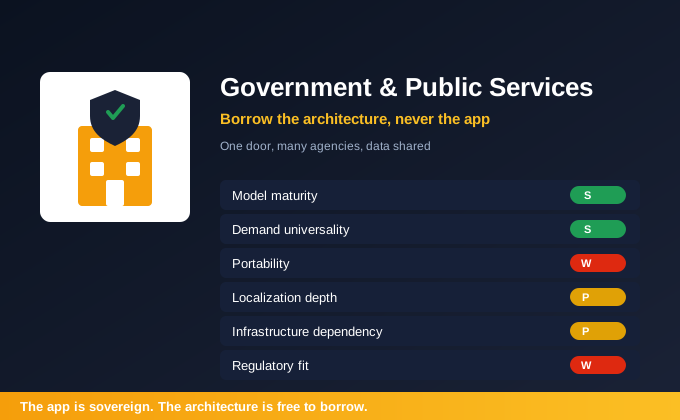
China turned government into a runtime — 1.07 billion e-social-security cards, 120M registered users on Zhejiang's 浙里办, and national one-network service. But you cannot export a Chinese government app. The lesson is the architecture, not the payload. Here is what a universal runtime should copy.
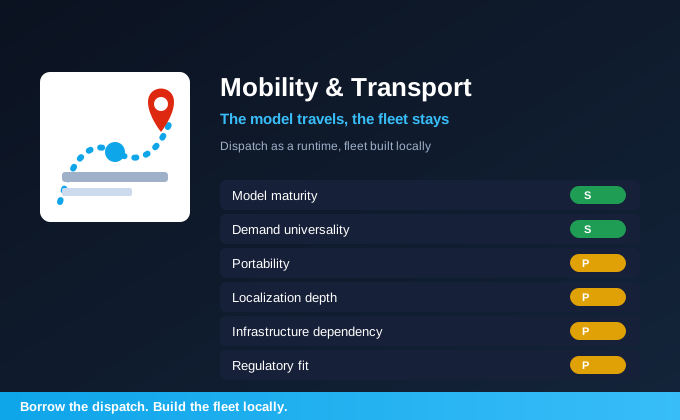
China runs the world's busiest mobility layer — Didi alone did 12.39 billion China-Mobility trips in 2024 and 539M Chinese use ride-hailing. But the lesson for overseas is the dispatch model, not the fleet. Here is what a universal runtime should copy and what it must rebuild locally.
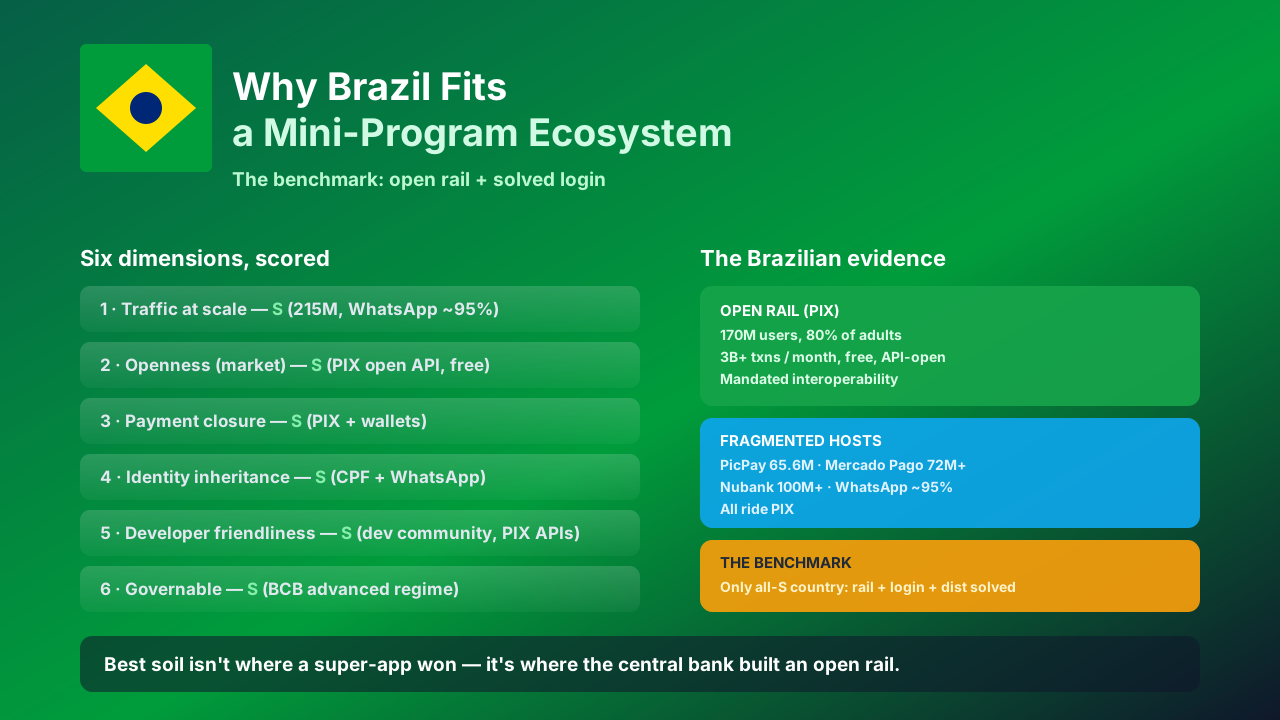
Brazil built the world's strongest real-time payment rail and then opened it. PIX — 170 million users, 80% of adults, 3 billion transactions a month, free and API-open — sits under PicPay, Mercado Pago, and Nubank. This is the benchmark case.
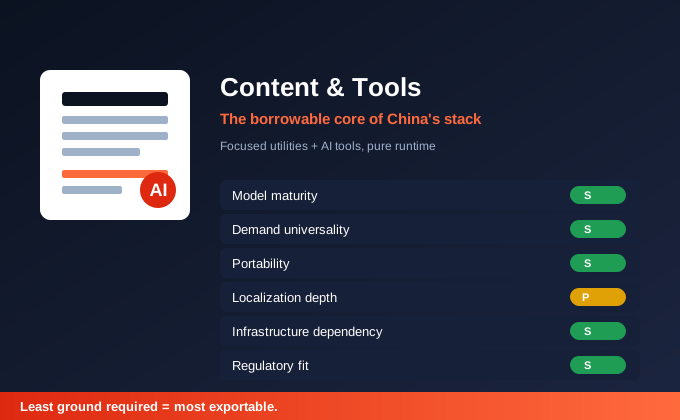
Content and utility mini-programs are the most exportable slice of China's ecosystem: pure logic and rendering, no payments rail, no national ID, no logistics. From a 740M-MAU phone top-up to AI assistants, this is the pattern a universal runtime can ship anywhere.
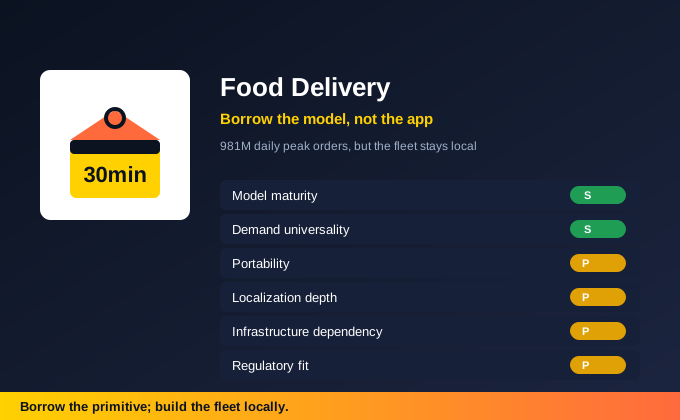
China runs the world's densest on-demand delivery network — a 98M-order single-day peak and 781B RMB instant retail in 2024. But the lesson for overseas is the pattern, not Meituan. Here is what a universal runtime should copy and what it must rebuild locally.
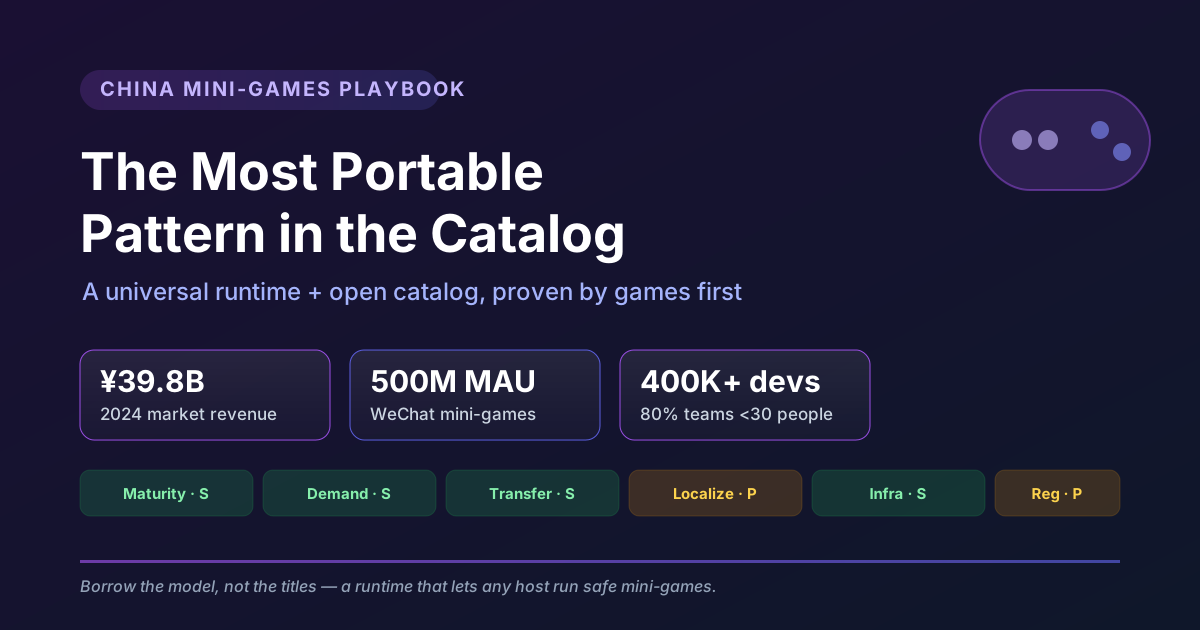
China's mini-game market hit RMB 39.8 billion in 2024 with 500 million monthly users and 400,000 developers. It is the purest proof that a universal runtime plus an open catalog travels — because games depend on almost no local rails.
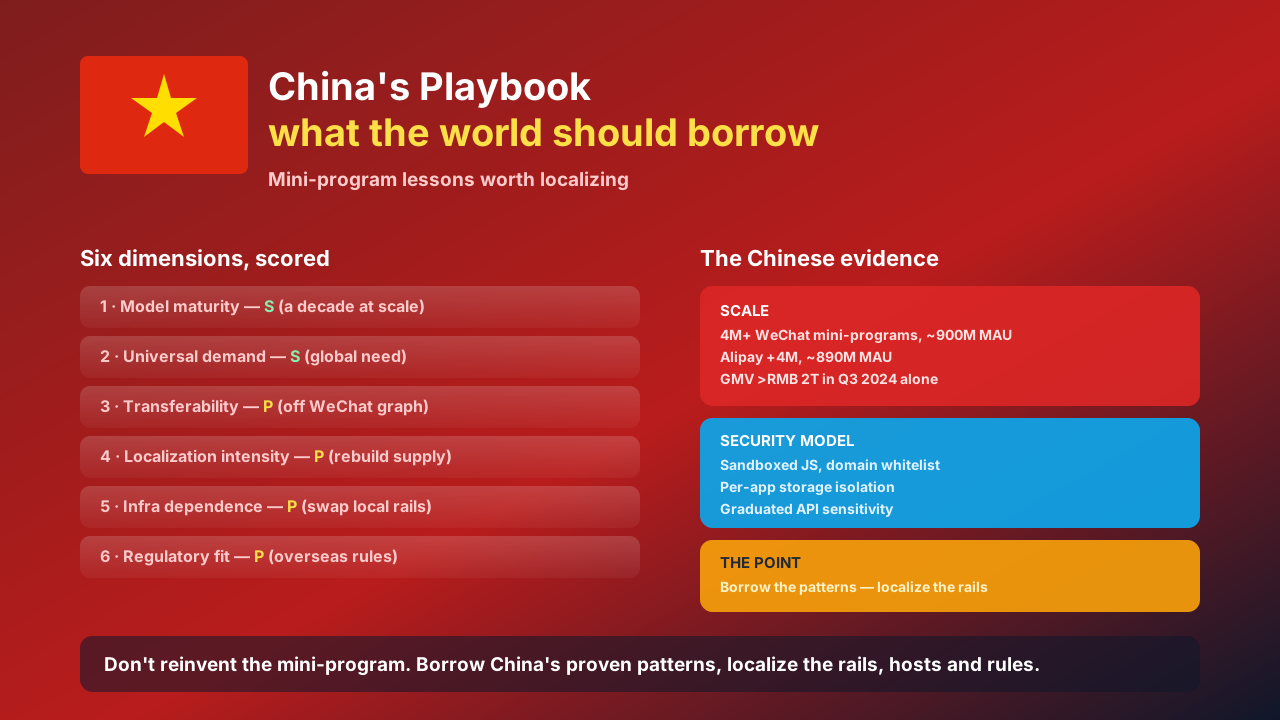
China ran the world's largest mini-program lab — 4M+ WeChat mini-programs, ~900M MAU, trillions in GMV, and a sandbox security model the rest of the world is still catching up to. Here is a scorecard of which proven patterns are worth adopting, and what to localize.
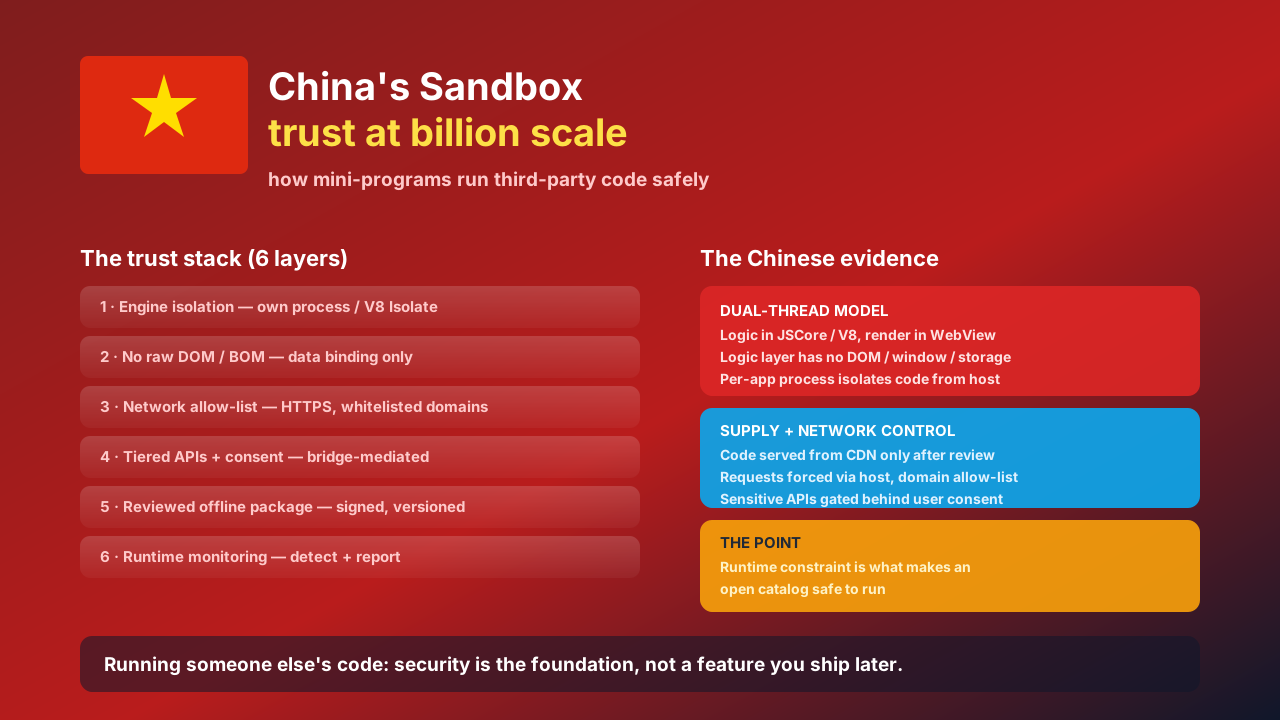
WeChat and Alipay run millions of third-party mini-programs on a billion phones, touching payments and identity. They solved it with a layered trust stack — engine isolation, no raw DOM, network allow-lists, tiered APIs, reviewed code and runtime monitoring. That stack is exactly what a universal runtime must ship.
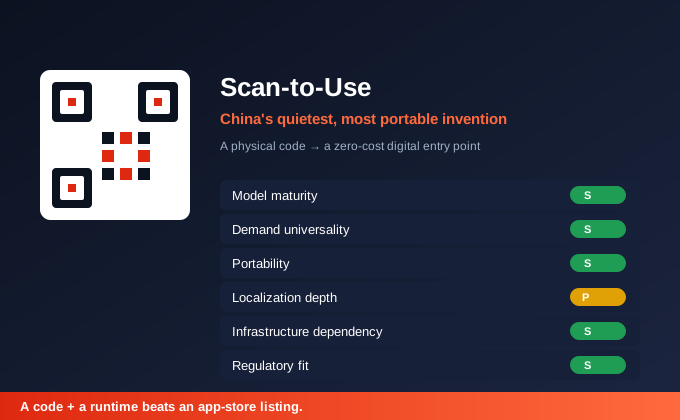
The QR-code-to-mini-program flow is the most underrated pattern China validated: a physical code becomes a zero-cost digital entry point. No payments rail, no national ID, no logistics — just a camera, a runtime and a tap. That is the cleanest canvas a universal runtime can offer.
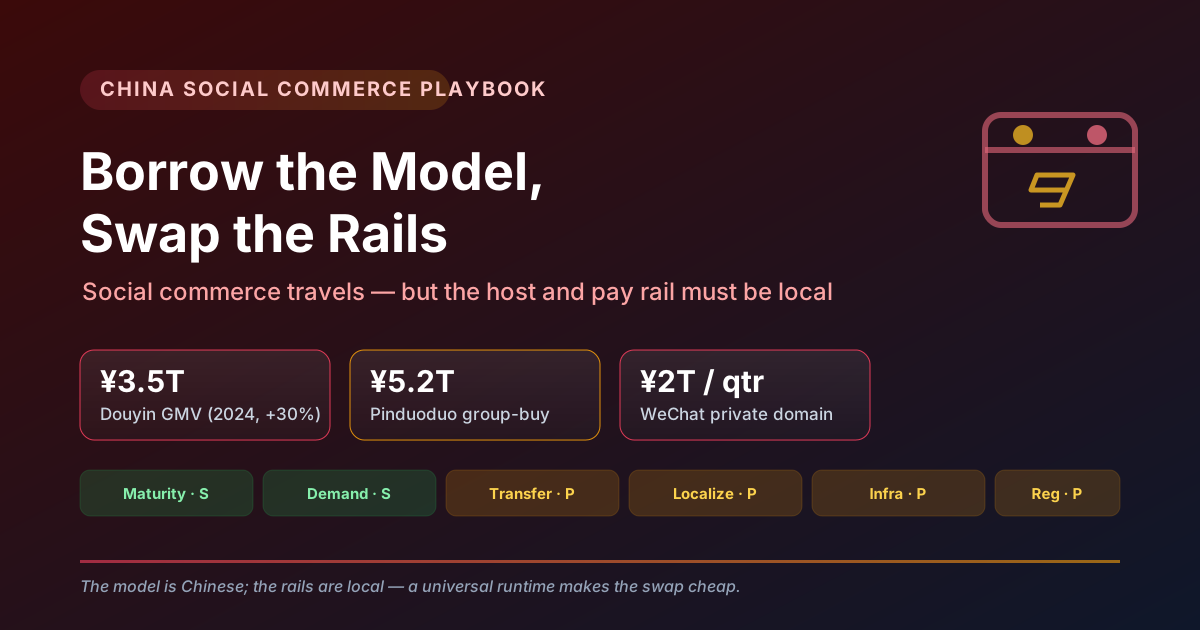
China's social commerce hit trillions in GMV — Douyin ~RMB 3.5T, Pinduoduo ~RMB 5.2T, WeChat private-domain over RMB 2T in a quarter. The lesson for the rest of the world is clear: the model travels, but you must swap in a local social host and a local payment rail.
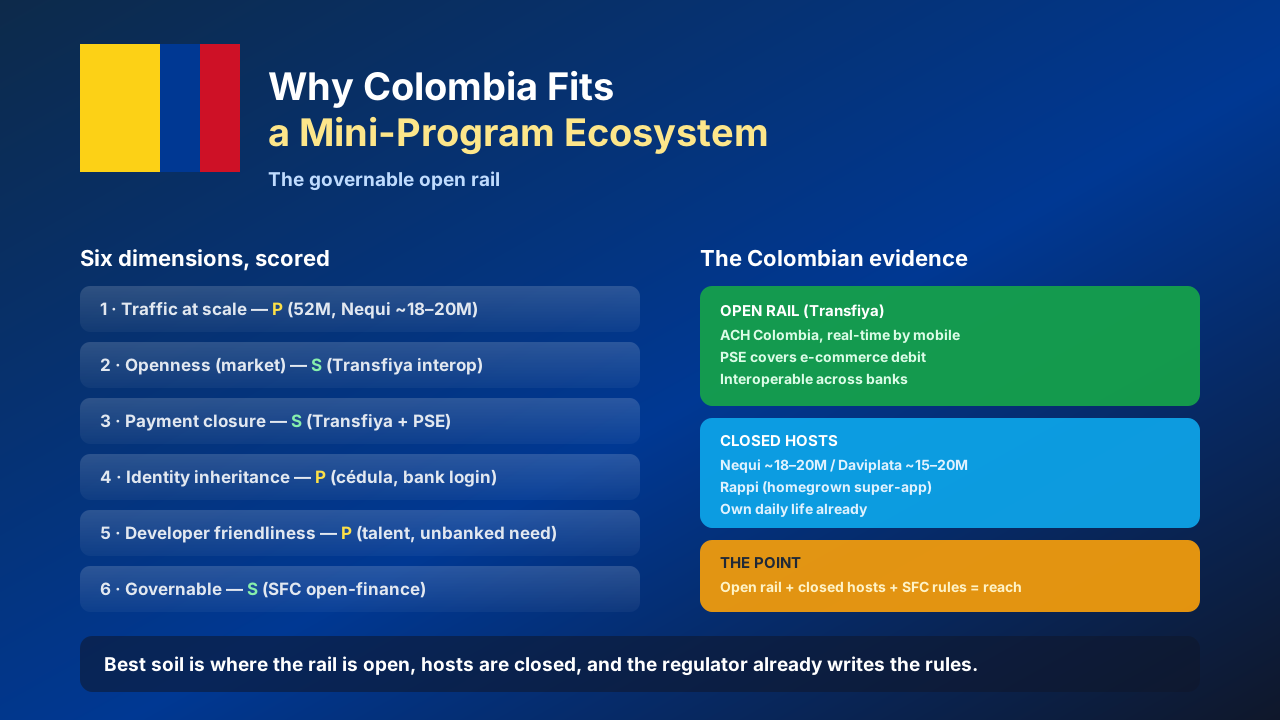
Colombia is the governable open rail. Transfiya gives interoperable instant payments, PSE covers e-commerce, and the SFC is actively writing the open-finance rulebook — while Nequi, Daviplata and Rappi already own daily life as closed hosts.
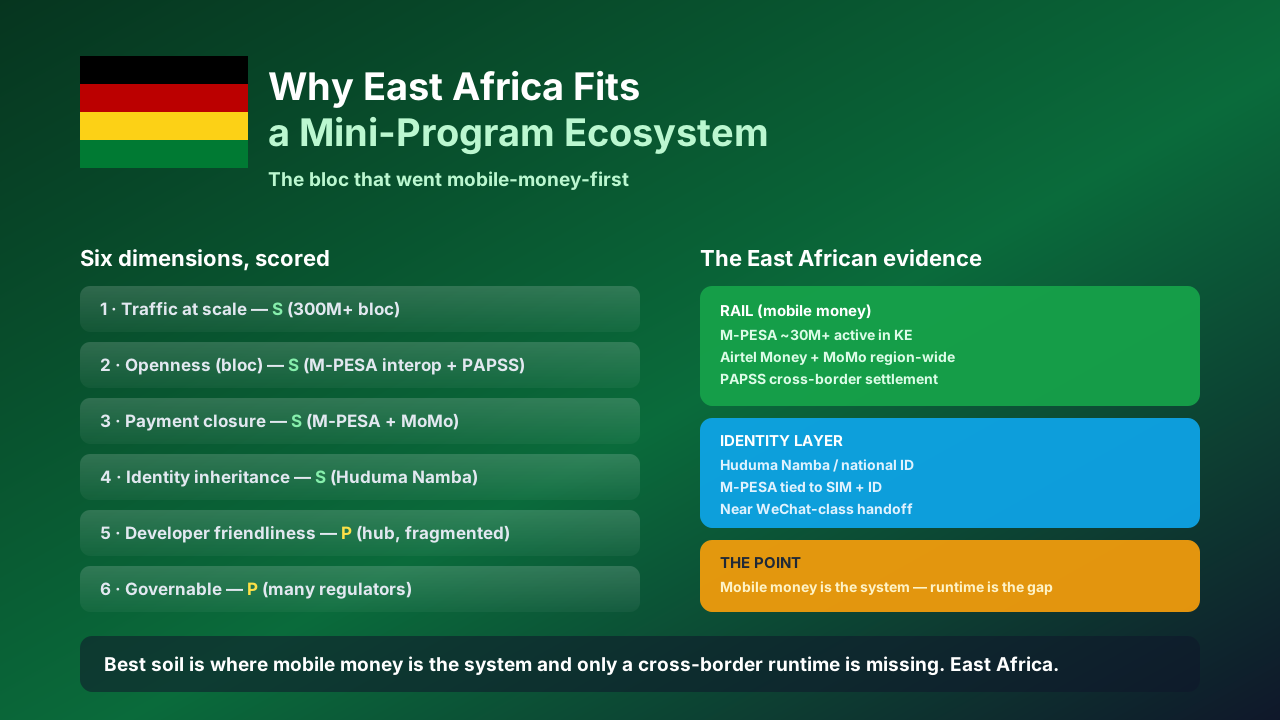
East Africa is not one market — it is a bloc of 300M+ people who went mobile-money-first. M-PESA, Airtel Money and MoMo rails plus PAPSS cross-border settlement make it the most payment-ready region on earth, fragmented only by closed national hosts.
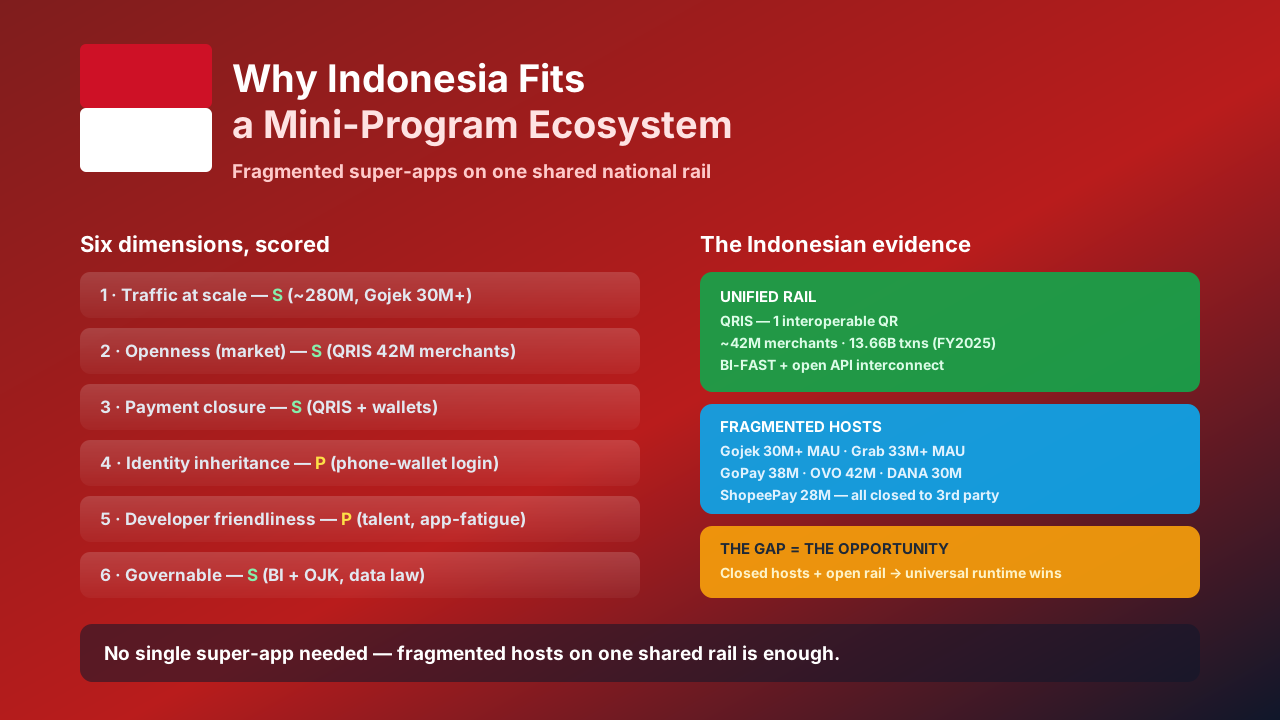
Indonesia has 280 million people, a dozen super-apps, and a government-mandated interoperable payment rail — but the hosts stay closed. That gap is exactly the opportunity.
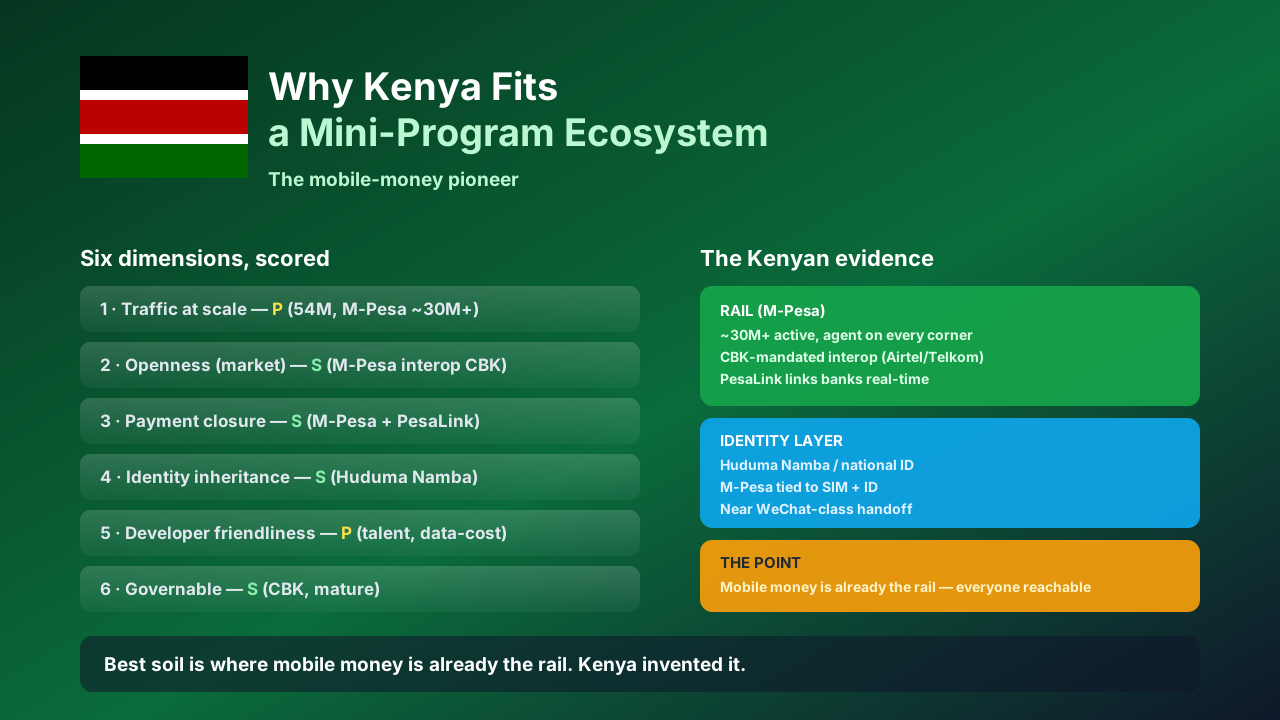
Kenya is the mobile-money pioneer. M-Pesa is the rail of daily life — 30M+ active users and an agent on every corner — now interoperable by CBK mandate, with Huduma Namba as a near-universal identity layer.
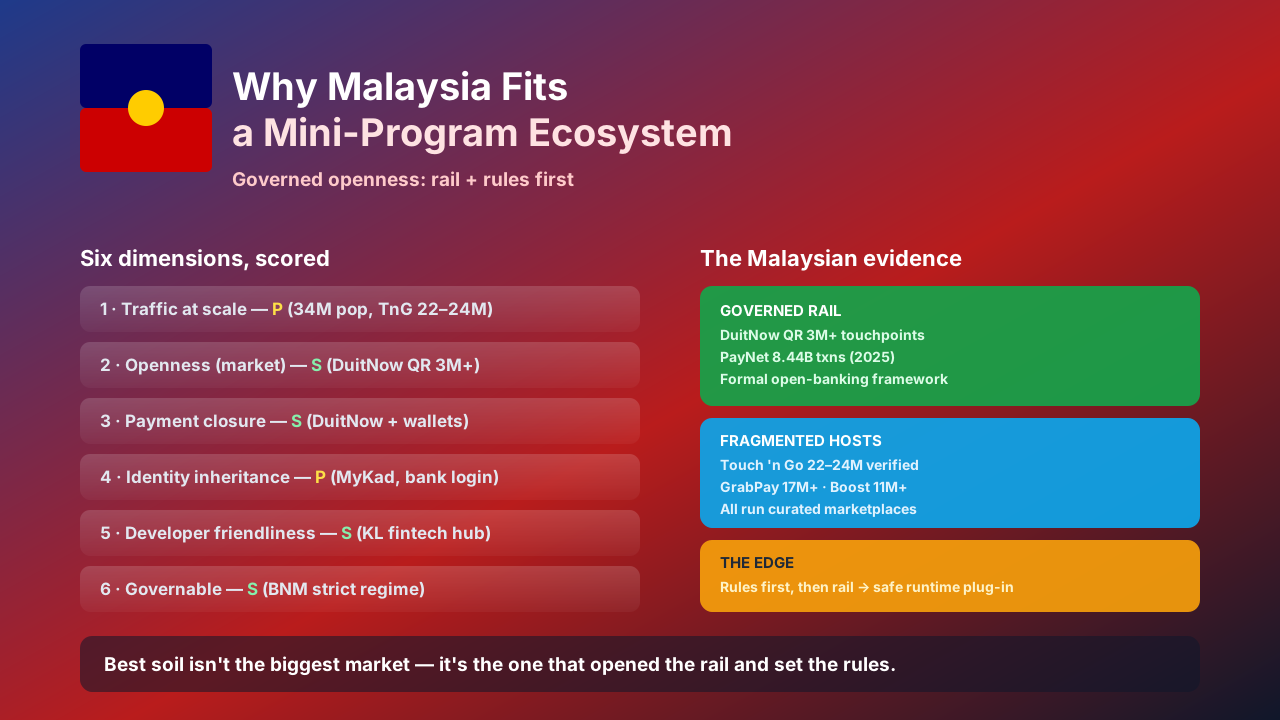
Malaysia is small in population but tops the region in rail maturity. DuitNow — PayNet's interoperable QR and open-banking layer — sits under Touch 'n Go, GrabPay, and Boost, with Bank Negara setting the rules.
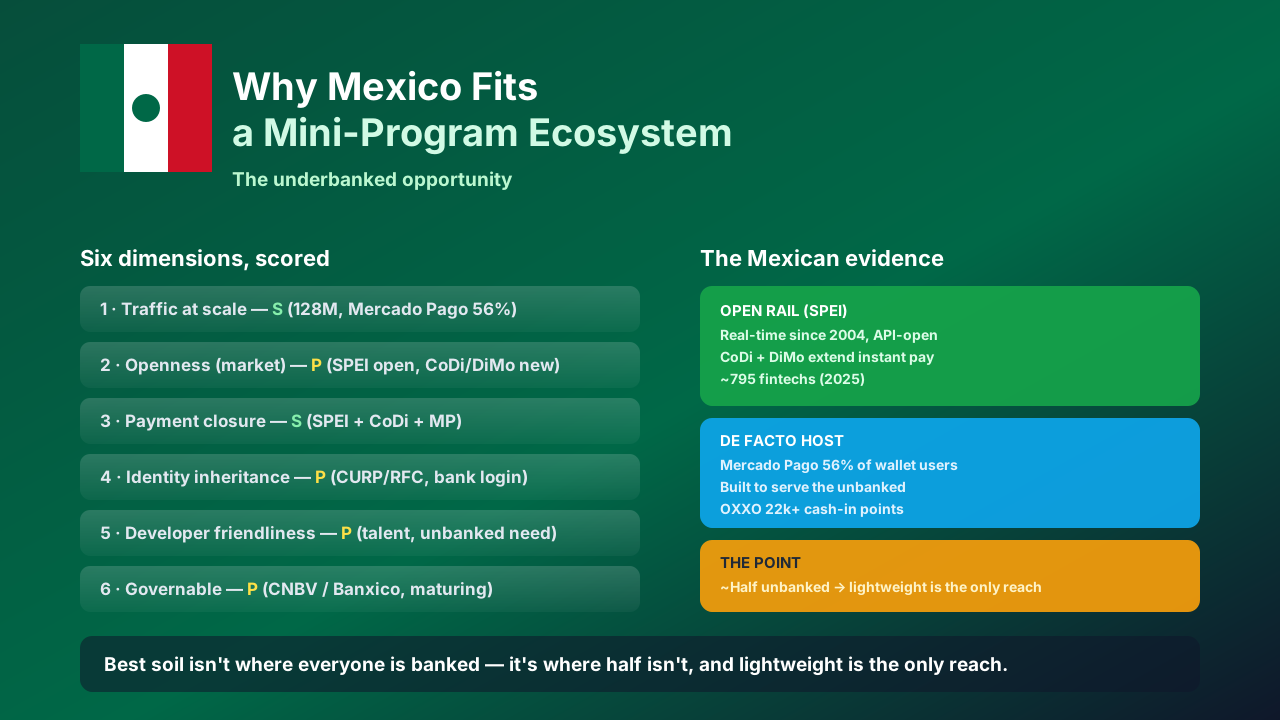
Mexico is the underbanked opportunity. Nearly half the population has no account, yet SPEI — a real-time rail since 2004 — plus CoDi and DiMo give an open infrastructure, and Mercado Pago already reaches 56% of wallet users. Lightweight beats native here.
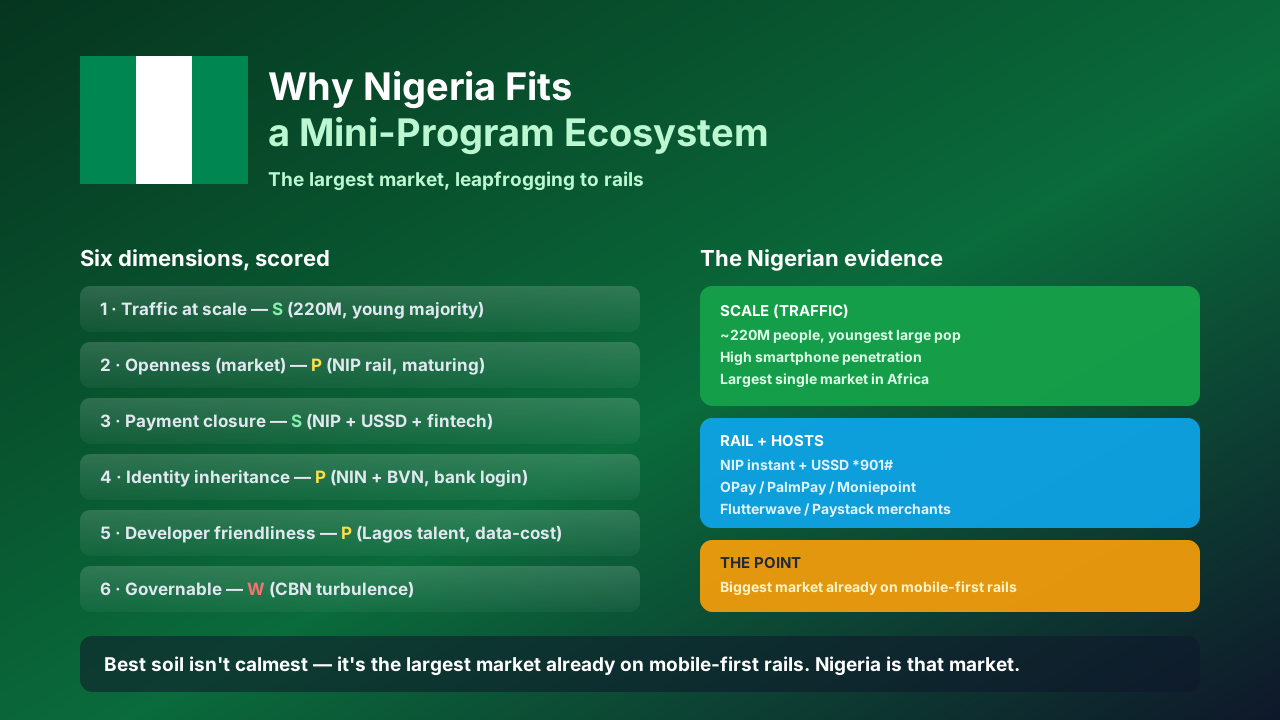
Nigeria is the largest market, leapfrogging to rails. 220M people, a young majority and a ferocious fintech scene (OPay, PalmPay, Moniepoint, Flutterwave, Paystack) sit on NIP instant payments and USSD — the rails already exist.
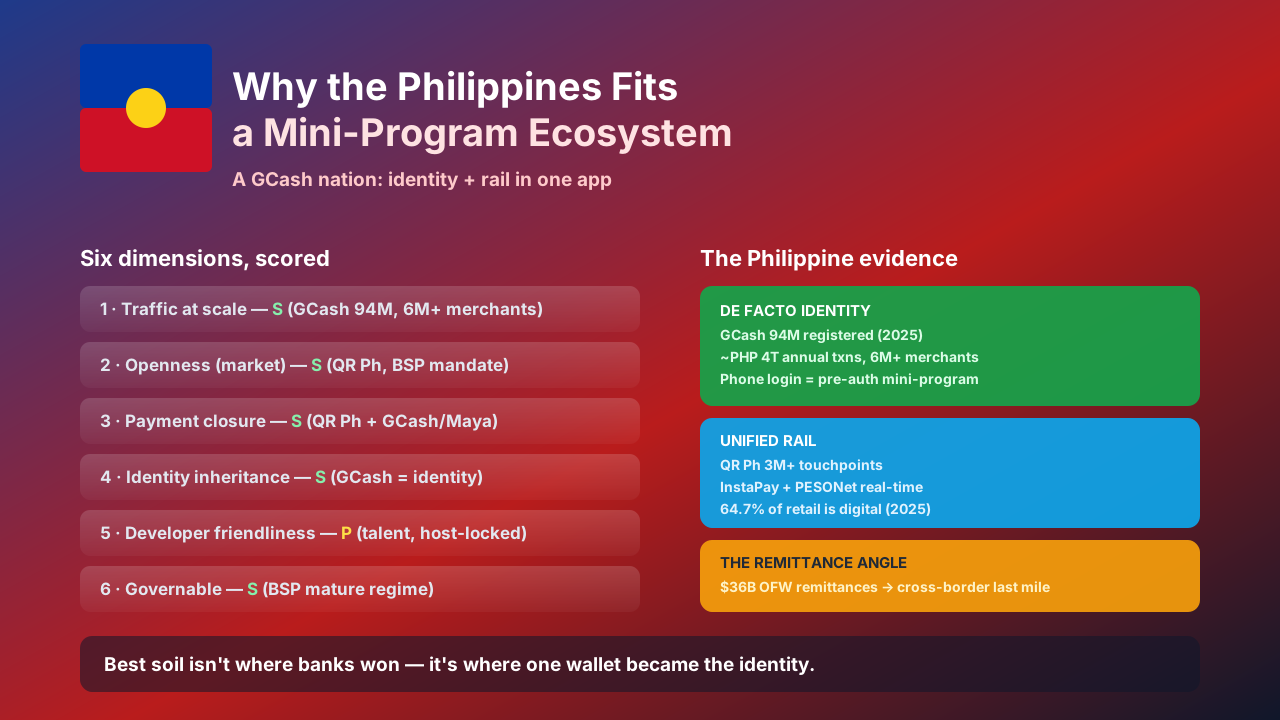
The Philippines is a GCash nation. With 94 million registered users, a central-bank-mandated interoperable rail, and $36 billion in remittances, closed hosts plus a de facto identity layer is the mini-program opening.
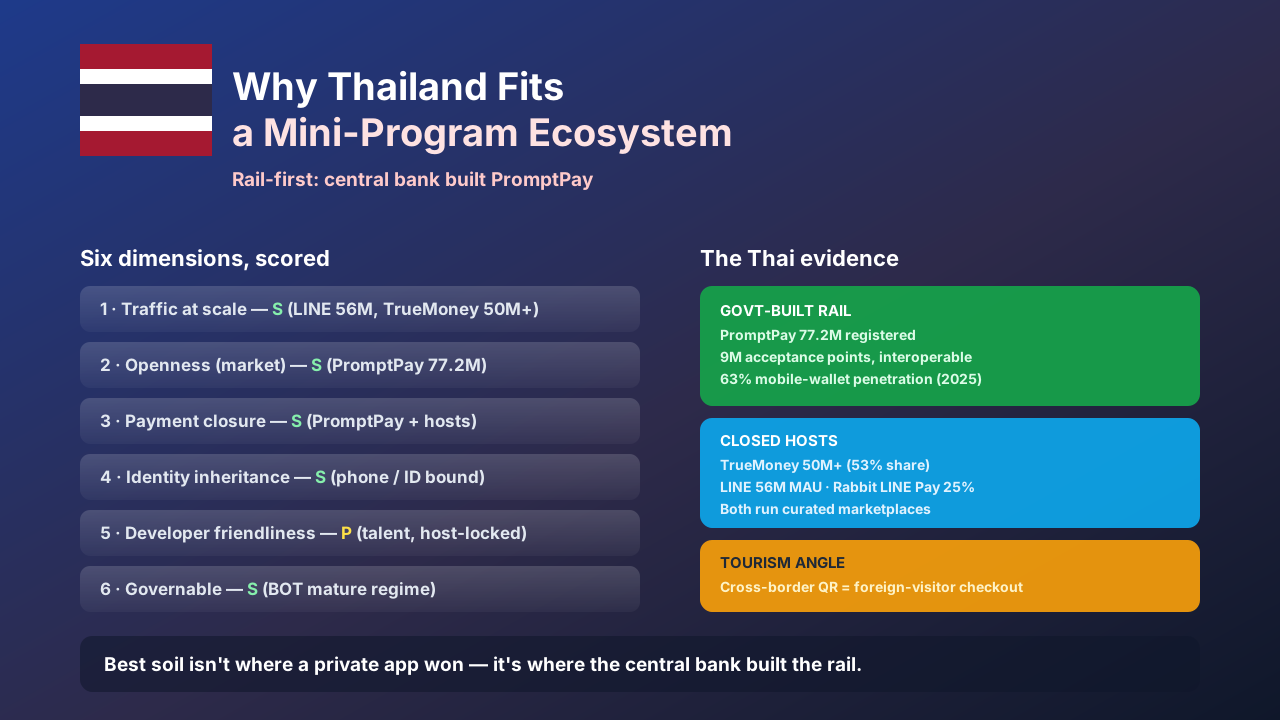
Thailand pairs a government-built rail with two strong hosts. PromptPay — 77 million registered, mandated by the Bank of Thailand — sits under TrueMoney and Rabbit LINE Pay. Closed hosts on an open rail is the mini-program opening.
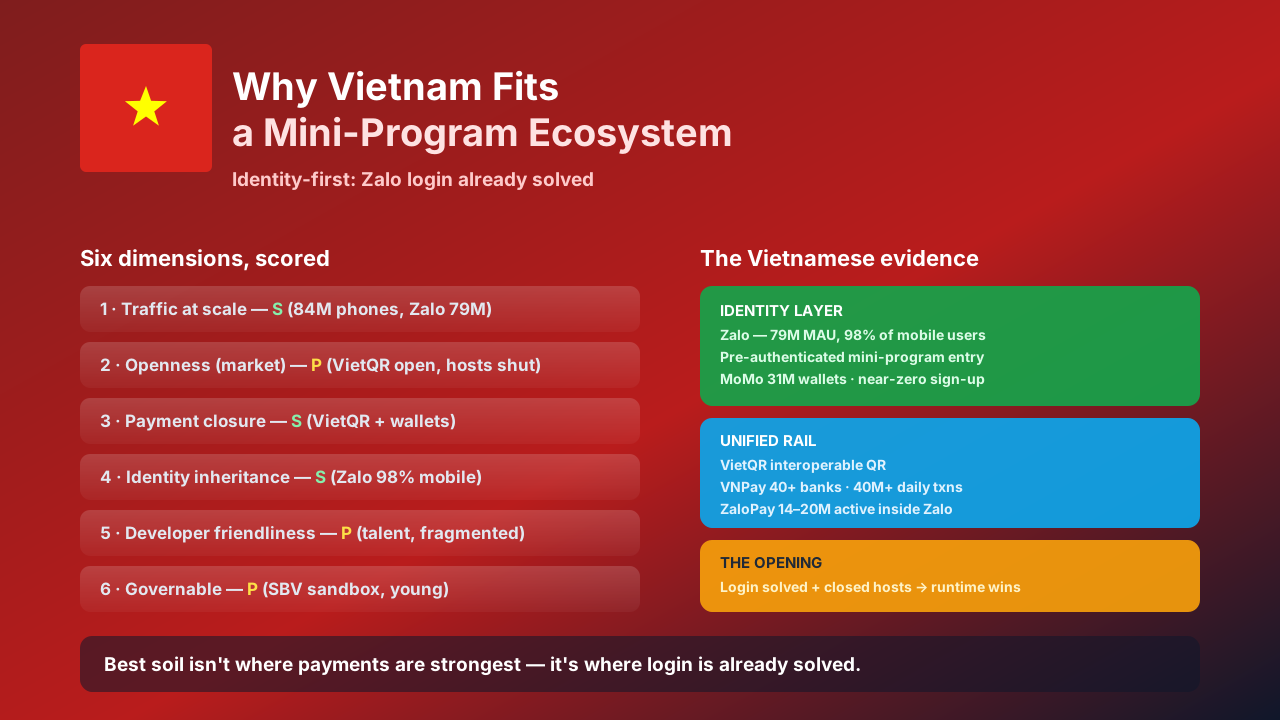
Vietnam's superpower is identity, not payments. Zalo reaches 79 million people — 98% of mobile users — and MoMo adds 31 million wallets. Closed hosts plus near-universal login is exactly the mini-program opening.
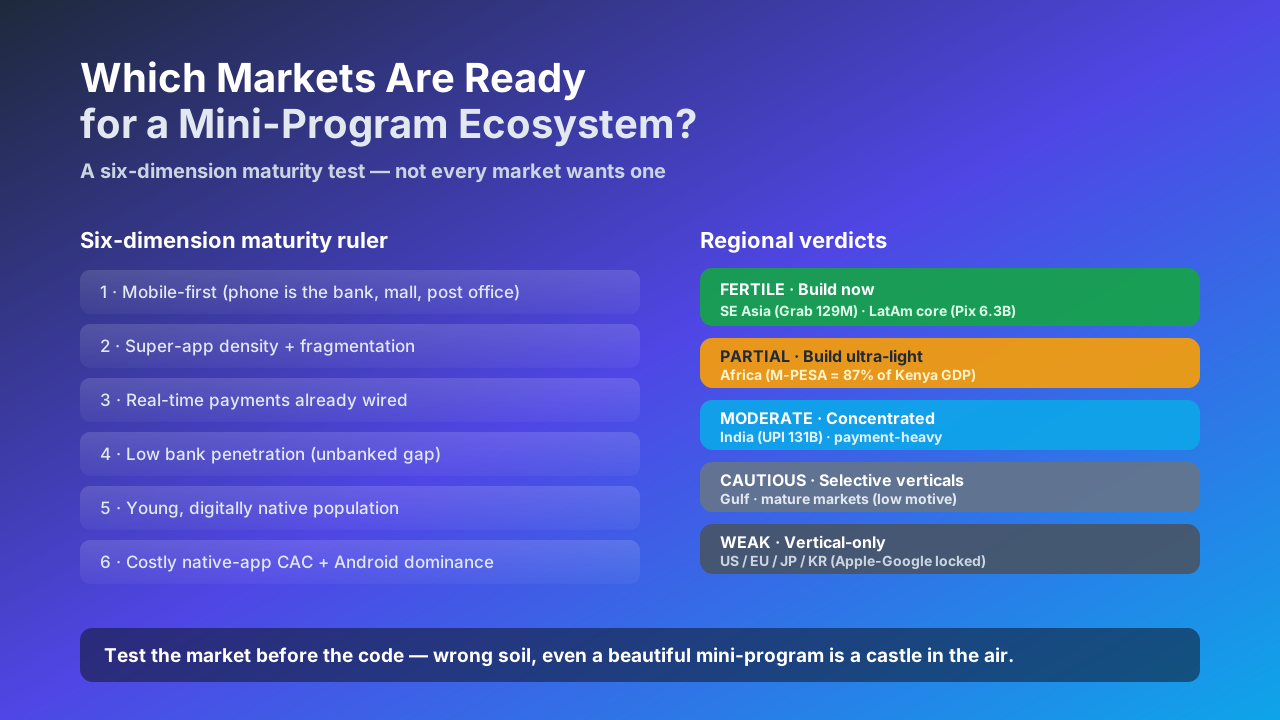
Mini-programs are not a universal fix. We run a six-dimension maturity test on the world's major markets to see where the soil is actually right.
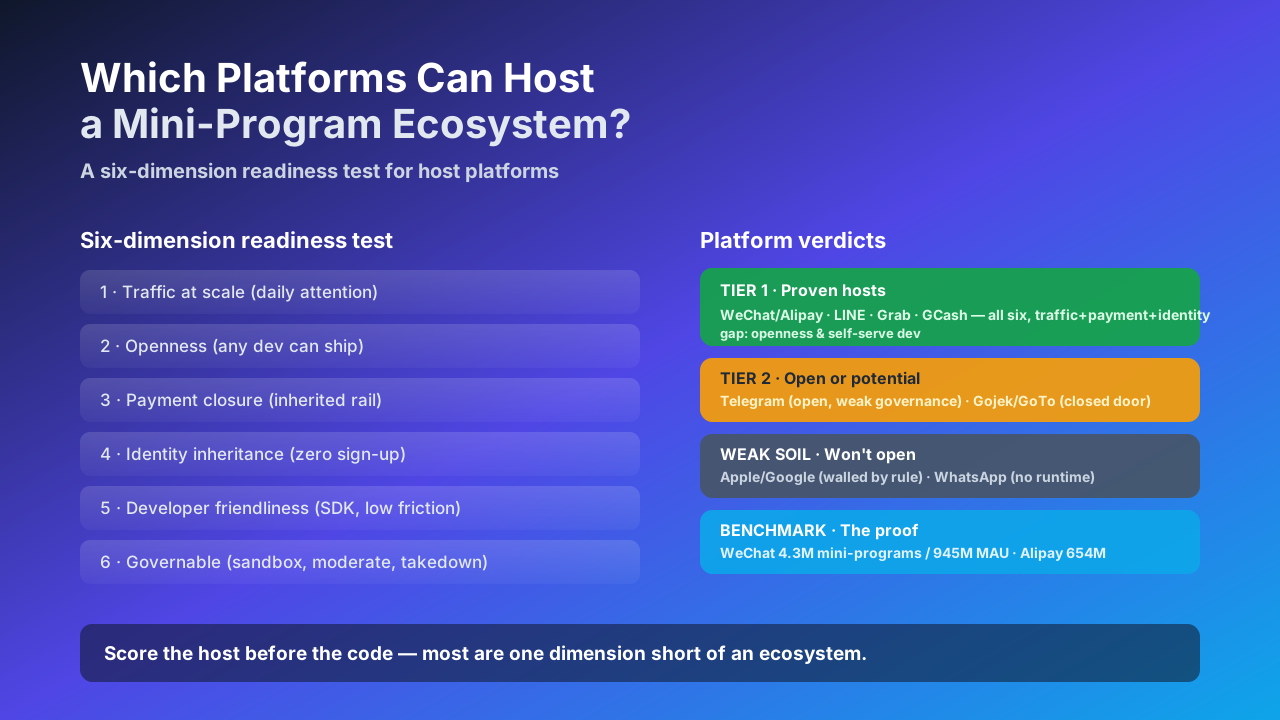
Most apps dream of becoming the next WeChat. Hosting a mini-program ecosystem is a different job, and most platforms that could host one, don't. We score the real hosts on six dimensions.
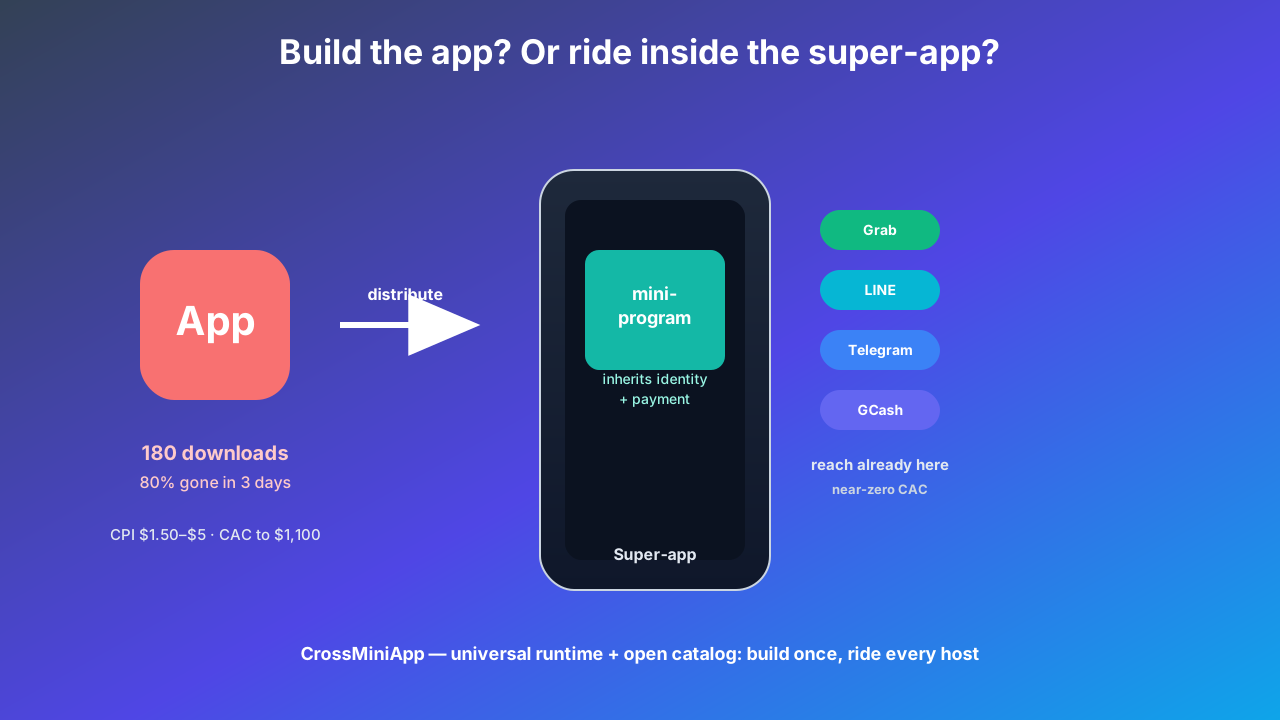
Most apps die not because the product is bad, but because distribution is. Spend $3–$12 to buy a user who uninstalls in three days. Meanwhile Grab, LINE, Telegram and GCash already hold the attention. Here is which apps should be mini-programmed and shipped inside those hosts instead.
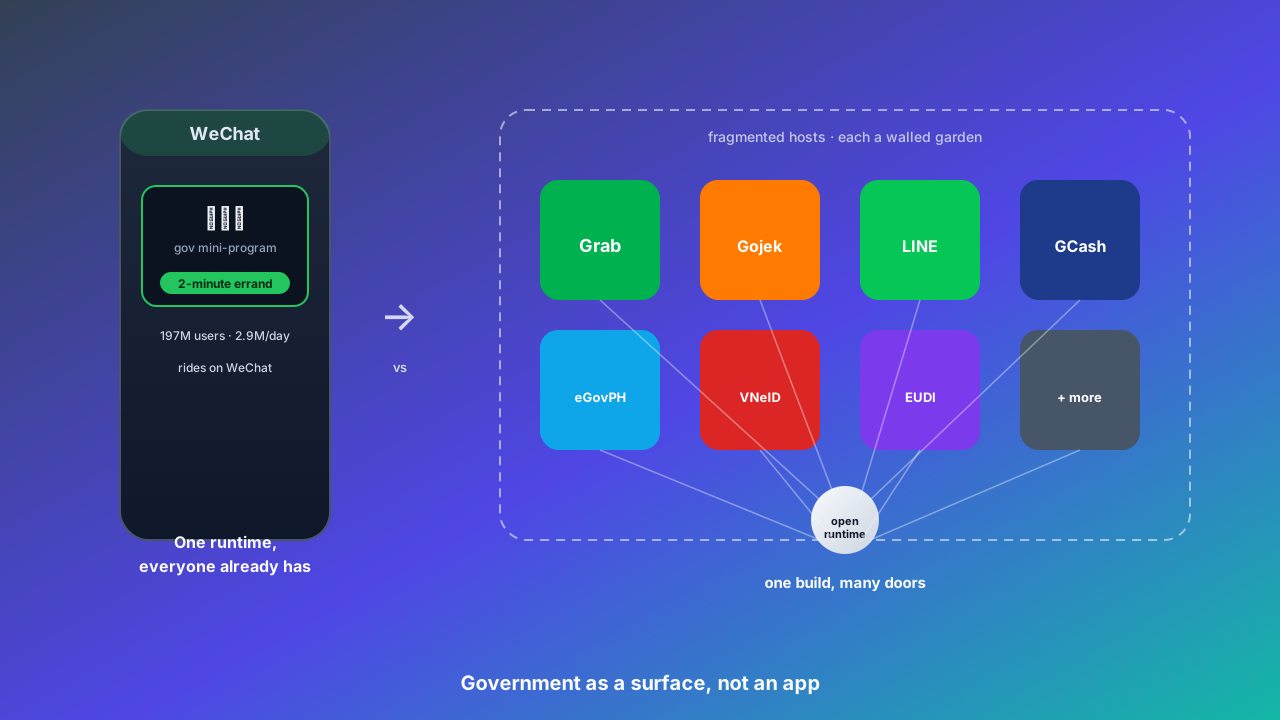
China didn't ship a government app. It parked the government inside WeChat as a mini-program. Southeast Asia is building sovereign apps instead. Here is why a portable, governed surface beats another download.
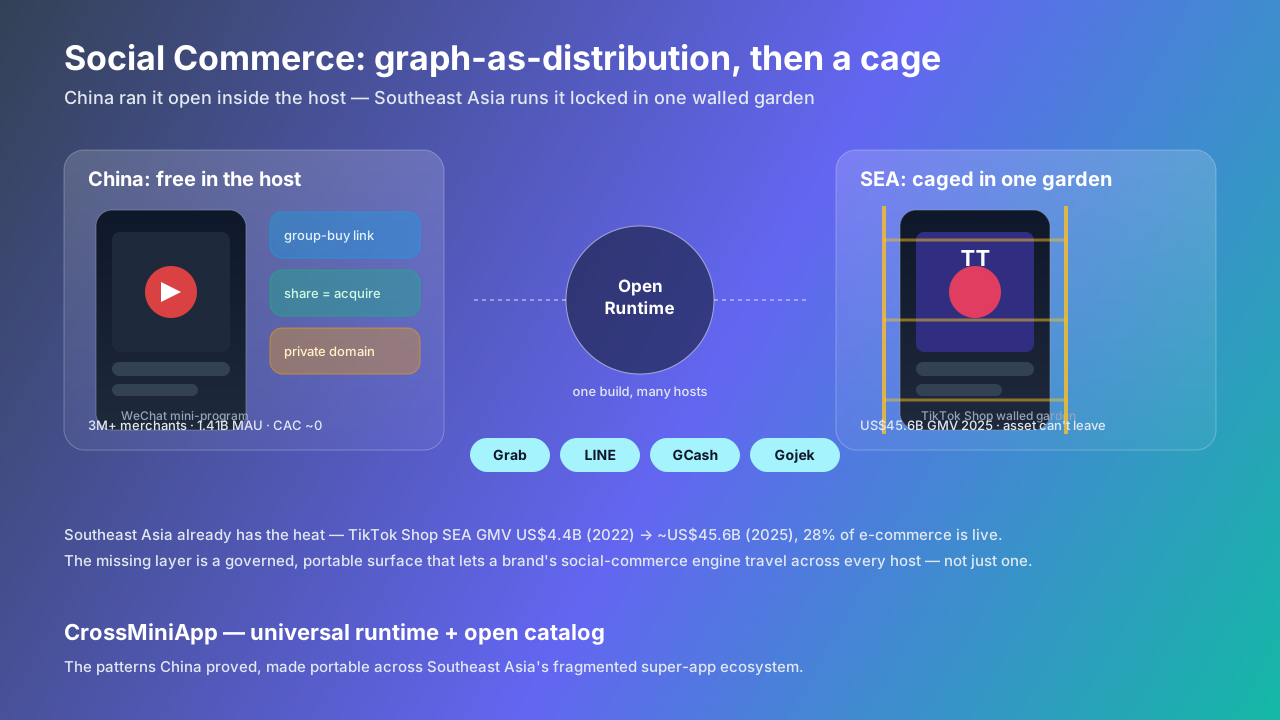
China's social commerce ran on a host-resident stack — mini-program plus social graph plus private domain plus livestream checkout — that turned products finding people into a governed, viral, repeatable surface. We decode Pinduoduo and WeChat Channels and map the lesson to Southeast Asia, where TikTok Shop's walled garden locks creators out of their own social assets.
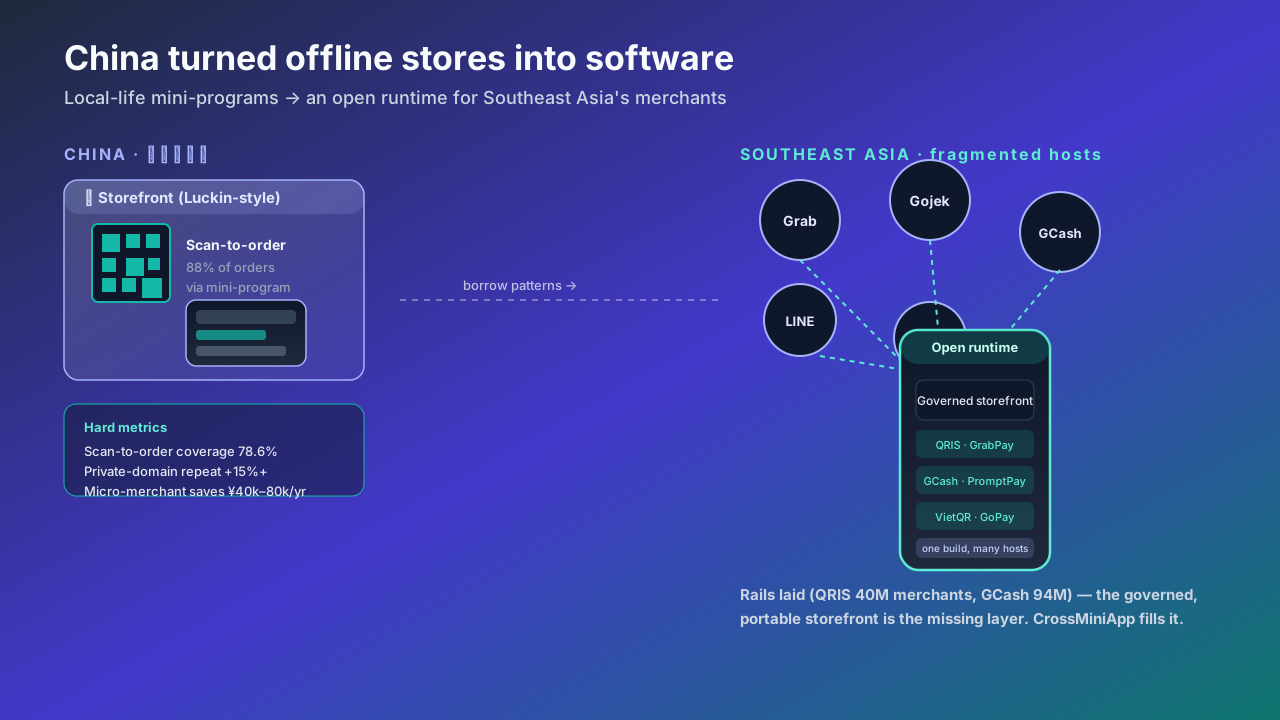
China turned offline stores into software: scan-to-order, private-domain membership, and host-inherited payment made dine-in and local-life services a governed, data-rich layer. We decode Luckin and China's local-life playbook and map it to Southeast Asia, where payment rails like QRIS, GCash and GrabPay are laid but merchant-facing mini-programs stay fragmented.
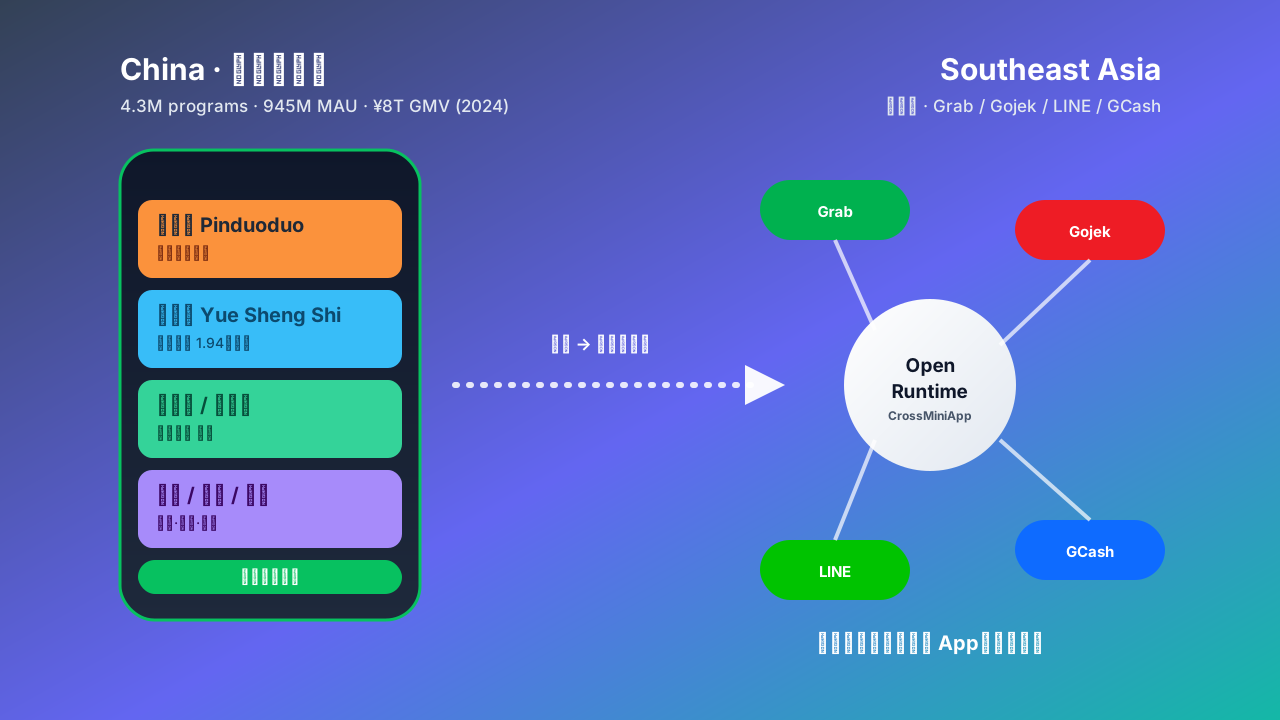
China runs about 4.3 million WeChat mini-programs with roughly 945 million monthly users and over 8 trillion yuan in 2024 GMV. We inventory the standout programs — Pinduoduo, Yue Sheng Shi, Starbucks and KFC, Didi and Meituan, Ctrip and China Merchants Bank — decode the patterns that made them win, and map those patterns to Southeast Asia's fragmented super-app market, where Grab's 2025 Partner Apps prove the model is arriving on its own.
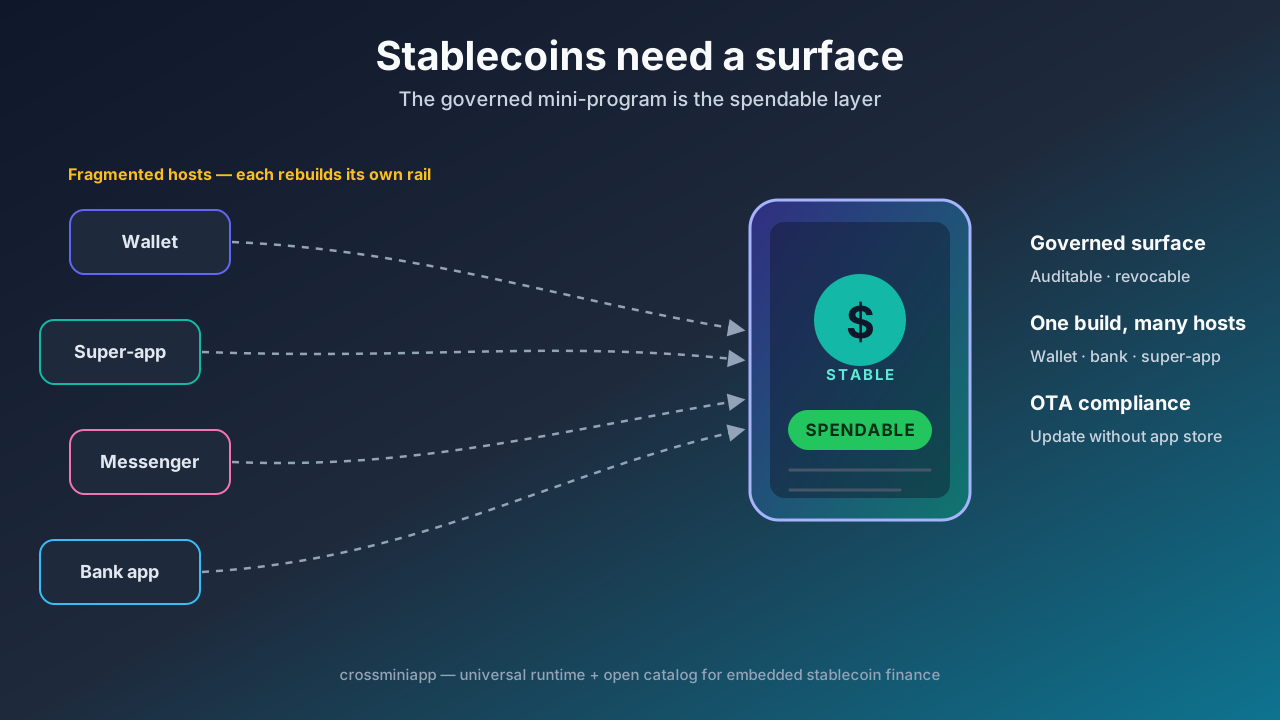
In 2026 stablecoins became payment infrastructure: the U.S. GENIUS Act and EU MiCA gave the money layer compliance cover. But in LatAm, Africa and Southeast Asia, fragmented super-apps and wallets lack a unified, governed, auditable distribution surface. This article shows why the governed mini-program is the missing layer that makes stablecoins actually spendable.
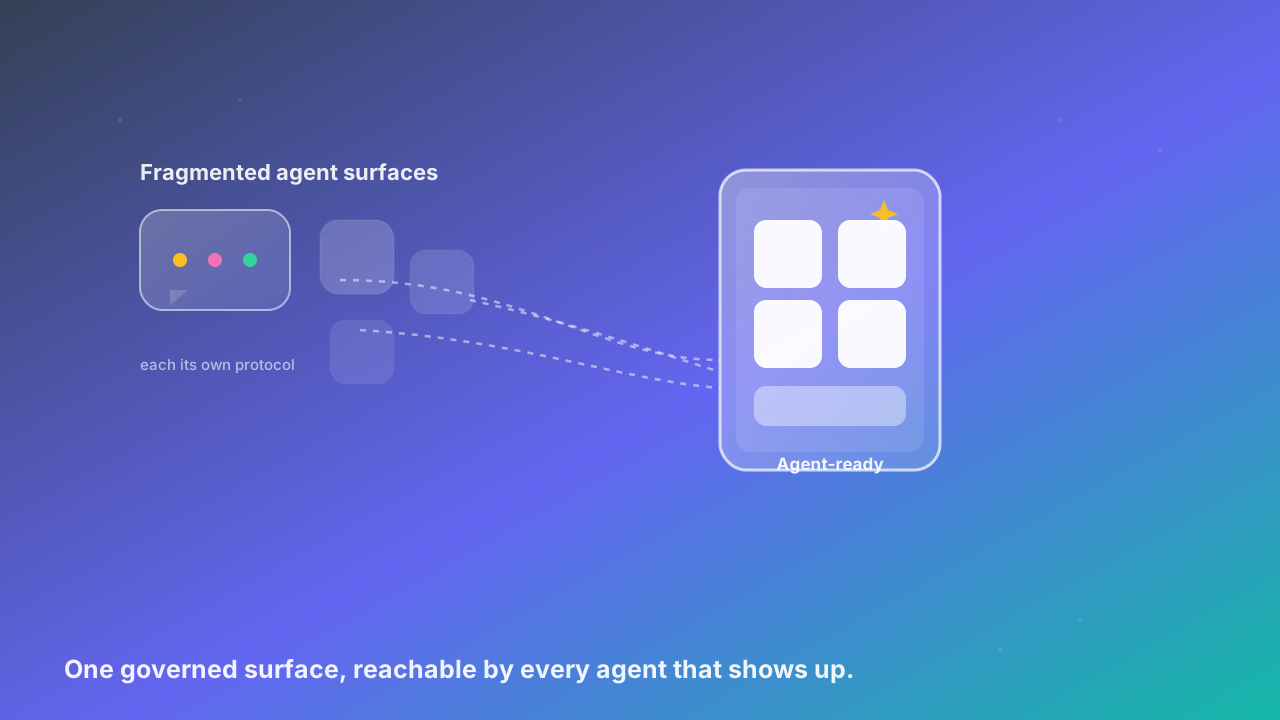
Agentic commerce moved from thesis to infrastructure in 2026, but its agents live inside fragmented super-app, messenger, and LLM surfaces. This article shows why a governed mini-program plus universal runtime is the safe execution surface for agentic services overseas.
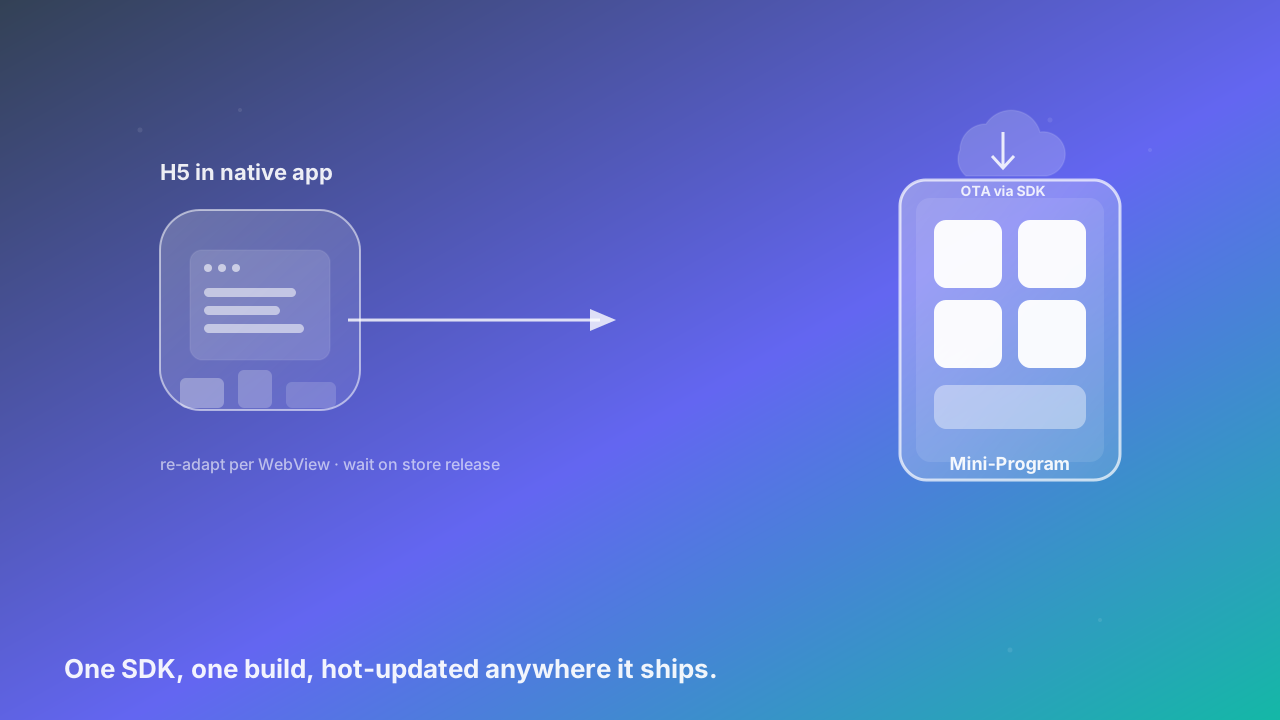
Embedding H5 inside a native app means re-adapting for every WebView and waiting on store releases. This article shows how Cross Mini App's SDK embeds web content as a governed mini-program with over-the-air hot updates, ending multi-end rework and release-train coupling.
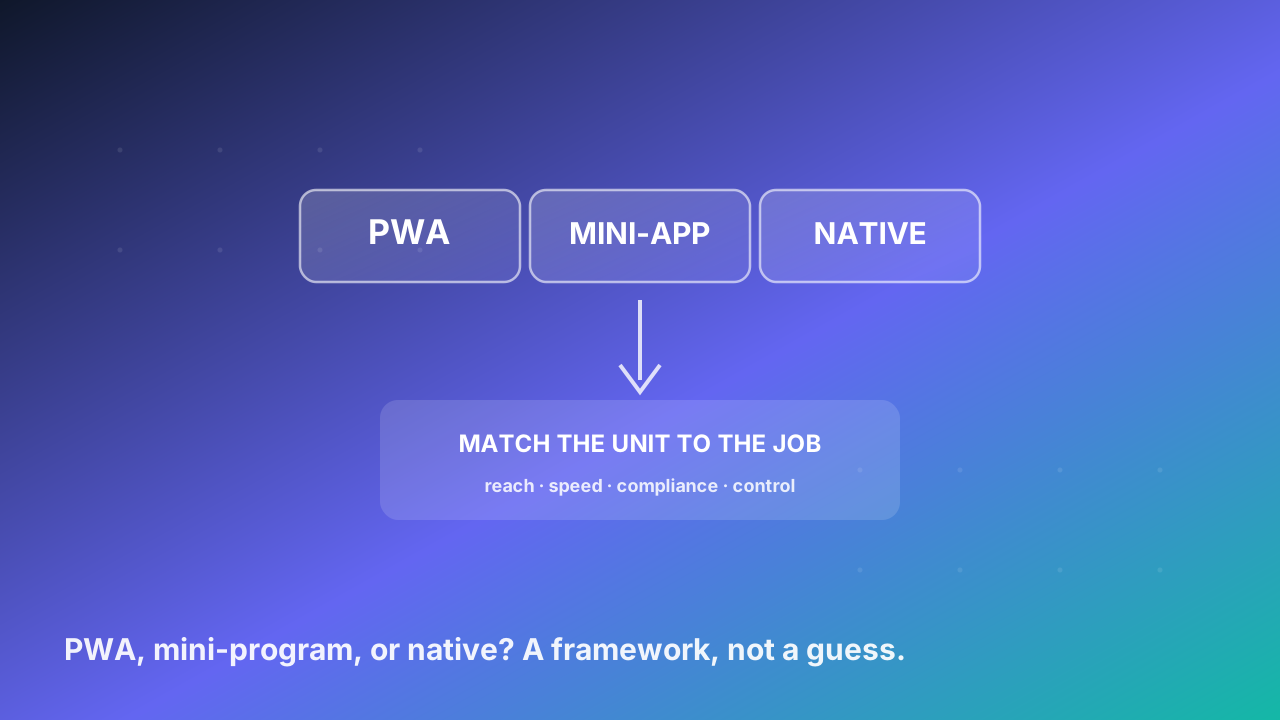
Stop guessing which app form to build. A practical 2026 framework maps your real constraints — reach, time-to-market, compliance, payment, control — to the right unit: PWA, native, or a governed mini-program.
A standalone app is the wrong carrier for many businesses outside the US and Europe. This regional analysis shows which models fit a mini-program instead, and why, country by country.
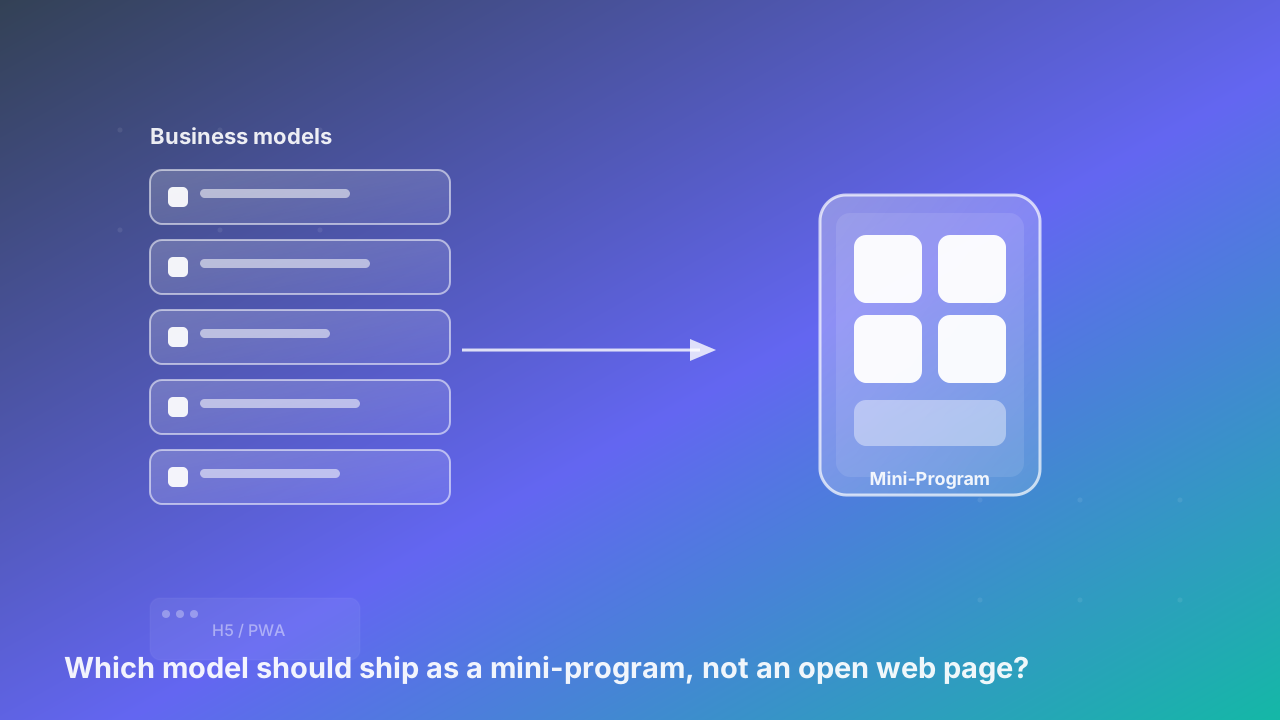
A technical comparison of H5, PWA, and mini-programs already exists. This article cuts across business models instead, giving a decision matrix for which verticals should ship as a governed mini-program rather than an open web page or an installable PWA.
Generosity is a moment — a story, a disaster, a friend's fundraiser. The gift is won or lost inside the app the donor already trusts, and a governed mini-program delivers it with proof.
China didn't adopt mini-programs — it built an alternative internet on top of them. WeChat alone runs ~4.3 million programs with ~945M monthly users and over ¥8 trillion in 2024 GMV. Here's how the model works and why it scales.
Mini-programs are no longer a China-only story. Telegram, LINE, Grab, Gojek, and Kakao have built real mini-app platforms across Asia, Latin America, and beyond. Here is the global map and what it means for distributors.
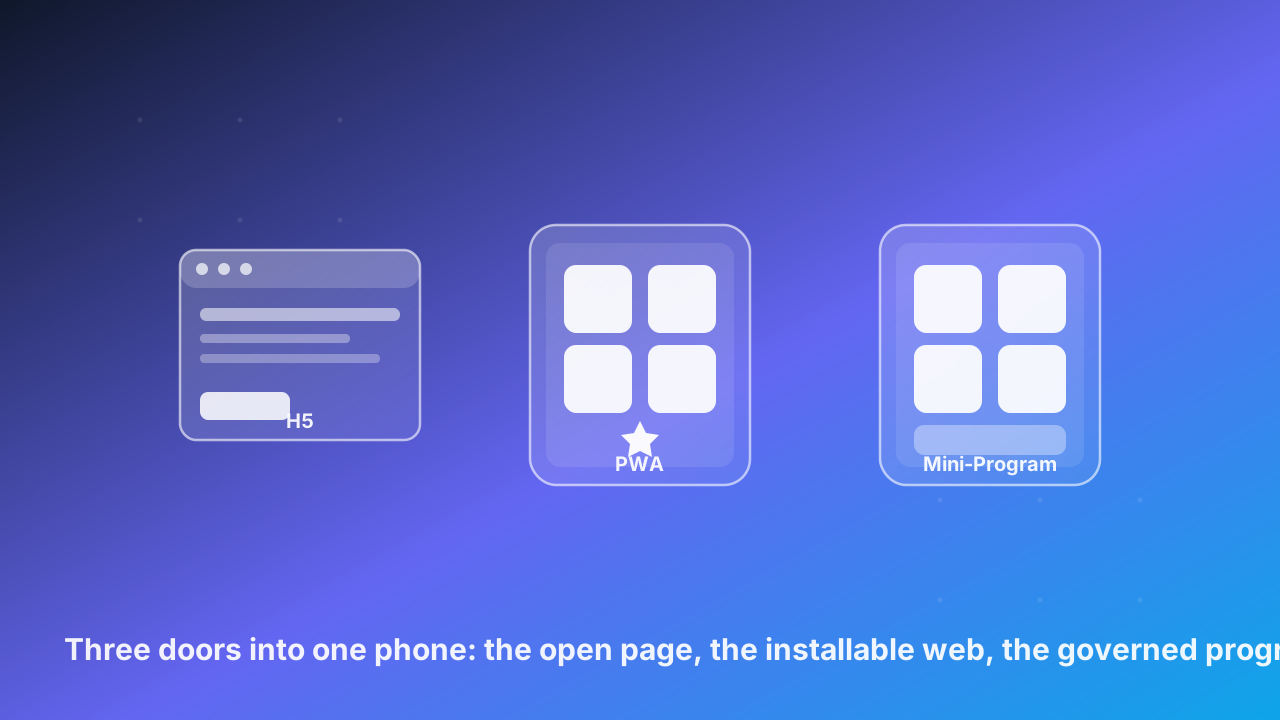
The mobile web is not one thing. It is an open H5 page, an installable PWA, and a governed mini-program. This deep comparison shows where each one wins in 2026.
E-commerce trained the world to expect a parcel at the door in two days. The final leg is won or lost inside the app the customer already opens — and a governed mini-program is the unit that delivers it.
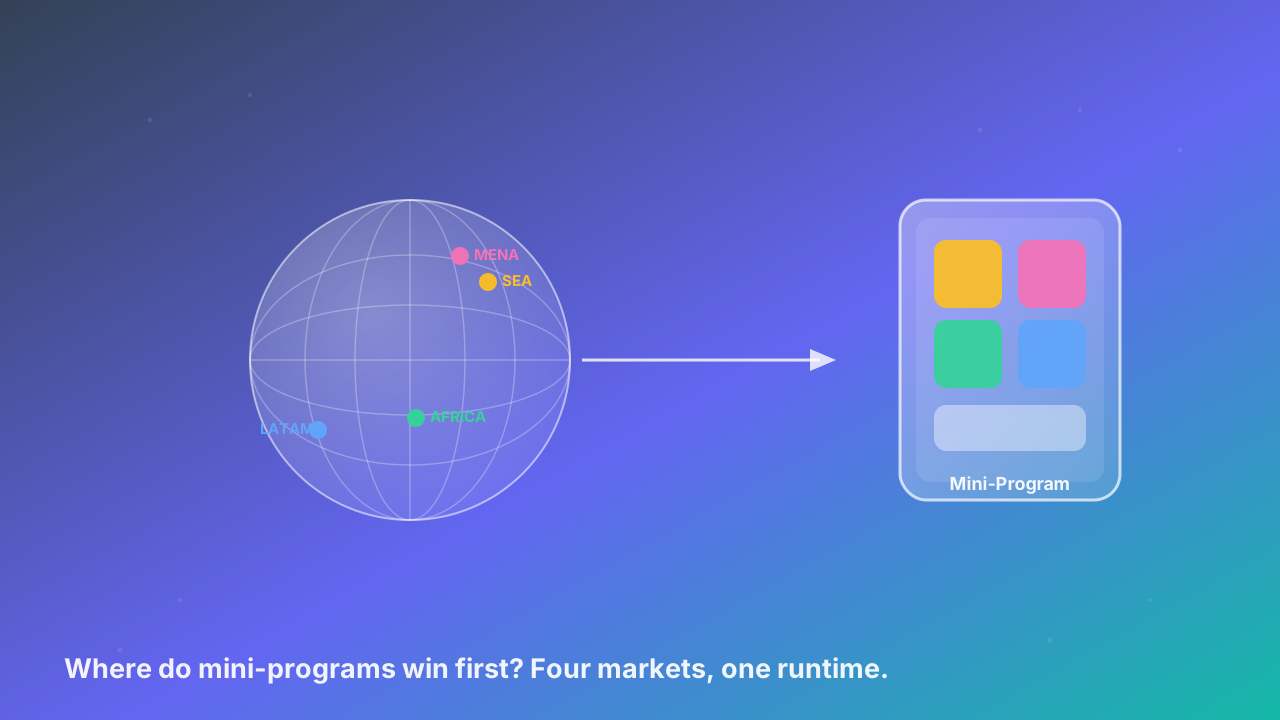
Not every market is ready for the mini-program model. This field guide names the four where the pattern wins first - super-app, wallet, and messenger markets - and shows how to pick the host, the models, and the carrier, while contrasting with the independent app and the cold-start H5 or PWA.
Every mini-program platform today is a walled garden — WeChat, Alipay, Telegram, LINE. Great for the host, punishing for developers. An open runtime with a portable catalog is the model that actually serves global distribution.
A mini-program and an H5 page both live on a phone, but they obey different laws of distribution, identity, and trust. This deep comparison shows which one to build in 2026.
Progressive Web Apps promised one web app for every platform and no app store. In the real world they hit a glass ceiling — iOS limits, invisible in China, weak install intent. Governed mini-programs inherit the host's trust instead.
Smallholders feed the world, yet the services they need — advisory, credit, markets — never reach them. A governed mini-program delivers those services inside the app the farmer already trusts.
A ticket is just a token. Its value is realized at payment and at the gate. A governed mini-program delivers ticketing, entry, and fraud control inside the event app or wallet the fan already uses.
Loyalty is shifting from a separate app to a reward embedded at the moment of payment. The governed mini-program is the unit that delivers points, tiers, and perks inside the host the customer already trusts — no install, no second login.
Micro, small and medium enterprises are 90% of the world's businesses yet most still lack an online presence. The governed mini-program — dropped into the super-app, wallet, or messenger a merchant's customers already trust — is the unit that finally brings the corner store online.
Telemedicine is a $152B market growing 20% a year, yet billions still cannot reach a clinician. The bottleneck is not technology — it is distribution. Here is why the mini-program, not the native app, is how care crosses the last mile.
App downloads stalled in 2025 while in-app spending climbed. Attention is concentrated, the install barrier is high — and the next billion users are not in the app store at all. Here is why install-free mini-program distribution is the growth market.
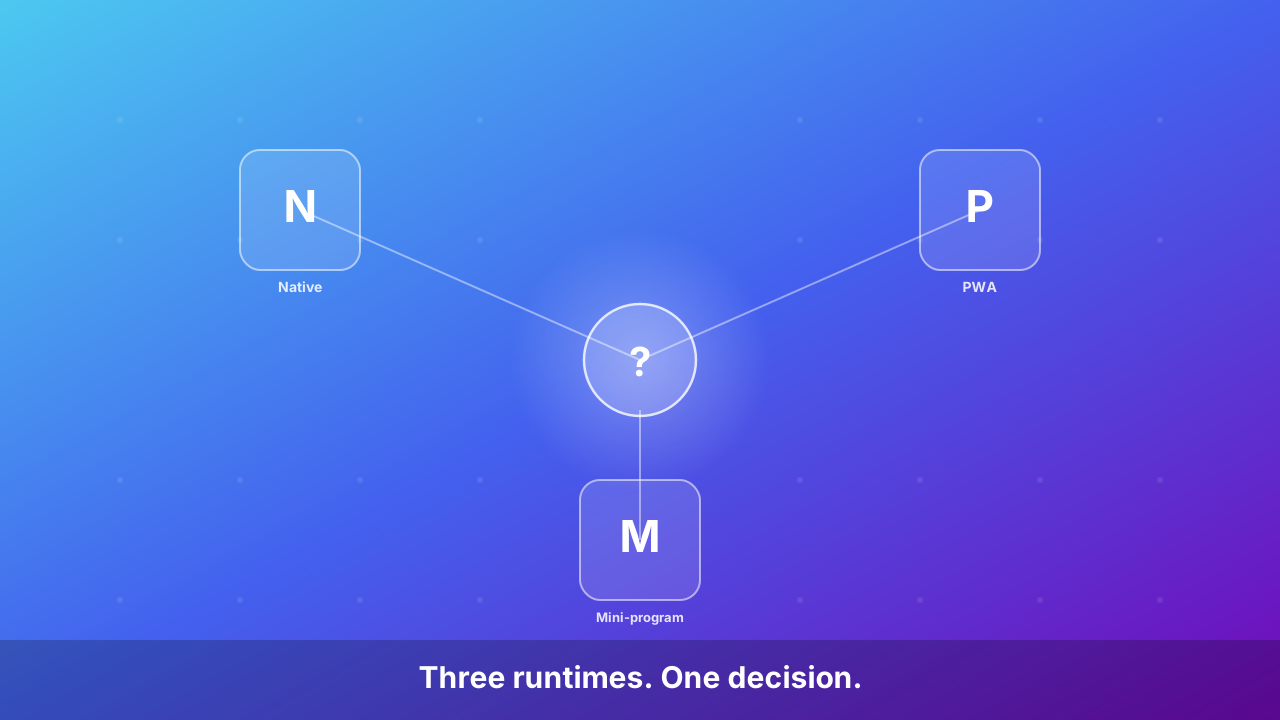
Three runtimes compete for your mobile experience in 2026: native apps, progressive web apps, and mini-programs. Here is a decision framework built on real deployment data — and why a cross-app runtime changes the math.
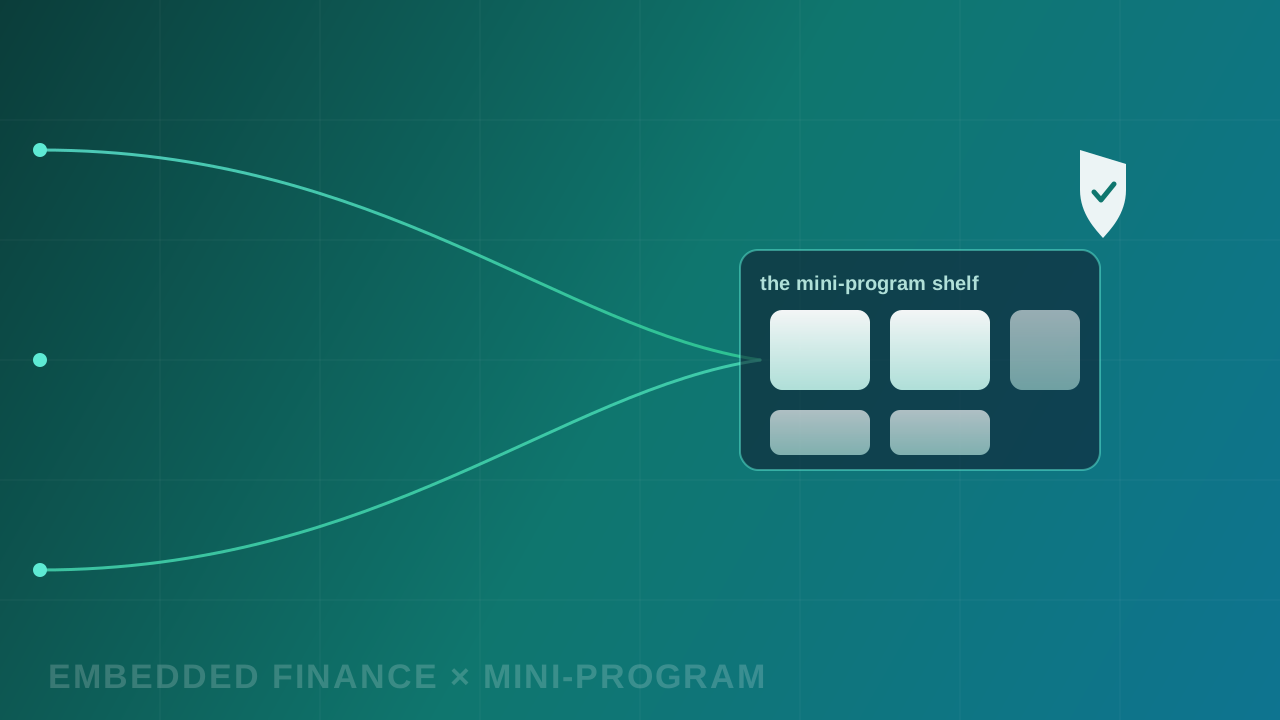
Real-time payments and open banking have laid the pipes. But the financial services shelf inside banks and super-apps is still empty. Mini-programs are the composable front-end that turns rails into experiences — and a cross-app runtime is the universal shelf.
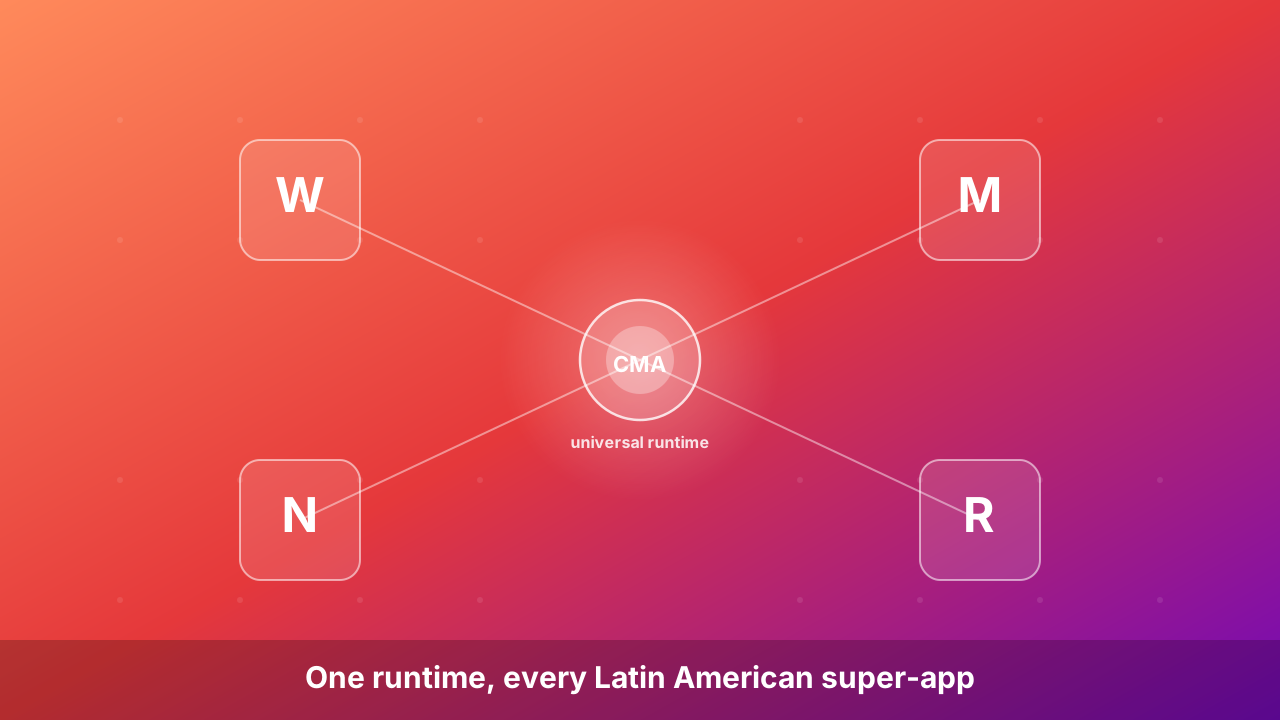
While Silicon Valley debates app fatigue, Latin America is quietly building a continent of super-apps — with traffic and payments but an empty service shelf. Cross Mini App's open catalog is the missing piece.
As agentic commerce breaks out in 2026, AI agents can talk but can't act. Mini-programs — structured, invocable, payment-ready — are emerging as the execution layer agents need, and as the fastest bridge from China's proven service library to global AI surfaces.

A practical playbook for bringing proven Chinese mini-program content into Southeast Asia's fragmented super-app market — using a cross-app runtime to reach Grab, Gojek, LINE and Telegram users without rebuilding from scratch.
A deep comparison of mini-program adoption in mainland China versus overseas markets, and why importing proven mini-program content is the fastest path to the global trend.

AI is on every roadmap, but shipping it is slow. Cross Mini App lets you drop LLM-powered mini-programs into any host app in days — no app-store review, no model infra.
Insurance is bought when it is needed, not when it is sold. Embedded insurance puts the policy at the point of need — and the governed mini-program is the unit that delivers it inside the app the customer already uses.
Nations like India, Singapore, and Estonia proved national digital platforms work. The next unit of public service is the governed mini-program that lands inside the super-app, messenger, or bank a citizen already trusts.
International tourism hit 1.4B arrivals in 2024, yet the cross-border traveler still faces a wall of incompatible local apps. The governed, embeddable mini-program — available instantly inside a trusted host — is becoming the universal travel layer.

Social apps are using Cross Mini App to drop third-party mini-games into their experience in days — lifting retention and turning idle scroll sessions into ad revenue.
Why game teams embed mini-games into social, entertainment, and lifestyle apps — dodging store fees, killing user acquisition costs, and shipping updates without review.
How financial institutions embed lending, wealth, and insurance mini-programs into partner apps — with sandbox isolation that meets financial-grade compliance.

How app owners use embedded shopping mini-programs to monetize traffic, cut acquisition cost, and reach precise audiences — without platform lock-in.

How a single lifestyle app becomes a local-life hub by embedding food delivery, ride-hailing, and home services as mini-programs — with zero operational burden.

How education providers turn courses, quizzes, and assessments into mini-programs that open inside the tools learners already use — with hot updates that keep content current.
Explore how cross-app mini-program distribution unlocks new revenue streams, reaches untapped audiences, and creates a flywheel effect for both app owners and developers.
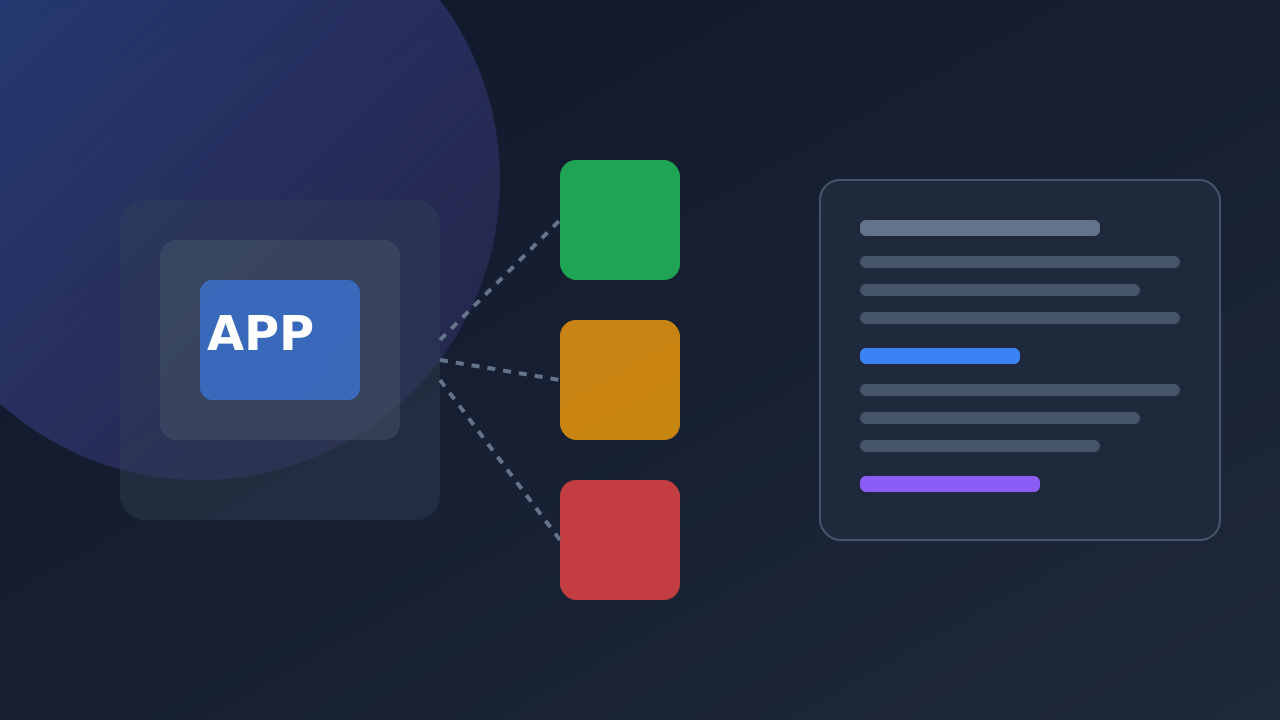
Understand the technical architecture behind mini-program containers — sandboxed runtimes, bridge protocols, and how Cross Mini App ensures native performance across platforms.