
A billion-person lab for the governed program
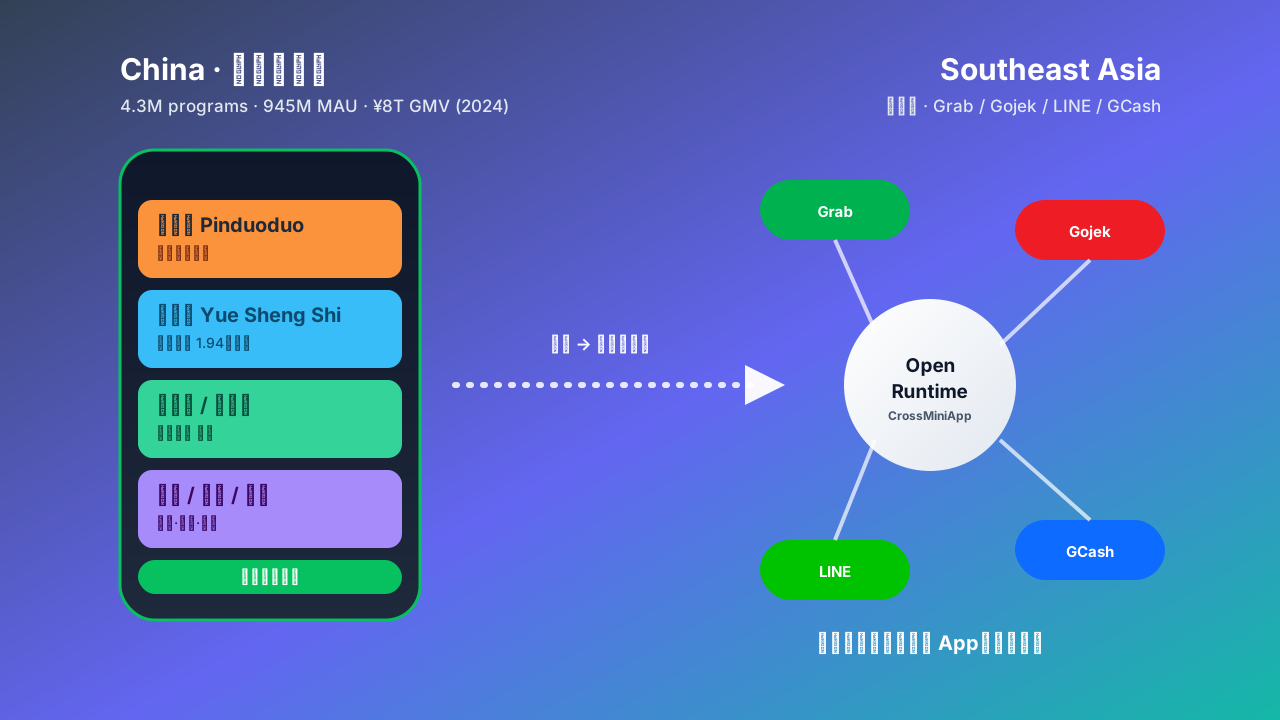
China's mini-program stack is the largest live experiment in governed, host-resident software on earth. WeChat alone runs about 4.3 million registered mini-programs, reaching roughly 945 million monthly active users in 2025, and facilitated over ¥8 trillion (≈ US$1.1 trillion) in GMV in 2024 — a figure Tencent disclosed in its Q3 2025 corporate overview. Alipay runs a second ecosystem of similar scale. The lesson is not "China has WeChat." It is that an entire economy of services was rebuilt as lightweight programs inside a trusted host, not as standalone app installs.
The standouts: five categories that actually worked
Not every program wins. The ones that did share a shape. Here is the inventory.
| Category | Standout program | Hard metric | Pattern that won |
|---|---|---|---|
| Social e-commerce | Pinduoduo | Mini-program DAU passed 10M by Nov 2017; served 360M users by May 2018; MAU grew 195M (2018) → 487M (2020); most-popular WeChat mini-program in May 2020 | Borrowed WeChat's social graph for group-buy fission; ~65% of users in tier-3-and-below cities |
| Government & public services | Yue Sheng Shi (Guangdong) | Launched May 2018; 194M real-name users and 17B+ transactions by Aug 2025; ~2.78M daily transactions; Ministry of Public Security real-name + real-person verification | High-frequency civic needs inside one governed, auditable surface |
| QSR order-ahead & retail | Starbucks / KFC / McDonald's | Order-ahead + membership + payment in one tap; became the default digital channel for China's quick-service restaurants (pattern-level, no single public GMV) | Offline traffic digitised; private-domain membership captured |
| Mobility & local life | Didi / Meituan | Ride-hailing, food delivery, and in-store services delivered as lightweight host-resident entries | One host, many daily-life services, low install friction |
| Travel & finance | Ctrip (Trip.com) / China Merchants Bank | Flight/hotel booking and mobile banking delivered inside the host, compliant by design | Financial services shipped in a governed, revocable runtime |
Two of these carry hard, citable numbers (Pinduoduo and Yue Sheng Shi); the QSR row is described at the pattern level because the chains do not publish per-mini-program GMV — but the mechanism is the same and equally instructive.
The five transferable patterns
Strip away the Chinese context and five design rules survive:
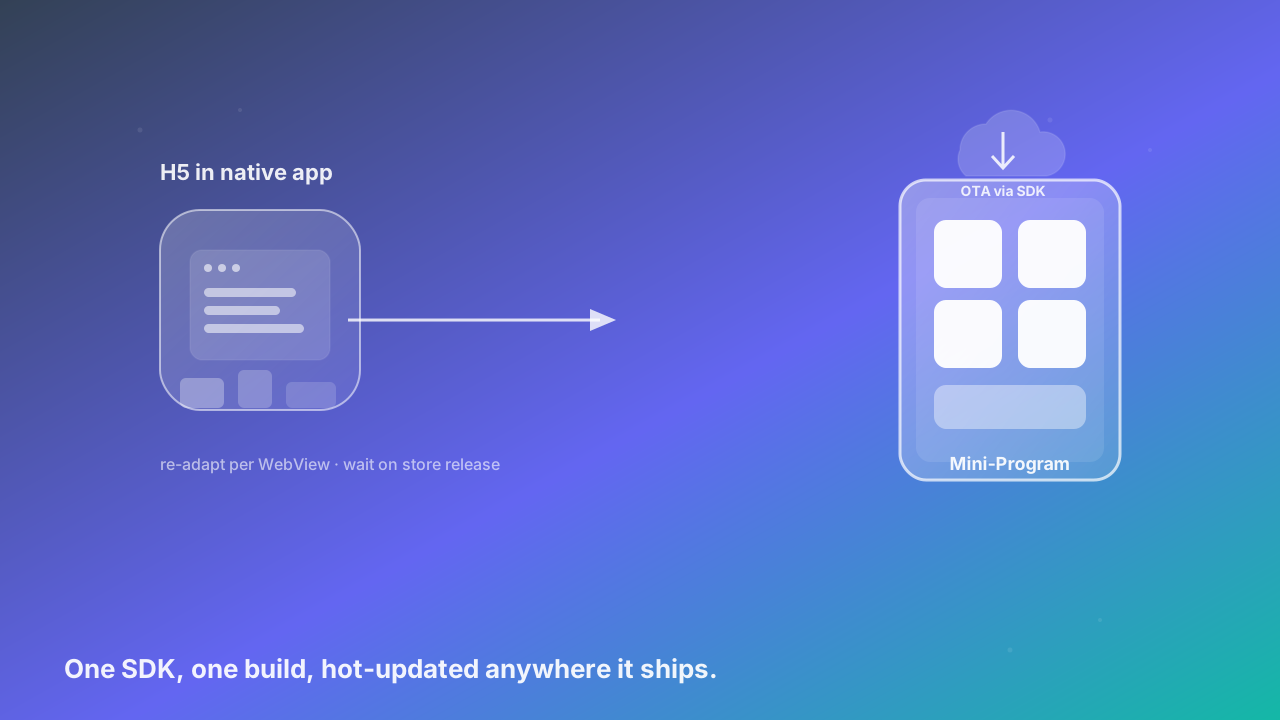
- Zero-install, tap-to-use entry. The cost of trying a service drops to a tap, not an install — which is why millions of programs exist and merchants launch in days.
- The host's graph is the distribution channel. Pinduoduo did not buy an app-store position; it rode WeChat group chats. Discovery came from the social graph, QR codes, and search inside the host.
- Inherited identity and payment. A mini-program inherits the host's verified user and wallet. No cold-start onboarding, no re-entered card.
- Lightweight iteration plus platform governance. Programs update fast and can be taken down at the platform level — a property regulators and users both trust.
- Build once, reuse across scenarios. The same runtime serves commerce, government, finance, and games.
Southeast Asia: the mirror, and the mismatch
The region already has the traffic. Grab serves 46 million monthly transacting users across eight countries, posted $3.37 billion in 2025 revenue and its first full-year profit, with Malaysia alone contributing $1.04 billion. GoTo (Gojek + Tokopedia) runs 100M+ monthly active users and over $22 billion in annual gross transaction value. The Asia-Pacific super-app market is worth more than $58.3 billion and compounding above 30% a year.
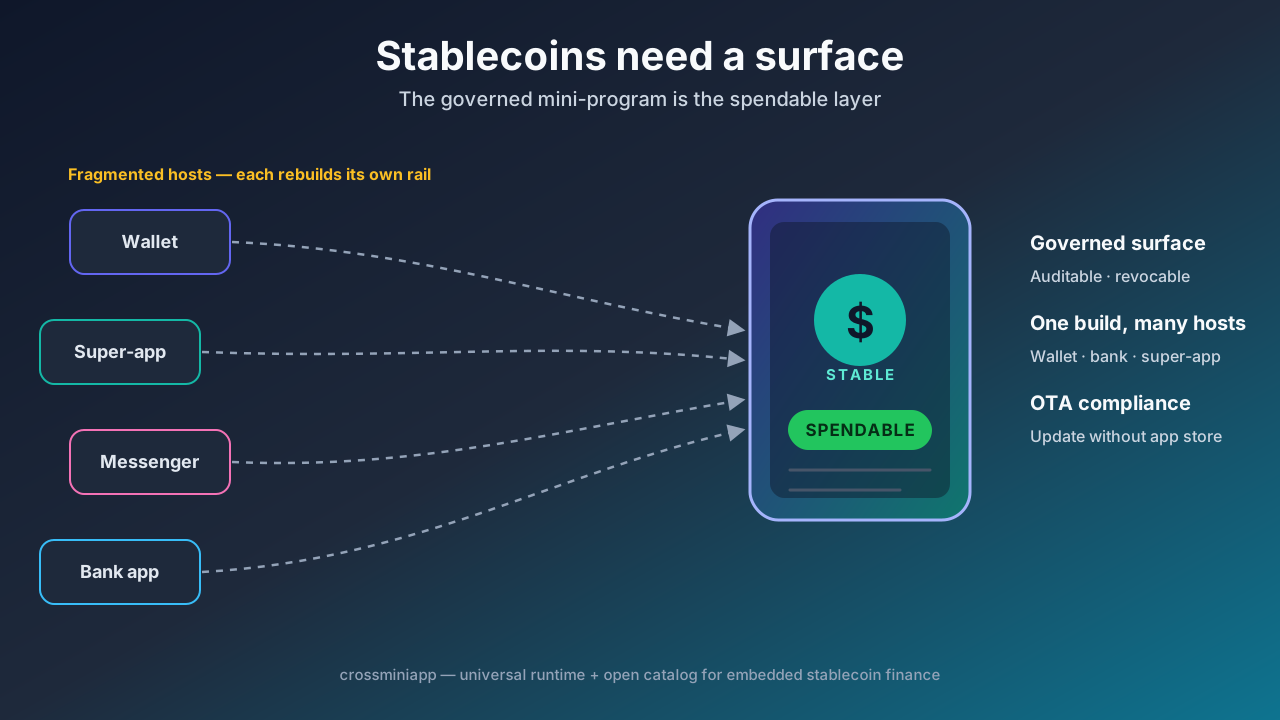
But the mirror cracks on fragmentation. Southeast Asia has no single WeChat. Instead it is a patchwork — Grab and Gojek in ride-hailing and delivery, LINE in Thailand and Taiwan, GCash in the Philippines, Telegram Mini Apps across the region — each with its own login, wallet, and review process. In Indonesia, more than 74% of the population is unbanked or underbanked, and the region is overwhelmingly Android-first. A service rebuilt per host is an N×M problem all over again.
The tell that the model is arriving on its own: on October 22, 2025, Grab launched Partner Apps — third-party services (Firsty, HelloRide, Jolibox, redBus, Drive lah) embedded natively inside Grab, reusing its 46M users and payments with no extra download or login. That is a mini-program platform, built by a super-app, for its own walled garden.
What Southeast Asia can actually borrow
The lesson is not "copy WeChat." It is to borrow the validated patterns and ship them on an open runtime:
- Borrow Pinduoduo's acquisition playbook — win users through the host's social and relationship graph with a lightweight entry, instead of rebuilding a native app and paying to acquire from zero.
- Borrow Yue Sheng Shi's civic model — put high-frequency government and public services into a governed mini-program (a pattern we detailed in our govtech distribution piece).
- Localise the order-ahead retail pattern — reuse GrabPay and GoPay rails instead of standing up a new terminal.
- Break the wall with an open runtime — build once and distribute into Grab, Gojek, LINE, and GCash simultaneously, rather than re-integrating per gatekeeper.
- Treat governance as a selling point — in a tightening regulatory environment, a governed, revocable, auditable surface is the trust feature, not the tax.
Where CrossMiniApp fits
CrossMiniApp is the universal runtime plus the open catalog. It does what Grab Partner Apps does not: it lets a governed mini-program travel across many hosts, not just one. The China casebook shows the patterns that win; the open runtime makes them portable across Southeast Asia's fragmented ecosystem — one build, many super-apps, no wall.
Sources
- CoinLaw — WeChat statistics (Tencent-sourced mini-program GMV and MAU, ¥8T 2024)
- Review42 — WeChat Mini Programs statistics 2026 (4.3M programs, 945M MAU)
- Guangdong Digital Government — Yue Sheng Shi monthly data release
- Grab — Partner Apps launch press release (Oct 22, 2025)
- Growth HQ — Southeast Asia Super App Market 2025-2026 (Grab vs GoTo)