
The agent already shops
In 2026 the story stopped being a forecast. OpenAI and Stripe shipped the Agentic Commerce Protocol, Google shipped the Universal Commerce Protocol with Shopify, Walmart, Target and the card networks, and Visa wired its network straight into ChatGPT. ChatGPT, Google AI Mode, Microsoft Copilot, Perplexity and Amazon's Rufus are now surfaces where a user can describe a need and an agent researches, compares, and in many cases checks out. eMarketer puts autonomous checkout inside AI platforms at $20.57B of U.S. retail ecommerce in 2026 — roughly four times 2025 — and Gartner says 48% of retailers plan to deploy agentic AI this year. The agentic layer is live (eMarketer, Gartner).
The fragmentation trap
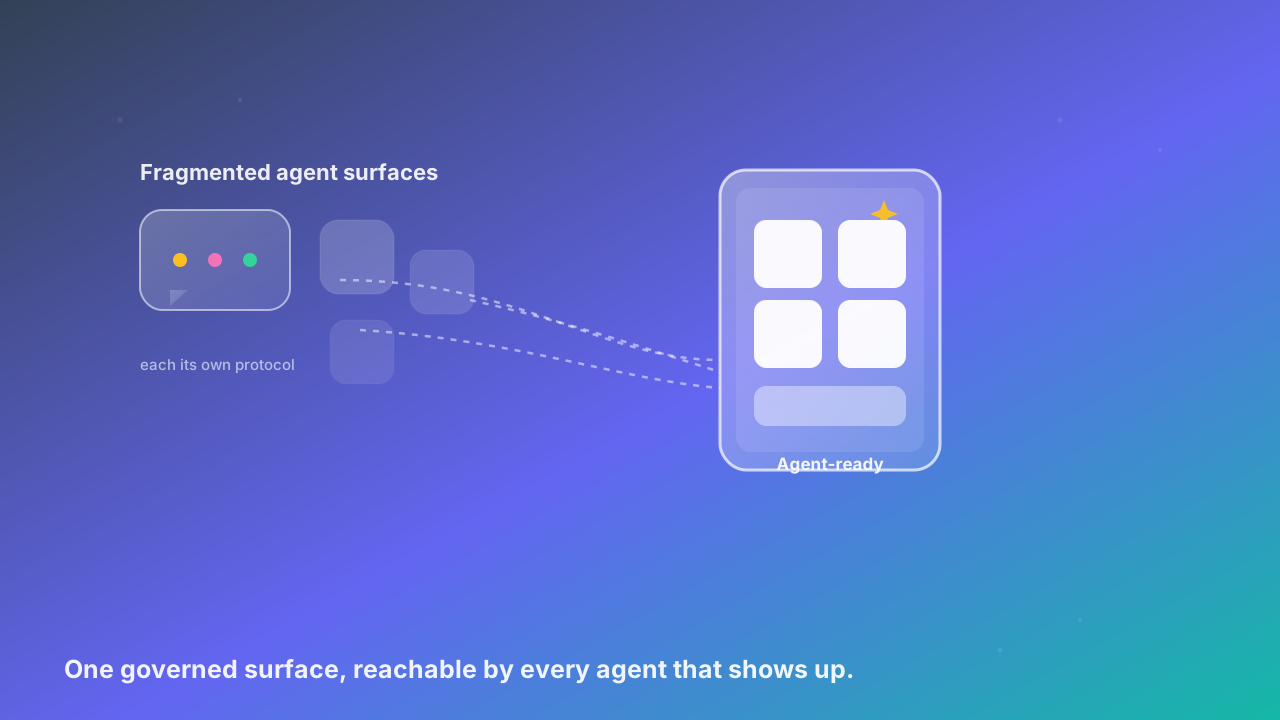
Here is the part the headlines miss: there is no single agent, and overseas there is no single WeChat. ChatGPT runs on the Agentic Commerce Protocol, Google on the Universal Commerce Protocol, Amazon on its own walled garden, and Meta is teasing its own agentic commerce for Instagram, Facebook and WhatsApp. Each surface has its own protocol, its own visibility rules, and its own line between discovery and checkout. A third-party service that wants to be found and executed by agents faces an N×M problem: every service, rewired for every agent entry point, in every market.
That is exactly the shape crossminiapp exists for. The overseas app market is a constellation of parallel super-apps, messengers, and wallets — not one daily-infrastructure app. The winning architecture is not another agent. It is a runtime that sits above all of them and speaks each surface's language.
Why bare H5 and a standalone app both miss
The agent reads before it buys, and most web content is invisible to it. Adobe's 2026 benchmark found the average retailer's product pages are only 66% machine-readable and homepages 75% — roughly a quarter of retail content simply does not reach the LLM that is driving the new traffic (Adobe Digital Insights). A bare H5 page, built for human eyes, is the worst case: no structured surface, no governed identity, no in-context payment.
A standalone app, meanwhile, misses the conversation entirely. The agent lives where the user already talks — inside ChatGPT, Google, WhatsApp. An app icon the agent cannot see is an app the agent will never call.
What the agent actually needs to act
An agent acting on a user's behalf needs three things a raw web page cannot provide:
- A governed, discoverable surface. The agent must be able to read it, trust it, and know what it is allowed to do. A vetted mini-program — audited, scoped, revocable — is that unit.
- Inherited identity and payment. The agent should not rebuild login and checkout per service. The mini-program receives verified identity from the host and calls the host wallet in-context.
- A safe execution boundary. The agent's action — reserve, compare, purchase — has to run inside a sandbox the host can audit and pull, because the trust gap is real: major surveys show most users still will not hand an agent their payment credentials, and only a quarter would trust even a known retailer's agent to run an end-to-end journey.
The mini-program as the agent's execution surface
This is where the crossminiapp model lands. Your service is built once as a governed mini-program against a standard API surface, then dropped into any agentic or host surface that integrates the runtime — no per-agent, per-market rebuild:
- One build, many agents. The runtime abstracts the differences between ChatGPT's protocol, Google's protocol, and a messenger host, so a service is reachable wherever the agent already is.
- Governance resolves the trust gap. Because the program is audited and revocable, the host — not a faceless agent — vouches for it. That is the piece the raw-agent model is still missing.
- Native capability bridge. Identity, payment, and device APIs are brokered through reviewed SDK endpoints, so the agent acts with the host's trust rather than around it.
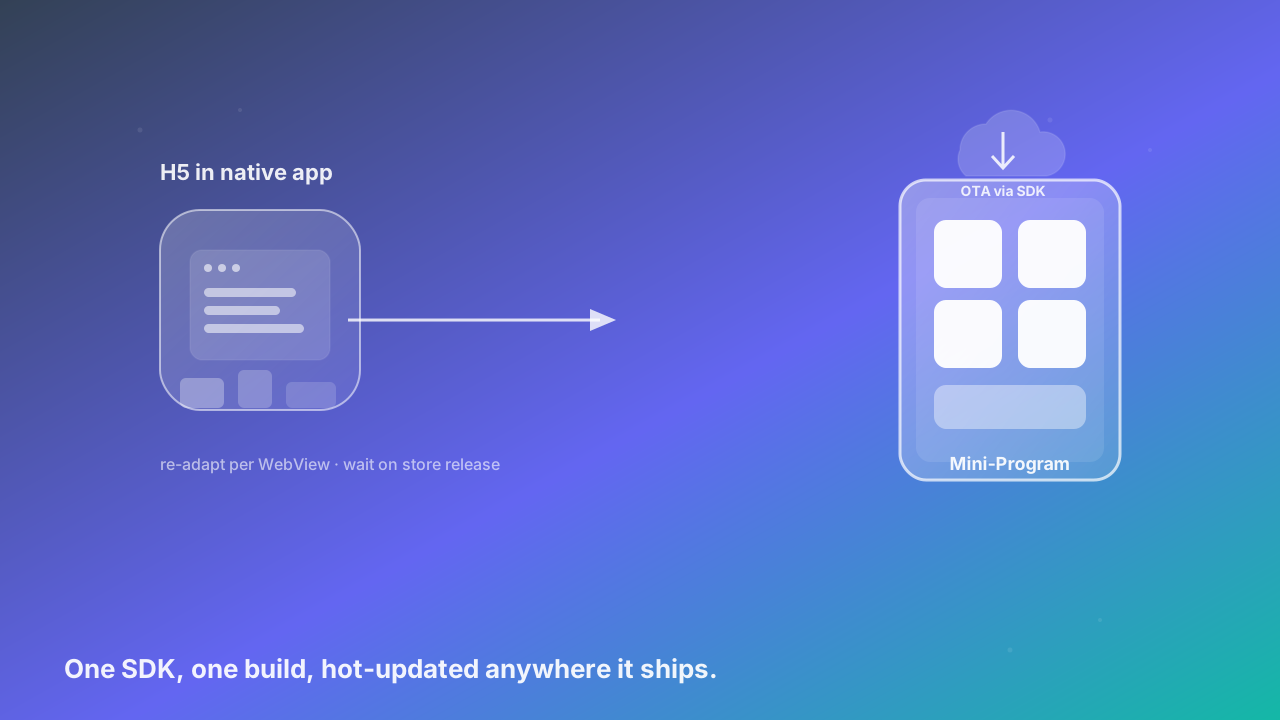
- OTA iteration. As agent protocols evolve weekly, the mini-program's logic updates over the air through the SDK — no app-store release for the service layer.
Side-by-side
| Dimension | Bare H5 | Standalone app | CrossMiniApp SDK mini-program |
|---|---|---|---|
| Agent readability | Poor (built for eyes) | N/A (agent cannot see) | Structured, governed surface |
| Entry-point reach | Universal web only | Misses the conversation | Where the agent already is |
| Governance and trust | None | Brand-only | Audited, revocable, host-vouched |
| Multi-surface reuse | Rewire per agent | Rebuild per platform | One build, many surfaces |
| Iteration speed | Static deploy | App-store release | OTA via SDK |
Where it pays off first
The pattern fits the surfaces that already ride host trust and instant rails: embedded finance and bill pay, where the agent tops up or moves money through the host wallet; retail and local discovery, where the agent finds and reserves through the host; and government and utility services, where the governed program is the only compliant way an agent may act. In each, the cost of rewiring per agent is paid repeatedly; the runtime pays it once.
Where CrossMiniApp fits
CrossMiniApp is the universal runtime plus the open catalog, delivered through one SDK. As agents become the new storefront, the service that wins is the one any agent can read, trust, and call — built once, embedded wherever the agent already lives, inheriting host identity and payment, and updated over the air. For teams watching agentic commerce arrive in fragments across overseas super-apps and messengers, the mini-program is the unit that finally lets a service be agent-ready without being rewritten for every agent that shows up.