
The wrong question is 'app or mini-program'
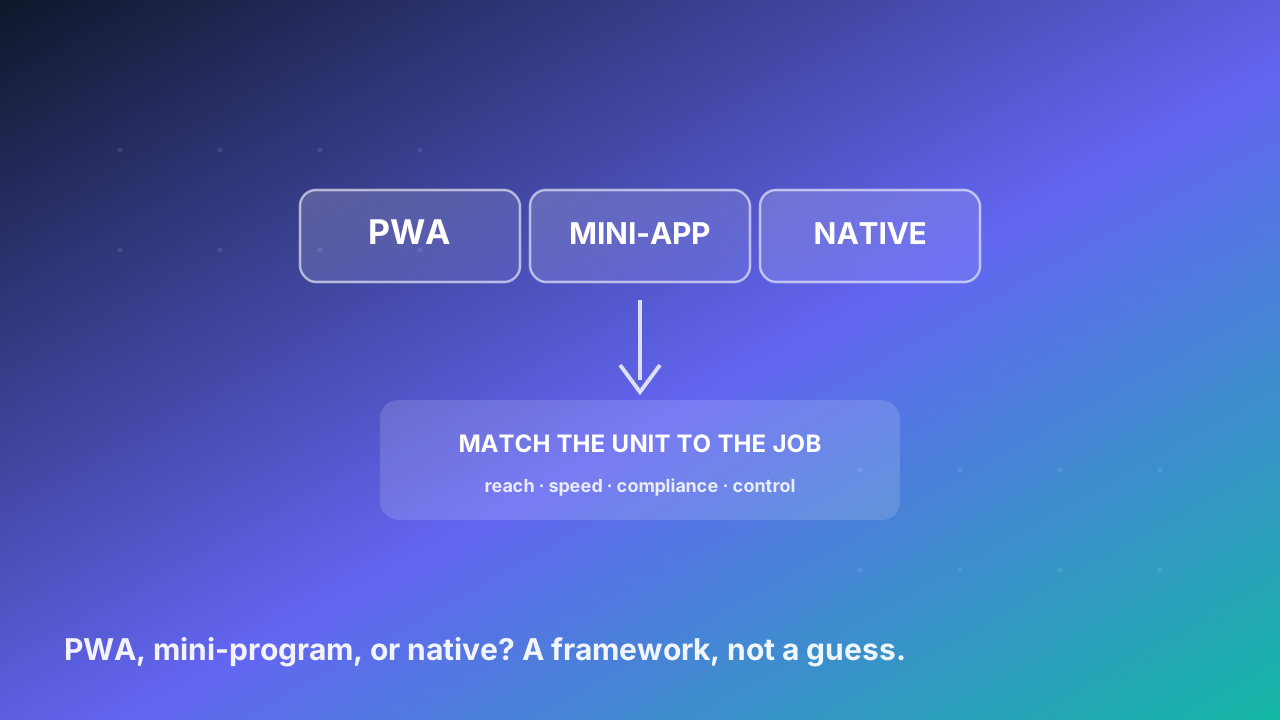
Most strategy decks frame the choice as a technology decision: native app versus mini-program. That framing is backwards. Outside the United States and Western Europe, the real question is where does the user already live, and whose trust do you borrow. In market after market, the answer is a super-app, a messenger, or a wallet — not a home-screen icon you have to earn from zero.
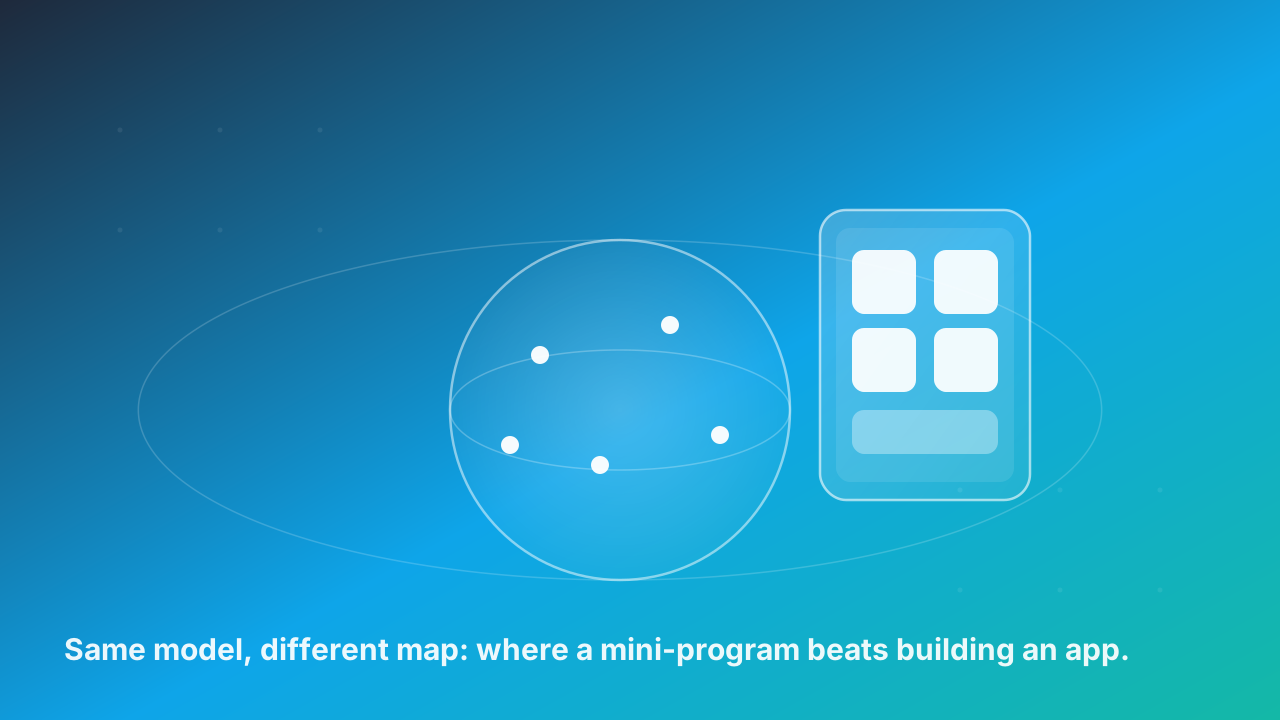
This article maps, region by region, the business models that belong inside a mini-program and would struggle or die as a standalone app. The throughline is economic, not technical: distribution, trust, and acquisition cost vary by country, and they decide the carrier.
The four conditions that point to a mini-program
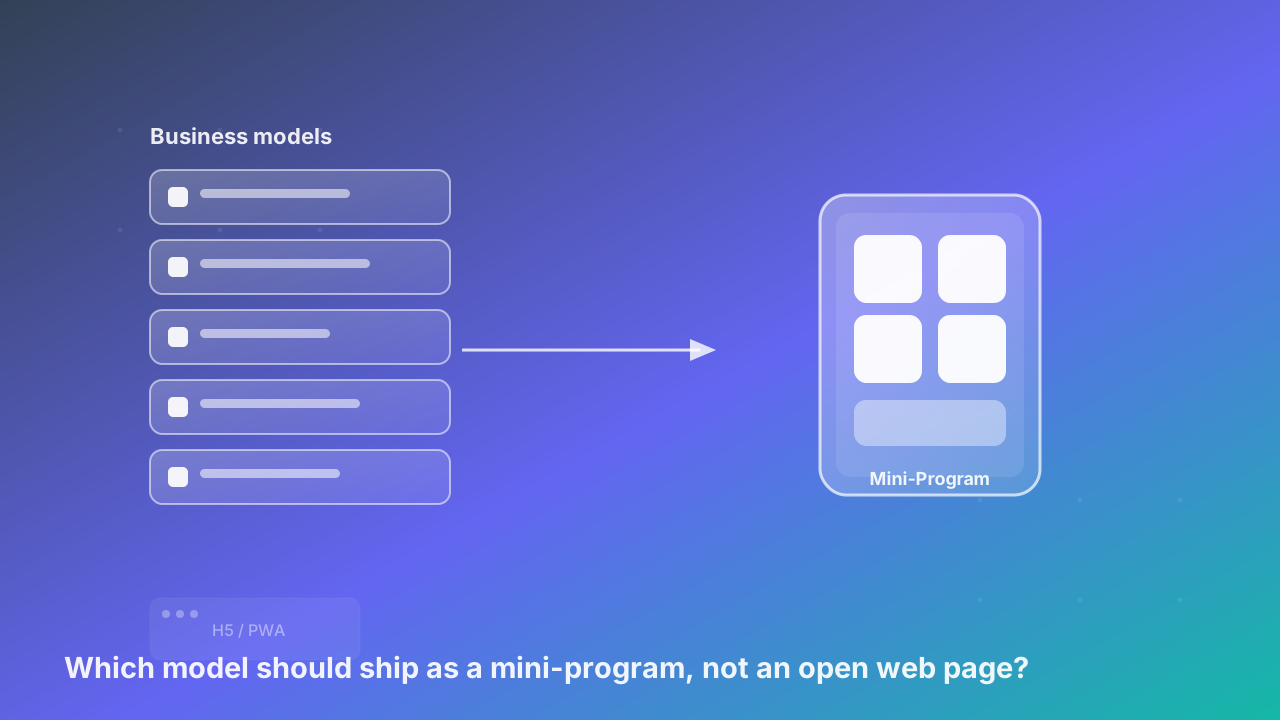
A model fits a mini-program instead of a standalone app when most of these hold:
- Distribution is already owned by a host. The user opens Grab, WhatsApp, or M-Pesa every day. Your service appears inside that surface rather than fighting for a home-screen slot it will never win.
- Trust must be borrowed, not built. Payments, lending, and government services need a regulated, known entity vouching for you. A host with 90 million users is that voucher; a new app icon is not.
- Acquisition cost is prohibitive on your own. In emerging markets, installs are expensive, storage is scarce, and data is metered. A program you reach through a host has zero install and zero storage tax.
- The use is transactional, not a destination. Users do not seek you as a brand. They pay a bill, top up airtime, or order lunch in context. A governed program inside a host is the natural unit; a destination app is overkill.
Where these conditions fail — a strong home-screen brand, deep OS integration, or no dominant host — a standalone app still wins. We return to that at the end.
Southeast Asia: embed in the super-app, don't fight it
Southeast Asia is the clearest case. More than 70% of the region's adults are unbanked or underbanked, and digital wallet usage already runs around 83% — higher than the UK. The daily surface is a super-app: Grab serves 44–45 million monthly transacting users and 119 million annual users across eight countries with 6–7 million merchants; GCash has 90 million-plus registered users in a country of 115 million; GoPay around 38 million monthly users, OVO 60 million-plus, DANA reported at 170 million, and Vietnam's MoMo over 40 million.
Business models that fit a mini-program, not a standalone app:
- Hyperlocal services and merchant ordering inside Grab or Gojek. A salon booking, a mechanic dispatch, a restaurant reorder — these ride the super-app's logistics, payments, and daily habit. A standalone app cannot buy Grab's surface or its near-zero acquisition cost.
- Bill pay, top-up, and micro-lending inside GCash or MoMo. These are trust- and frequency-driven, not destination-driven. Users already trust the wallet with their money; a separate finance app starts from zero trust and loses.
- Government and utility services via the host. Where the wallet is the only formal financial entry point for most users, the governed program is the only realistic delivery unit.
Latin America: meet the user inside WhatsApp and PIX
Latin America inverts the super-app story: the daily surface is the messenger, not a single commerce app. WhatsApp penetrates 85–96% of smartphone users daily in Brazil and sits at 75–80% across the region. On top of that, Brazil's central-bank instant payment PIX reached 170 million users — about 93% of adults — processing roughly BRL 28 trillion through October 2025 and leading e-commerce with a 42% share, ahead of cards. Mercado Pago has 72 million-plus users across eight countries; Nubank serves 100 million-plus; Mercado Libre sees 64 million daily active users.
Business models that fit a mini-program, not a standalone app:
- Conversational commerce and PIX-powered payments inside WhatsApp. Brazil is already turning WhatsApp into a bank teller: banks and fintechs let users move money, pay bills, and check balances by chat. A merchant running a storefront or a bill-pay flow inside the chat beats a standalone shopping app that has to re-acquire the user.
- Community group-buy and reseller flows in messaging. Latin America's retail market is ~USD 1.9 trillion in 2025 and heavily mobile; social and chat-driven commerce converts where a cold app install does not.
- Micro-lending and insurance accessed by conversation. Lower-income and remote users prefer messaging over a banking app. The program inherits the messenger's reach and PIX's settlement.
The host here is the chat plus the instant-payment rail. A standalone app duplicates both and loses.
Africa: ride the rails you cannot rebuild
Africa is the most extreme case. Global registered mobile-money accounts hit 2.3 billion in 2025, up 13%, with sub-Saharan Africa making up about two-thirds of new accounts. In Kenya, M-Pesa holds roughly 90% of mobile-payment share with about 40 million users — around 70% of adults. Nigeria's OPay reached nearly 60 million registered users by late 2025 with 800,000 merchants on its rails; PalmPay operates 35–50 million users across a million-plus agent and merchant network. The World Bank finds mobile money is the only formal financial entry point for 70%-plus of rural sub-Saharan Africans.
Business models that fit a mini-program, not a standalone app:
- Airtime, data, and bill top-up. These are high-frequency, low-trust-threshold transactions that ride existing rails. A standalone app cannot match M-Pesa's 90% trust or OPay's merchant density.
- Agent-assisted onboarding and merchant pay. Distribution runs through physical agent networks — PalmPay's million-plus agents — that no app can replicate with a download.
- Micro-lending and micro-insurance. Credit scoring compounds on the wallet's transaction history. The governed program inherits the rail and the data moat; a new app starts empty.
In a market where smartphones are still transitioning from feature phones and data is metered, the program delivered through the wallet or the agent is the only unit that reaches the next user.
India and South Asia: a caveat
India complicates the pattern. The Unified Payments Interface (UPI) and a strong standalone-app culture (Paytm around 72 million monthly users, plus PhonePe and Google Pay) mean the super-app-host model is weaker; WhatsApp Pay remains capped. Mini-programs fit here mainly as WhatsApp-based commerce and UPI-linked flows, not as a wholesale replacement for apps. The lesson: the framework still applies, but the dominant host is less settled.
The Middle East and North Africa: early, app-heavy
MENA has high smartphone penetration and real super-app contenders (Careem, Talabay/Talabat, regional wallets), but app culture is stronger and regulation is uneven. Mini-programs fit ride-hailing adjacencies, government services, and wallet-embedded finance where a host already owns daily use; destination brands still prefer apps. Treat MENA as a lagging version of the SEA playbook.
The United States and Europe: the counterexample
Here the rule flips. There is no dominant daily host — no WeChat, no Grab, no WhatsApp-commerce rail that most users open habitually. Super-app culture is weak, and privacy rules (GDPR) make host-embedded data sharing cautious. A standalone app remains the right carrier for a destination brand, and a mini-program fits mainly messaging-native communities via Telegram Mini Apps (which sit atop a 1-billion-user surface) and lightweight brand extensions. The US and EU are where you build the app; everywhere else in this analysis, you usually embed.
Regional fit at a glance
| Region | Dominant host | Models that fit a mini-program | Why not a standalone app |
|---|---|---|---|
| Southeast Asia | Grab, GCash, GoPay, MoMo | Merchant ordering, bill pay, micro-lending, gov services | Host owns the daily surface and the trust |
| Latin America | WhatsApp + PIX, Mercado Pago | Conversational commerce, PIX pay, group-buy, micro-lending | Messenger + instant rail beat a cold install |
| Africa | M-Pesa, OPay, PalmPay | Top-up, agent pay, micro-lending, insurance | Rails and agent networks can't be rebuilt |
| India | UPI, Paytm (weaker host) | WhatsApp commerce, UPI flows | Host less settled; apps still lead |
| MENA | Careem, wallets | Ride adjacencies, gov, wallet finance | App culture stronger; host less dominant |
| US / EU | None dominant | Telegram Mini Apps, brand extensions | Build the app; no habitual host |
When a standalone app is still the answer
The mini-program is not universal. Choose a standalone app when: you are a destination brand users actively seek; you need deep OS integration (offline-first, heavy media, wearables); the region has no dominant host; or you must own the first-party data and relationship without a mediator. The strategy is to match the carrier to the region's reality, not to a global template.
Where Cross Mini App fits
Cross Mini App is the runtime and the open catalog for the governed-program model. The regional hosts in this analysis — Grab, GCash, WhatsApp and Telegram, M-Pesa and OPay — are fragmented and each speaks its own format. Cross Mini App lets you build a mini-program once against a standard API surface and drop it into any trusted host instead of rewriting per platform. Pre-compliant, sandboxed, and localized, these programs inherit the host's identity, payment, and daily surface, with no install. For the business models above, that is the unit that actually reaches the next billion users — built once, embedded everywhere their host already is.
The map, restated
Stop asking whether to build an app. Ask where your next user already is, and whose trust you can borrow. In Southeast Asia, Latin America, and Africa, the answer is a host you embed into, not an icon you beg for. Ship the program where the user lives, and let the region decide the carrier.