

PWA vs Mini-Program vs Native: A Selection Framework for 2026
Stop guessing which app form to build. A practical 2026 framework maps your real constraints — reach, time-to-market, compliance, payment, control — to the right unit: PWA, native, or a governed mini-program.
Cross Mini App Team
September 19, 2026 · 3 min read
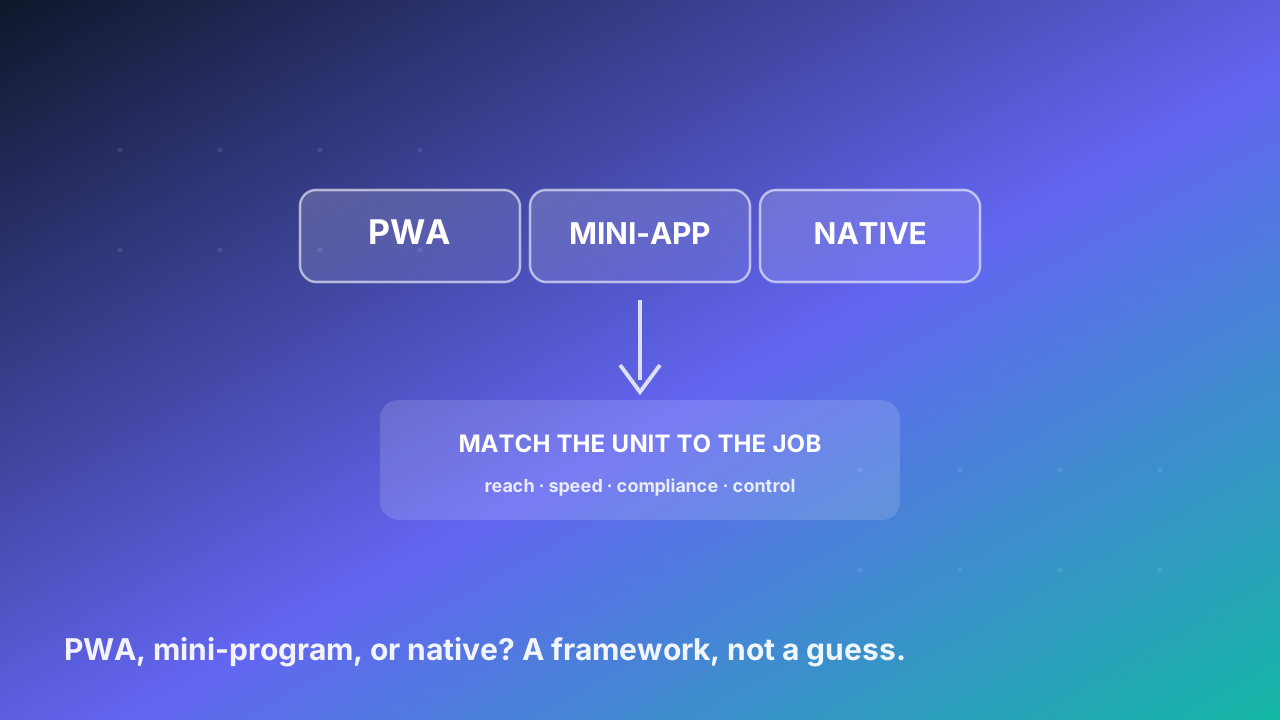
The wrong question
Teams still ask "should we build an app or a website?" That framing is obsolete. In 2026 you choose among three delivery units — Progressive Web App, native app, and governed mini-program — and the right answer is a function of your constraints, not fashion.
The decision dimensions
| Dimension | PWA | Native app | Governed mini-program |
|---|---|---|---|
| Reach / discovery | Link-only; weak install intent | App store; strong but competitive | Inside a host with daily usage |
| Time to market | Fast (web stack) | Slow (per-store build + review) | Fast (sandbox, light review) |
| Distribution control | You own the link | Store owns the gate | Host owns the surface |
| Identity & payment | You rebuild per market | You rebuild per market | Inherited from host |
| Compliance posture | Hard to prove | Yours to certify | Audited sandbox, provable |
| Offline capability | Limited | Full | Host-dependent |
| Cross-host portability | High (web) | None (store-locked) | High (open runtime) |
The rules of thumb
Use a PWA when the job is a fast, link-shareable web experience with light engagement — a marketing flow, a document, a one-off interaction. It is the cheapest way to be reachable, not the way to own a relationship.
Use a native app when you need deep device access (Bluetooth, background sync, heavy offline, AR), or when you are building the primary product and can win the home-screen slot and the app-store investment. Native is the right unit for the product that is the company.
Use a governed mini-program when you need to reach a trusting user inside a host they already open, and especially when the market is regulated, multi-currency, or multilingual. It inherits identity, payment, and consent, ships instantly, and passes the compliance bar a telco, bank, or marketplace will actually approve.
The pattern most teams miss
The three are not mutually exclusive — they are layers. A native app can host mini-programs. A PWA can be the top-of-funnel that hands off to a deeper experience. The mistake is treating one unit as the whole strategy. Match the unit to the job at that moment in the journey, then let an open runtime carry the governed program across hosts so you are not rewriting it per walled garden.
A simple triage
- Do you need deep device APIs or is this the core product? → Native.
- Is this a light, link-driven, low-commitment interaction? → PWA.
- Do you need trust, payment, and compliance inside a host you don't own, across markets? → Governed mini-program.
If you answered "yes" to 3 — which is most distribution, commerce, and services work — the governed mini-program is your unit.
Where Cross Mini App fits
Cross Mini App is the runtime and open catalog that makes the third option real at scale. You build a governed mini-program once and distribute it across many trusted hosts — wallets, maps apps, super-apps, marketplaces — inheriting identity, payment, and consent instead of rebuilding them. Pre-compliant, sandboxed, and localized, it reaches users on the surfaces they already trust, with none of the per-store or per-garden rewriting. Pick the unit by the job; let an open cross-app runtime carry it everywhere.
Decide by constraint, not by hype
The 2026 answer is rarely "app vs web." It is "which unit fits this moment, and how do I carry it across hosts without rebuilding?" Get that right and distribution stops being a bet and becomes a system.
Related Posts
Generosity is a moment — a story, a disaster, a friend's fundraiser. The gift is won or lost inside the app the donor already trusts, and a governed mini-program delivers it with proof.
China didn't adopt mini-programs — it built an alternative internet on top of them. WeChat alone runs ~4.3 million programs with ~945M monthly users and over ¥8 trillion in 2024 GMV. Here's how the model works and why it scales.
Mini-programs are no longer a China-only story. Telegram, LINE, Grab, Gojek, and Kakao have built real mini-app platforms across Asia, Latin America, and beyond. Here is the global map and what it means for distributors.