From Impulse to Impact: Why Giving Ships as a Mini-Program
Generosity is a moment — a story, a disaster, a friend's fundraiser. The gift is won or lost inside the app the donor already trusts, and a governed mini-program delivers it with proof.
Cross Mini App Team
September 19, 2026 · 4 min read
Generosity is a moment, not a habit
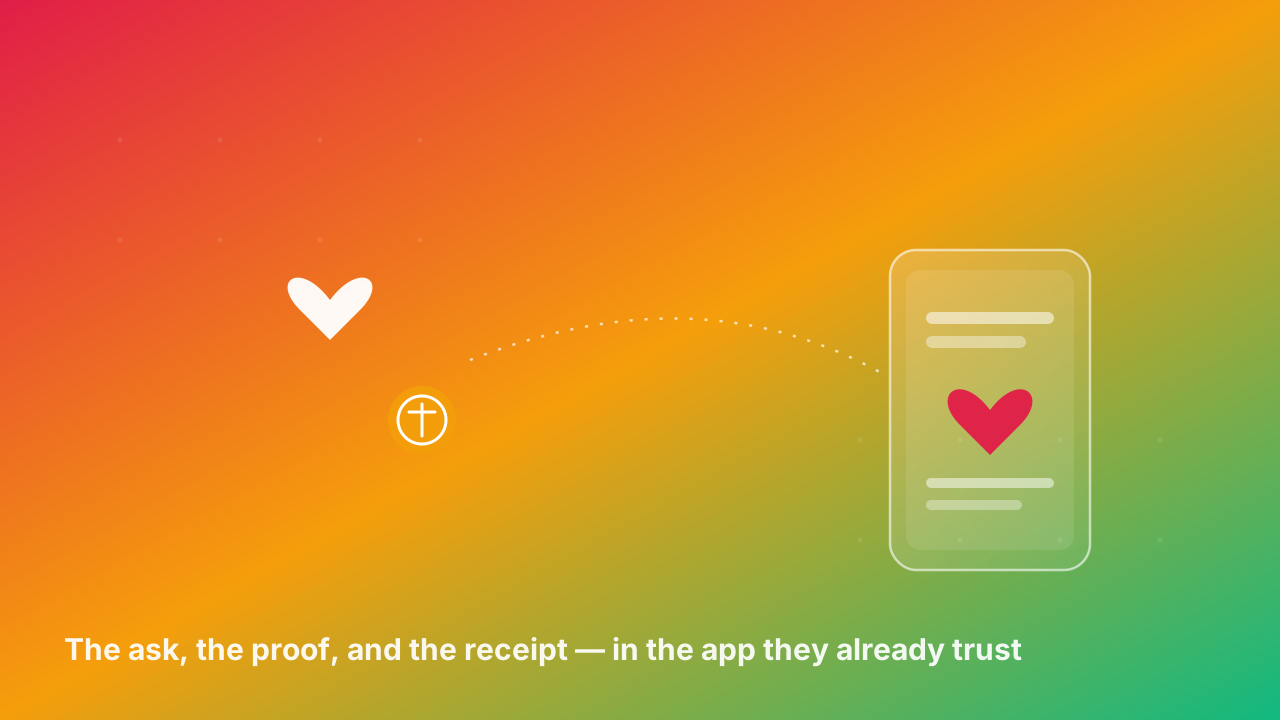
A donor scrolls a feed, sees a fundraiser for a flood halfway across the world, and feels the pull to give — right now, before the feeling fades. The charity, the campaign, the receipt: all of it comes down to this one tap. The philanthropic sector has spent years building donation portals nobody visits, while the moment of generosity happens somewhere else entirely. And the governed mini-program is the unit that lets a host deliver the gift at the moment it is felt.
The scale is enormous
The numbers describe a tide too big to ignore:
- A record 4.3 billion people helped a stranger, volunteered, or donated in the month before the survey (CAF World Giving Index 2024), across 142 countries.
- 64% of people worldwide donated money in 2024 — 40% of it directly to people in need, 36% to charities, 24% to religious organizations (CAF World Giving Report 2025).
- In the United States, total giving reached US$592.5 billion in 2024, up 6.3% (Giving USA).
- Donors are going digital fast: 63% preferred online channels in 2024; mobile devices drove 53% of nonprofit website visits, and digital wallets — PayPal (accepted by 76% of nonprofits), Apple Pay (47%), Google Pay (40%) — are now the default at the moment of giving.
Why the gap persists
The old model sends the donor to a separate website, a mail appeal, or a clunky checkout that forgets who she is. It fails at the moment of generosity:
- The feeling is perishable. By the time the donor finds the portal, opens it, and fills the form, the impulse has cooled.
- Trust is the bottleneck. Donors increasingly demand proof — where the money goes, who handles it — and a cold checkout with no visible accountability loses the gift.
- Friction kills conversion. Every extra field, every card re-entry on a phone, every broken mobile page sheds donors exactly where margins are thinnest.
Real programs already run
- WeChat 公益 and similar in-app charity programs let hundreds of millions give, track impact, and get receipts without leaving the social app.
- Facebook and Instagram fundraisers and donation stickers turn a feed into a giving surface; social giving with mobile, QR, and "Donate" buttons has climbed steeply.
- Super-apps like GCash and Grab embed donate features, meeting the giver inside the wallet she already trusts.
These are not pilots. They are the distribution backbone of the next decade of philanthropy.
The delivery problem nobody talks about
Embedding a donation, impact proof, and a receipt inside a host app sounds easy until compliance arrives. A wallet or social app will not accept a native donation flow with unaudited data scope and weak consent. What it will accept — across regions, languages, and currencies — is a bounded, sandboxed, compliant mini-program that inherits the host's identity, payment, and consent flow, and can show the donor exactly what happens next.
Why a mini-program, not another app
The governed mini-program is the natural delivery unit for giving:
- It inherits the host's trust. Login, KYC, and consent already happened in the host. The charity rides them — no new account, no new trust decision at the most emotional moment.
- It is instant and lightweight. No install funnel, no app-store review. The "give" button appears in-context, one tap from the story that moved the donor.
- It is provably transparent. An audited sandbox with explicit scope and consent flows is exactly what a wallet, a social app, or a regulator will approve — and it can surface impact and receipts natively.
What this means for nonprofits and hosts
If your 2026 plan assumes donors will find and install your donation app, reconsider:
- Meet the donor inside the app they already trust — a social feed, a wallet, a messaging app — instead of shipping them to a portal they will never bookmark.
- Ship a governed unit the host will embed. A sandboxed, compliant mini-program — not a native app — is the unit a WeChat, a GCash, or a Facebook will actually accept across regions.
- Design for the perishable moment. Mobile-first, wallet-ready, transparent by default. The next gift is decided in under a minute, on a phone, in a feed.
Where Cross Mini App fits
Cross Mini App is the runtime and the open catalog for the post-install era of generosity. You build a governed giving mini-program once and drop it into every trusted host — a social app, a wallet, a messaging platform. Pre-compliant, sandboxed, and localized, these experiences deliver the ask, the proof, and the receipt inside the app the donor already trusts, without asking her to install anything. Hosts get vetted causes they can embed in a single line; nonprofits stop rebuilding per store and per country; donors get impact and a receipt at the moment they give. For philanthropy — where donor trust, data privacy, and cross-border regulation make sandboxing non-negotiable — a governed cross-app runtime is the only safe unit to distribute at scale.
The gift follows the feeling, not the folder
For decades the default was "build a donation site, acquire cold, hope they return." In 2026 the growth is on the in-app surface, delivered as a governed mini-program through a cross-app runtime. Cross Mini App is building the shelf so the next ask, the next proof, the next receipt reaches the donor at the moment it matters — inside the app already open.
Related Posts
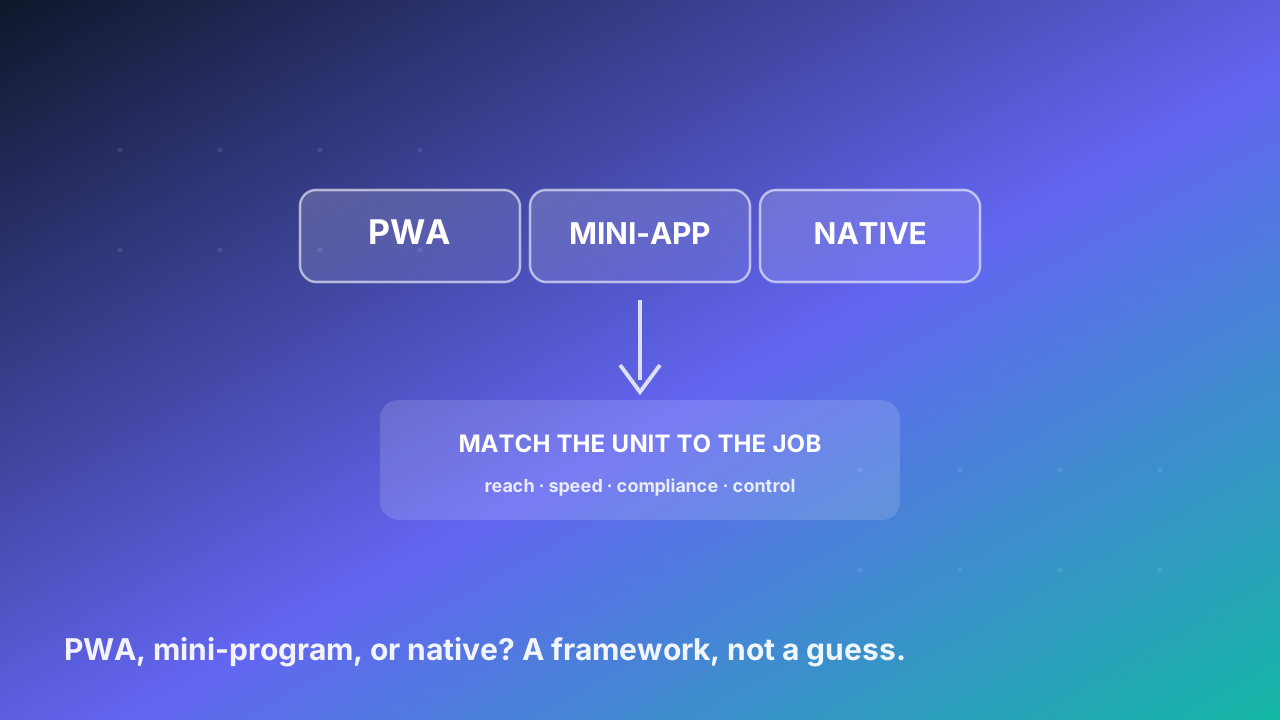
Stop guessing which app form to build. A practical 2026 framework maps your real constraints — reach, time-to-market, compliance, payment, control — to the right unit: PWA, native, or a governed mini-program.
China didn't adopt mini-programs — it built an alternative internet on top of them. WeChat alone runs ~4.3 million programs with ~945M monthly users and over ¥8 trillion in 2024 GMV. Here's how the model works and why it scales.
Mini-programs are no longer a China-only story. Telegram, LINE, Grab, Gojek, and Kakao have built real mini-app platforms across Asia, Latin America, and beyond. Here is the global map and what it means for distributors.