

Inside China's Mini-Program Economy: One Runtime, 4 Million Programs
China didn't adopt mini-programs — it built an alternative internet on top of them. WeChat alone runs ~4.3 million programs with ~945M monthly users and over ¥8 trillion in 2024 GMV. Here's how the model works and why it scales.
Cross Mini App Team
September 19, 2026 · 3 min read
A separate internet, built on runtime
Outside China, the mobile internet is a pile of standalone apps fighting for home-screen real estate. Inside China, a large share of daily life — ordering food, paying bills, booking a hospital slot, filing municipal forms — happens inside a handful of super-apps as mini-programs. The app is the operating system; the mini-program is the app.
This is not a feature. It is a parallel distribution layer that rewired how a billion people use software.
The scale is staggering
The numbers from Tencent and Alipay disclosures tell the story:
- WeChat mini-programs: about 4.3 million registered programs, roughly 945 million monthly active users (2025), running inside a WeChat + Weixin base of 1.42 billion monthly users. They facilitated over ¥8 trillion (≈ US$1.1 trillion) in GMV in 2024 — a figure Tencent disclosed in its Q3 2025 overview.
- Alipay: China's second-largest mini-program ecosystem, with around 400 million mini-programs and a mini-program audience near 650 million monthly users, sitting on an Alipay app base above 890 million.
- Douyin and Meituan extend the same pattern — short-video commerce and local services delivered as programs inside the host rather than as separate installs.
One runtime, millions of programs, a trillion-dollar economy — that is the Chinese mini-program stack in a sentence.
Why the model works
Three things compound to make it durable:
- Trust is pre-solved. WeChat Pay and Alipay already cleared identity, KYC, and payment for the user. A mini-program inherits that trust — no new account, no new card entry, no cold-start friction.
- Discovery is built in. Mini-programs are found through search, social sharing, QR scans, and official accounts — not an app store they have to choose to open. The distribution surface is the social graph itself.
- The cost of trying is near zero. A tap, not an install. Merchants can launch a service in days; users can abandon it with no uninstall guilt. Experimentation is cheap, which is exactly why millions of programs exist.
The lesson for the rest of the world
The Chinese model proves a thesis the rest of the world is only now catching up to: the unit of mobile software is shifting from the standalone app to the governed program inside a trusted host. The mechanics — sandboxing, inherited identity, instant access, compliant distribution — are portable. What's missing outside China is the open runtime that lets a program travel across many hosts instead of being locked to one.
Where Cross Mini App fits
Cross Mini App takes the Chinese lesson and removes the wall. It is the runtime and the open catalog: you build a governed mini-program once and distribute it across many trusted hosts — wallets, maps apps, super-apps, marketplaces — anywhere in the world. Pre-compliant, sandboxed, and localized, these programs inherit the host's identity and payment exactly like a WeChat mini-program, but they are not owned by any single gatekeeper. Hosts get vetted services they can embed in a line; merchants stop rebuilding per store and per country; users get the service at the moment they want it, inside the app they already trust.
The next billion users won't install your app
They will open a host they already use. China proved the governed-program model at a billion-person scale. Cross Mini App is building the open layer that lets the rest of the world plug into it — one runtime, many hosts, no wall.
Related Posts
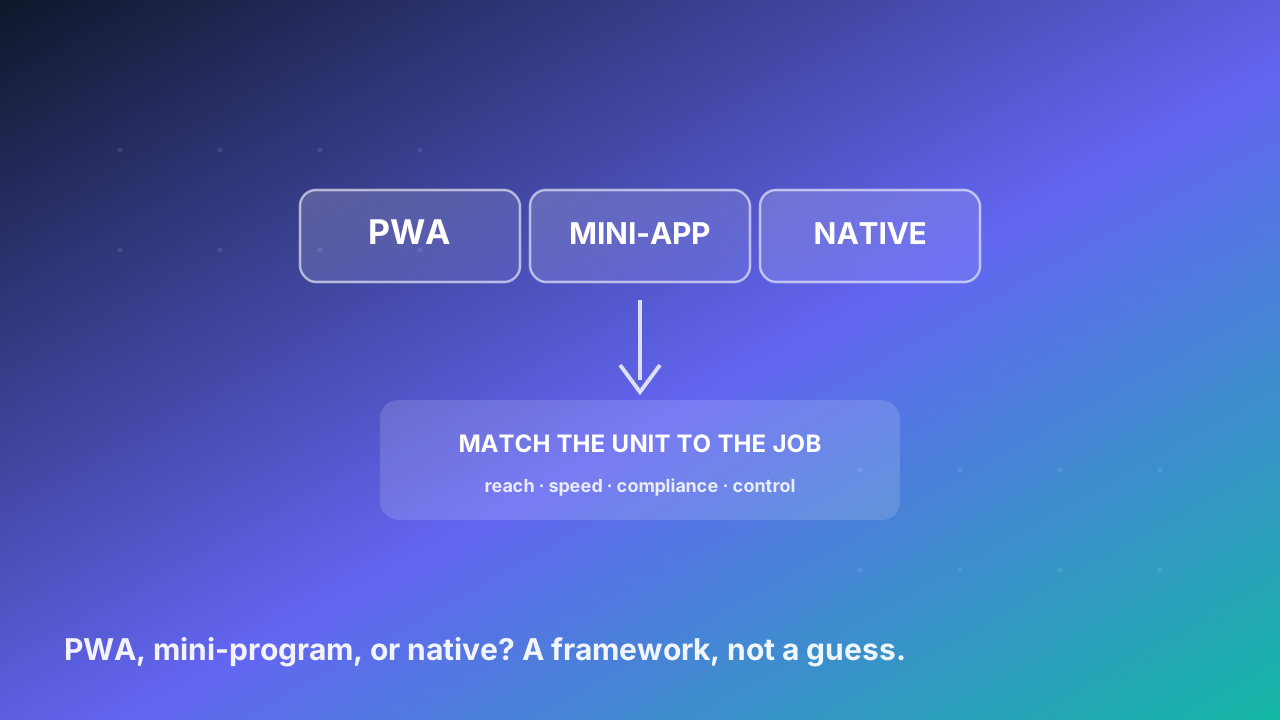
Stop guessing which app form to build. A practical 2026 framework maps your real constraints — reach, time-to-market, compliance, payment, control — to the right unit: PWA, native, or a governed mini-program.
Generosity is a moment — a story, a disaster, a friend's fundraiser. The gift is won or lost inside the app the donor already trusts, and a governed mini-program delivers it with proof.
Mini-programs are no longer a China-only story. Telegram, LINE, Grab, Gojek, and Kakao have built real mini-app platforms across Asia, Latin America, and beyond. Here is the global map and what it means for distributors.