
The comparison you have already read
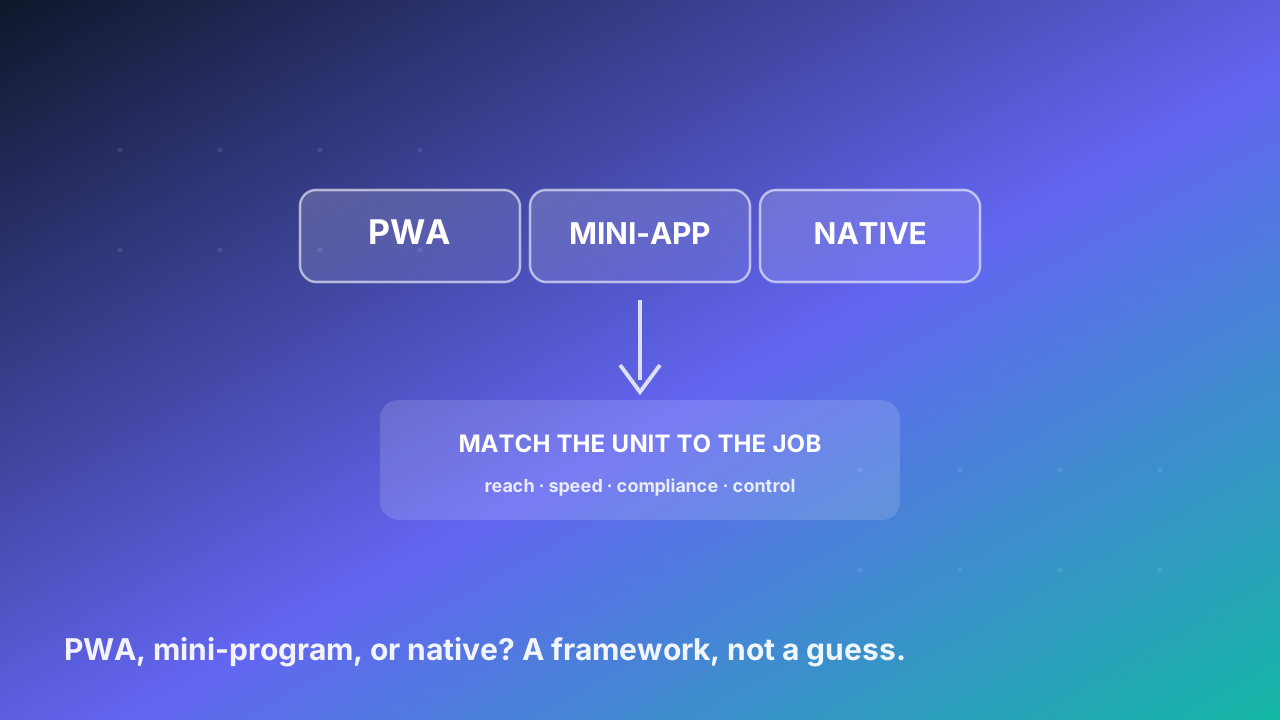
Two comparisons already exist on this site. One lays out how a mini-program differs from an H5 page at the runtime, identity, and payment level. Another puts H5, PWA, and the mini-program side by side as three mobile delivery models. A third maps, region by region, which models fit a mini-program instead of a standalone app.
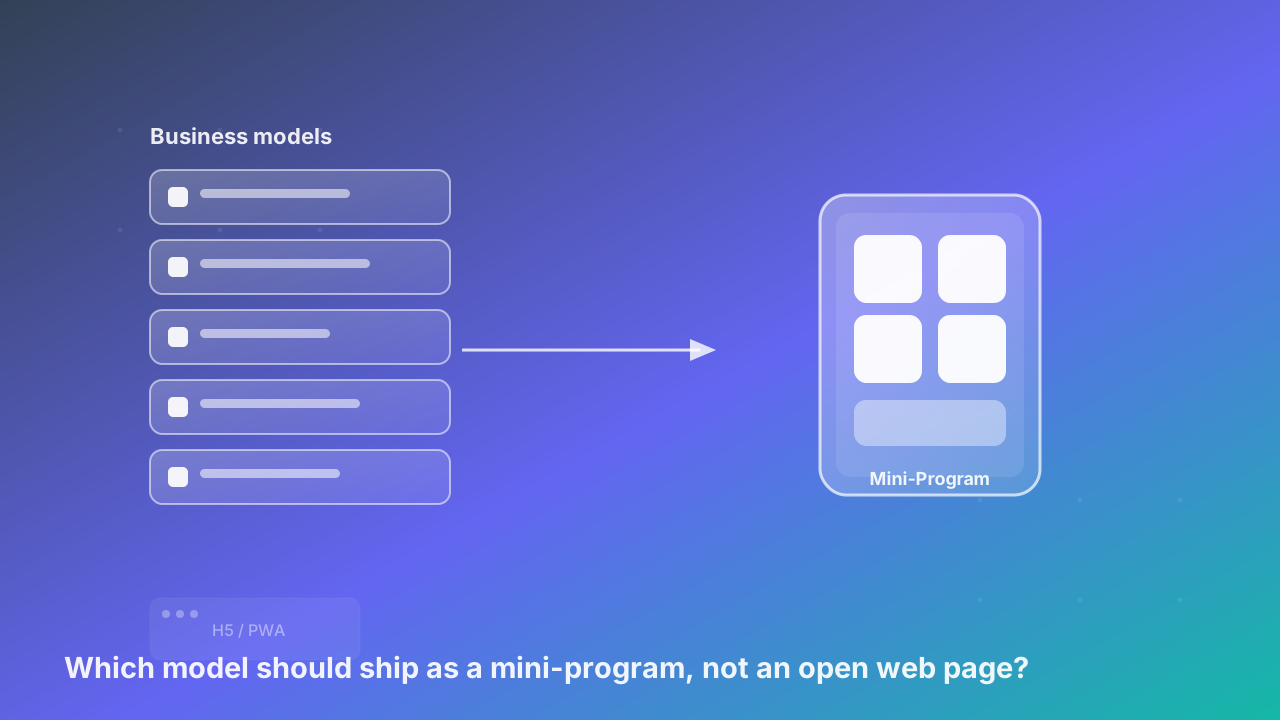
This article is the missing cut: the business-model cut. Technology explains what each model can do. Region explains where the user already lives. But the question most teams actually face is narrower and more practical: given my business model, which carrier should I build on — a governed mini-program, an open H5 page, or an installable PWA?
Below is a decision matrix you can take to a planning meeting.
The rule that decides it
A business model belongs in a mini-program rather than H5 or PWA when most of these hold:
- Payment must settle in context. If revenue depends on a checkout, a mini-program calls the host wallet — WeChat Pay, Alipay, the host's own rail — inside the same surface. H5 and PWA both push the user out to a gateway and back, and every redirect is a drop-off.
- Identity should be inherited, not rebuilt. A mini-program receives a verified identity token from the host with one tap. An H5 page or PWA starts from a blank login form.
- The use is transactional, not a destination. Users do not come to you as a brand; they pay a bill, order lunch, or book a ride in context. A governed program inside a host is the natural unit.
- Distribution rides a host you cannot buy. When the daily surface is a super-app, a messenger, or a wallet, the mini-program appears where the user already is.
- Trust or regulation requires a vetted unit. Banks, telcos, governments, and insurers get admitted at scale only as programs a host can audit and revoke.
Where those conditions fail — read-only content, a destination brand, deep OS integration, or no dominant host — H5 or PWA stays the better call.
The decision matrix
| Business model | Pick | Why |
|---|---|---|
| Embedded finance, bill pay, top-up, remittance | Mini-Program | Needs wallet, identity, and trust; the host is the trust source |
| Social and conversational commerce (group-buy, reseller) | Mini-Program | Lives inside a messenger host; a cold app install cannot win |
| Food delivery, ride-hailing, hyperlocal services | Mini-Program | Transactional; rides the host's logistics, payments, and habit |
| Membership, loyalty, rewards | Mini-Program | Inherits host identity; embeds in the daily surface |
| Ticketing, booking, reservations | Mini-Program (in-host) + H5 (public share) | Discovery inside host, sharing through links |
| Government and public services (G2C) | Mini-Program when the host is the entry point | Trust, vetted scope, and reach in one unit |
| Healthcare and telemedicine access | Mini-Program | Trust plus access where the host is the only digital front door |
| Paid education and courses | Mini-Program | Structured, paid, identity-bound learning inside a host |
| Insurance and micro-insurance | Mini-Program | Inherits trust and settles through the host wallet |
| Retail e-commerce storefront | Hybrid: H5 acquisition + Mini-Program checkout | Acquire publicly, settle in context |
| Content, news, media | H5 (or PWA for offline reading) | Read-only; found through search, not a host |
| SaaS and productivity tools | PWA or App | Destination-grade, deep features, first-party data |
| Mini-games and interactive marketing | Mini-Program | Host traffic plus instant play, no install |
Why the mini-program wins the transactional rows
The top of the table is not a coincidence. Embedded finance, social commerce, local services, loyalty, ticketing, government, healthcare, education, and insurance all share one shape: a high-frequency, trust-sensitive transaction that the user performs inside a surface they already trust. The mini-program inherits that trust and that surface. Rebuilding them as an H5 page or a PWA means re-earning login, re-building checkout, and re-buying distribution you can never match.
Embedded finance is the clearest case. Bill pay, airtime top-up, and remittance ride existing rails — M-Pesa, OPay, GCash, PIX. The program inherits the rail and the wallet's identity; a standalone web page starts empty and loses the conversion at the payment step.
Healthcare and government are access problems. In many emerging markets the wallet or super-app is the only formal digital front door most citizens have. A governed mini-program is the realistic unit that reaches them; an H5 site assumes a device, a search, and a login they may never complete.
Insurance and education are trust-plus-payment. Micro-insurance and paid courses both need a vetted seller and an in-context settlement. The host's review gate and wallet do the heavy lifting a new web property cannot.
Why H5 and PWA still win some rows
The bottom of the table is just as deliberate. Content, news, and media are read-only and discovered through search engines — the open web's native strength. A destination SaaS or productivity tool needs deep features, first-party data, and OS integration that a host sandbox constrains. These models should not be forced into a mini-program any more than a transactional flow should be forced into a web page.
H5 is the right carrier when you need universal, search-friendly reach on any device and zero dependency on a platform owner. PWA is the right carrier when you already have a web property and want app-like speed, offline caching, and push without a native build or app-store review — especially on Android where PWA support is strongest.
The hybrid is the mature answer
Most products that scale do not pick one. They use H5 or a PWA for the open-web surface — the marketing page, the shared link, the email — and a mini-program for the in-host transactional core. The skill is assigning each surface its job and wiring them so a user falls from a web link into a governed program without hitting a login wall.
Where Cross Mini App fits
Cross Mini App is the runtime and the open catalog for the governed-program model. The hosts in this matrix — Grab, GCash, WhatsApp and Telegram, M-Pesa and OPay, the wallets and super-apps — each speak their own format. Cross Mini App lets you build a mini-program once against a standard API surface and drop it into any trusted host instead of rewriting per platform. Pre-compliant, sandboxed, and localized, these programs inherit the host's identity, payment, and daily surface with no install. For the business models above, that is the unit that actually reaches the next billion users — built once, embedded wherever their host already is.
The decision, restated
Stop asking whether the web is better than an app. Ask, for your specific business model, who owns the relationship with the user at the moment that matters. If that moment is a transaction inside a host the user already trusts, the mini-program is the carrier. If it is a read or a destination the user seeks out, H5 or PWA is. Match the model to the moment, and the technology choice stops being a debate.