

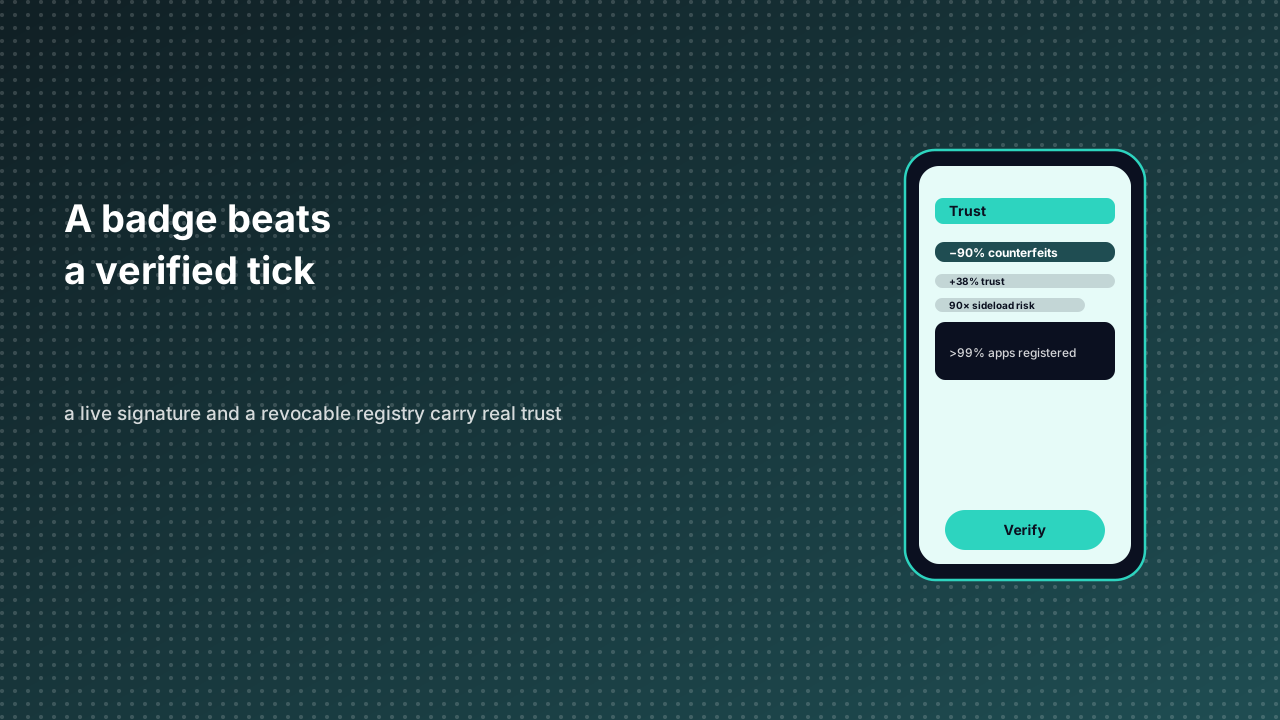
A counterfeit banking app can be a pixel-perfect copy of the real one. Same icon, the same login screen, the same support number. In the Chinese market, what separated the two was never the interface but an anti-fraud electronic identifier, issued under the Ministry of Industry and Information Technology and now covering more than a hundred apps across finance, securities and public services. Where that identifier was deployed, the number of counterfeit apps fell by more than ninety percent. In 2025 the system issued 41.05 million alerts tied to some 27,000 fraud apps. That is not a design achievement. It is an identity-governance achievement, and it makes one fact uncomfortable: the little verified ticks scattered across app catalogs cannot carry that kind of weight.
The reflex in catalog design is to treat trust as a status granted once. An applicant uploads documents, passes review, and receives a checkbox that never expires and never changes. The numbers from the two largest stores show how much work happens on the other side of that checkbox. Apple reported blocking more than 2.2 billion dollars in fraudulent transactions in 2025, against 11.2 billion dollars over six years, while rejecting over two million problematic submissions, pulling nearly 59,000 apps for bait-and-switch behavior and turning away more than 371,000 submissions for copying, spam or misleading users. Google said it stopped 1.75 million non-compliant apps before developers could publish them and another 872,000 high-risk apps before they reached users. Those are enforcement figures, not reassurance. They describe a catalog constantly cleaning up after identities that a static check failed to hold.
| Trust signal | What it actually proves | Where it breaks |
|---|---|---|
| Static verified checkbox | Passed review at one point in time | Goes stale once the account changes hands |
| Install and download counts | Popularity during a measured window | Inflated by coordinated install farms |
| Star rating | Aggregate mood of the people who rated | 63% suspect fake reviews when a badge is missing |
| Anti-fraud electronic identifier | Identity bound to a registered entity | Only works where a registry can revoke it |
| Store-level developer verification | Developer tied to a signing identity | Stops at the storefront; sideloaded malware runs 90x higher |
Consumer research explains why the badge carries weight beyond the tick. Verification badges lifted consumer trust in reviews by 38 percent, and 71 percent of consumers actively look for one while reading reviews, with 63 percent saying a missing badge makes them suspect the review is fake. Read carefully, those figures are not really about icons. They are about whether a claim can be traced to somebody who would lose something by faking it. A checkbox answers a thin question: did this pass once. A badge, when wired to a live signature and a revocable registry, answers a harder one — who stands behind this right now, and can that standing be withdrawn. The second question is the one that survives contact with a counterfeit.
Badges are not free, and the enthusiasm around them deserves a brake. A badge is only as strong as the registry underneath it. If verification is a single document upload that nobody rechecks, it is a checkbox wearing a badge's clothing, and users learn to ignore it. Google's own push for Android developer verification makes the point: more than 99 percent of Play apps are registered and most Play developers are verified, yet the company found malware from sideloaded sources more than 90 times as common as on Play. Verification that stops at one storefront does not travel with the app. There is also a cost at the edge. Stricter identity checks tend to push out hobbyists and small teams, who are often the source of the variety that makes an open catalog worth browsing. A catalog that verifies everyone into uniform respectability can end up with a safer shelf and a duller one.
A catalog that runs across multiple hosts needs the trust layer to live below the storefront. A mini program signed at submission and rechecked at the moment it opens gives every host the same answer about identity, whether the entry point is a bank's app, a messaging app or a third-party launcher. That requires signatures bound to legal entities, badges that can be revoked without a release cycle, and verification the runtime can evaluate rather than merely display. Cross Mini App sits at that layer, giving hosts a shared runtime where the identity signal travels with the package instead of dying at the download page. The badge is worth more than the checkbox only when something behind it is alive and willing to say no.
Sources
- Apple's 2025 fraud figures — blocked transactions, removals and rejected submissions for the year.
- Brand impersonation moving into app stores — how fake apps borrow a trusted identity.
- Anti-fraud electronic identifier coverage and alerts — the sectors covered and the warning counts behind the ninety-percent drop.
- Android developer verification and sideloading risk — verification progress and the malware gap between sideloading and Play.


