A traffic report can be technically accurate and still point the wrong way. An operator opens the weekly dashboard, sees assistant referrals rounded down to a fraction of a percent, and moves on. Nothing seems to warrant attention. Pull that cohort out of the aggregate and the shape changes: the few visits that arrived stayed longer and converted at a rate the main search channel rarely reaches. The volume is small and the behavior is strong. Both facts are true at once, and holding them together is the whole challenge.
That combination is the defining fact of AI referral traffic in 2025. A thin share of sessions carries a disproportionate amount of intent, and the usual reporting habits — sorted by volume, rounded to whole percentages — are built to hide exactly that.
The share is tiny. The currents underneath it are not.
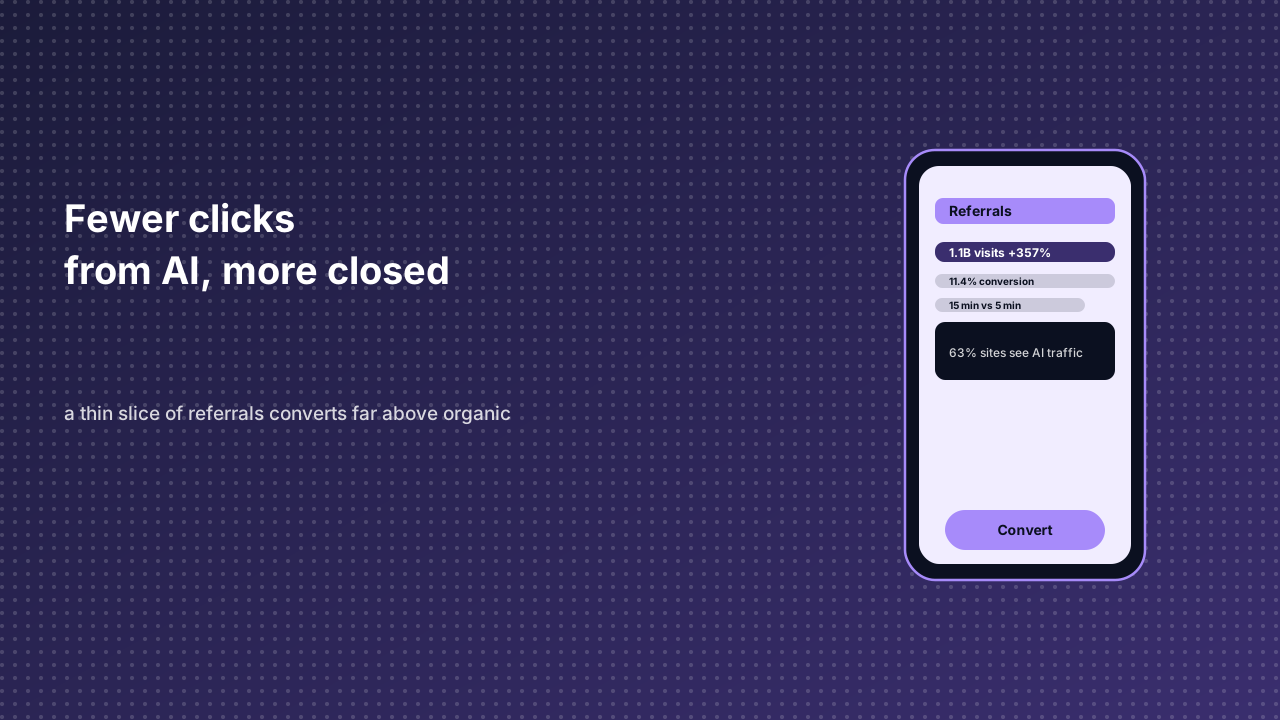
Similarweb counted more than 1.1 billion referral visits from AI platforms in June 2025, up 357% year over year, while monthly visits to generative-AI destinations rose 76% and app downloads climbed 319% (Similarweb investor release). Those are web-wide totals, and they are large. Zoom in on a single property and the picture inverts.
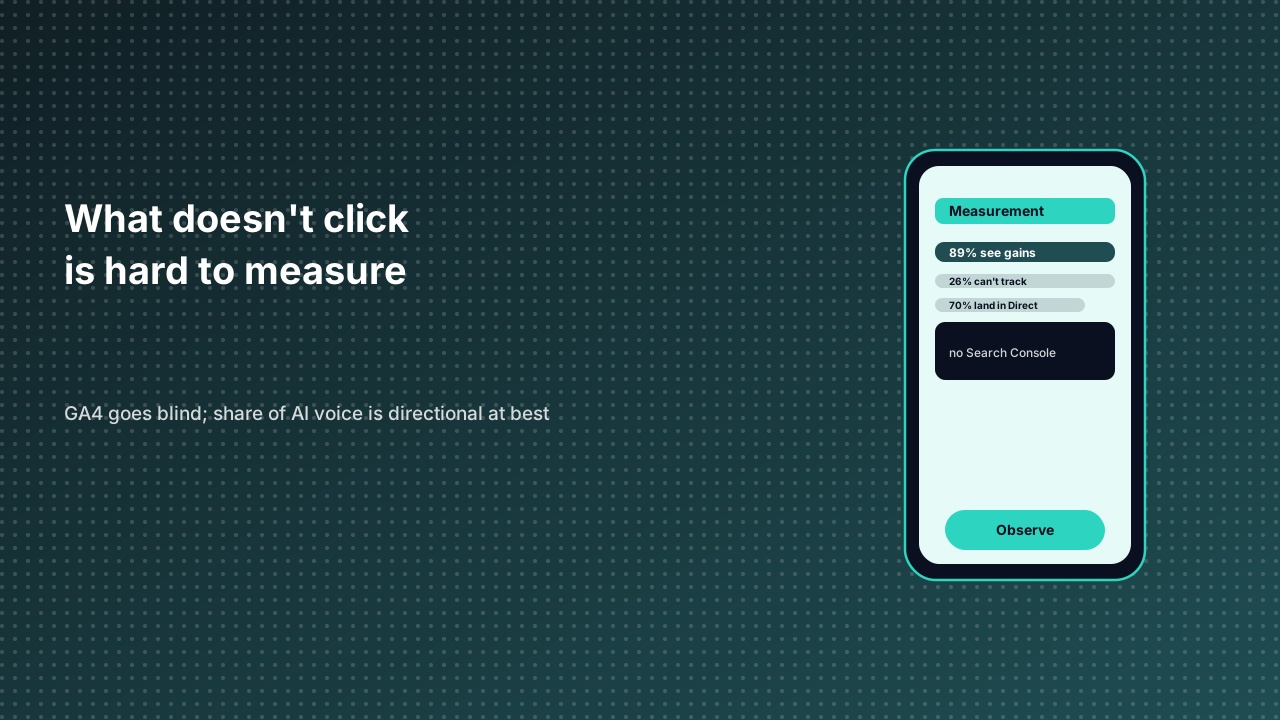
Ahrefs examined 3,000 websites and found that 63% had received some AI traffic, with ChatGPT taking roughly half, Perplexity close to a third, and Gemini around 18% — the top three together accounting for 98% (Ahrefs AI traffic study). Even on sites that did receive it, AI averaged just 0.17% of visitors. A later Ahrefs pass over more than 71,000 sites put ChatGPT at 0.25% of referral traffic, all assistants combined at 0.29%, and Google at 39.92%, with ChatGPT growing 11.9% month over month while Google fell 3.3% (reported by hosting.com). One visit in four hundred is not a channel. It is a signal, and signals deserve different handling.
A cohort that behaves differently
| Question | The AI-referred cohort | The search baseline |
|---|---|---|
| How much of the traffic is it? | 0.17% of visitors across 3,000 sites | Google still 39.92% of referrals across 71,000+ sites |
| How often does it convert? | 11.4% of ChatGPT referrals | 5.3% organic, 9.3% paid |
| How long does a visit last? | 15 minutes on average | 5 minutes from Google search |
| How deep does the visit go? | 12 pages per visitor | 9 pages per visitor |
| Which way is it moving? | ChatGPT +11.9% month over month | Google -3.3% month over month |
The conversion gap comes from Similarweb's State of Ecommerce 2025, where ChatGPT referrals converted at 11.4% against 9.3% for paid search and 5.3% for organic. The dwell and depth figures come from Similarweb's September 2025 U.S. desktop data: ChatGPT-referred visitors averaged 15 minutes and 12 pages, against 5 minutes and 9 pages for visitors arriving from Google (Similarweb analysis). A session three times as long is not a rounding error.
What the small percentage does and does not prove
The 0.17% and the 0.29% are not rival claims; they answer different questions. The first counts visitors in a 3,000-site sample, the second counts referral traffic across more than 71,000 sites a few months later. Different samples, different denominators, different months — and the definitions differ enough that averaging them would be meaningless. One can be adopted as a working baseline. Merging the two into a single trend cannot.
The growth figures need the same discipline. A 357% jump and an 11.9% monthly climb are percentages of a small base; compounding a small number still leaves a small number. Reading the derivative as the level is how a 0.17% sliver gets described as a channel that has already overtaken search. It has not. Google's 39.92% share is not a rounding error either.
There is also a softer caution about intent. The 15-minute dwell and the 11.4% conversion are observed behavior, not proof that assistants pre-qualify visitors. Someone who puts a specific question to an assistant may already be further along the decision; the assistant did not necessarily create that intent. The same reading applies to conversion: 11.4% versus 5.3% describes who tends to arrive, not a guarantee about who will arrive next quarter. Calling the relationship causal would upgrade a description into a promise, and the data does not support the upgrade.
A separate door for a small, valuable stream
A sliver that behaves this well is worth a shelf of its own. When an assistant names a mini app, the click is unusually fragile: it originates in a sentence rather than a ranked results page, and it lands wherever the catalog record points. A dedicated, machine-readable entry — one canonical description, stable identifiers, a clear category — gives the assistant something exact to cite and gives the arriving person a surface that works. The shared runtime matters as much as the listing, because a recommendation that opens into a dead end burns the highest-quality click in the funnel.
The Cross Mini App project treats the open catalog and the common runtime as one decision for that reason. The percentage will stay small for a while. That is not a case for ignoring it; it is a case for stopping the habit of measuring it with the same yardstick as search, and giving it a record of its own.