The answer was on the page, three paragraphs too late
A catalog team audited a quarter of assistant citations last winter and found a stubborn pattern. Its entries were named in answers often enough, but only the opening lines ever survived into the final response. The useful sentence — the one stating exactly what a program did — sat in paragraph four, behind a warm-up about the category. The assistant had already taken what it needed from the top and left. That is the plain logic behind answer-first writing: an engine assembling an answer under time pressure does not read the whole page before deciding what to quote.
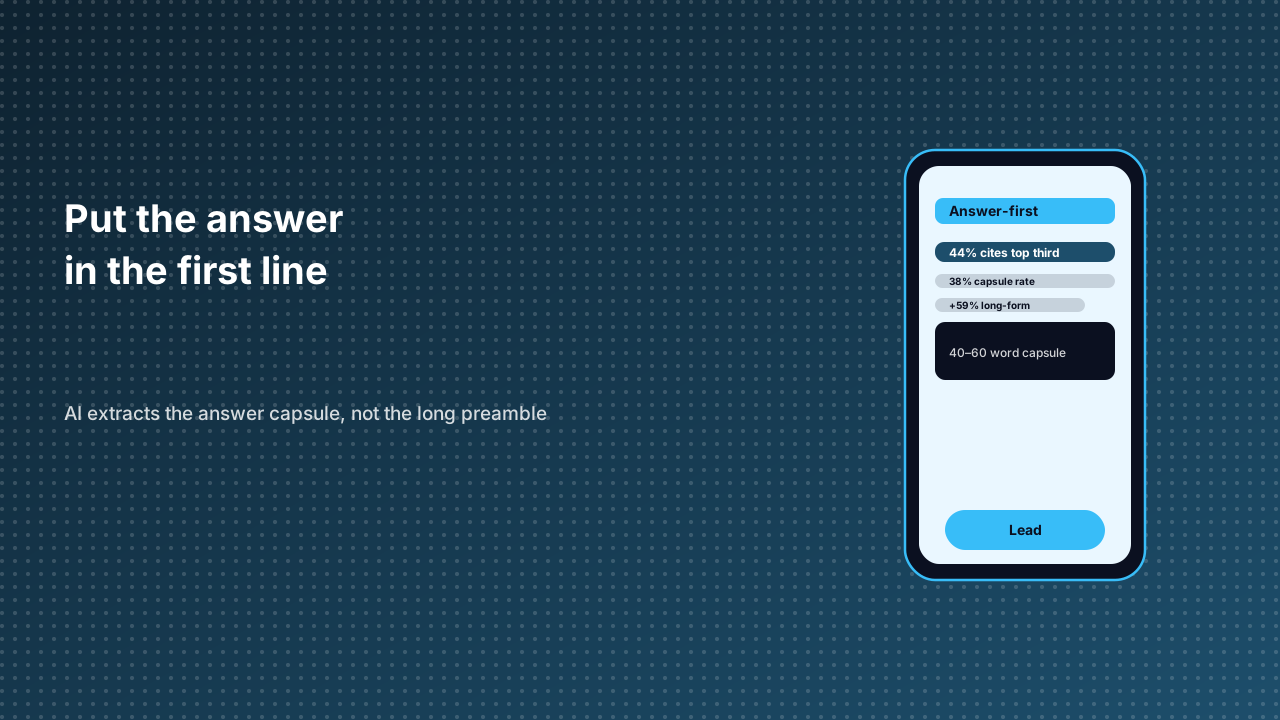
Kevin Indig's analysis of 18,012 ChatGPT citations across 1.2 million responses puts a number on the pattern. 44.2% of AI citations came from the first third of a page (AgentSite). Proximity to the top is not a stylistic preference; it is an extraction constraint. A sentence placed early is cheaper for a system to lift and safer to attribute, so it gets lifted.
That finding is why so much current advice collapses into one move: turn the heading into the question a person would actually ask, then answer it immediately. In the same line of analysis, the question-as-H2 plus a 40–60 word answer-capsule structure reached a 38% citation rate against baseline. A catalog entry stops being a brochure and becomes a quotable unit — a fact an engine can repeat without visiting.
What the research actually counted
Five findings, five different measuring sticks, and a few numbers that are easy to overread.
| Study | What was measured | Headline number | The fine print |
|---|---|---|---|
| Princeton / Georgia Tech GEO paper (KDD 2024, n=10,000) | Visibility lift inside generative answers; the only peer-reviewed controlled experiment in this area | Up to +40% visibility; sourced statistics +40%, citing credible sources +37%, fluency +15%, keyword stuffing +4% | Tactics split sharply — stuffing barely moves the needle |
| Kevin Indig, 2025 | 18,012 ChatGPT citations across 1.2 million responses | 44.2% of citations from the first third; question-as-H2 + 40–60 word capsule at 38% vs baseline | Observational, not a controlled trial |
| AirOps, 2025 | Passage shape in ChatGPT-cited pages versus Google's top result | 13.75 list-bearing passages per cited page vs under one; 79% use HTML lists vs 28.6% | Association, not a recipe |
| Industry studies (format) | FAQ schema, heading hierarchy, table count | FAQ schema pages 3.2x as likely in AI Overviews; clean H1>H2>H3 3.2x citation rate; 3+ tables +25.7% citations | Industry research, mixed methods — directional only |
| SE Ranking, 2025-11 (10,000+ pages) | Article length and section length against ChatGPT citation | 2,900+ word articles cited 59% more than under 800; 120–180 word sections 70% more than under 50 | One engine, one index |
Forty to sixty words is not a law of physics
The word count gets repeated as though it were physics. It is not. The 40–60 word capsule is a working convention among practitioners, roughly the size that fits inside an answer box, and nothing more. What the Princeton/Georgia Tech GEO paper actually established — the only peer-reviewed controlled experiment here, at KDD 2024 with n=10,000 — is that the tactics differ enormously. Statistics carrying sources added 40% to visibility, citing credible sources 37%, fluency 15%, while keyword stuffing managed just 4% (spawned.com). The lesson is not to hit a word count. It is to give the extractor something true and sourced that can be carried away intact.
And here is the uncomfortable trade-off. The same bluntness that makes a passage easy to quote can make an article unpleasant to read. A page assembled entirely from question-and-capsule pairs scans like a support queue: accurate, skimmable, and oddly soulless. Readers are still people. They arrive with half-formed questions and need a paragraph connecting the answer to a situation before they trust it. Structure the top for the machine, then earn the reader in the paragraphs underneath. Burying the answer fails the machine; flattening everything into capsules fails the human. The discipline is knowing which part of the page is doing which job.
The Indig and AirOps figures are observational as well. Pages that lead with a crisp answer may simply come from teams that also do everything else well. The structure is cheap to adopt and carries little downside, so it is worth doing — but it is not a guarantee, and anyone selling it as one is skipping the methodology.
Rewriting catalog entries around extraction
For a mini-program catalog the practical change is mechanical. Each entry becomes a question someone might genuinely ask, answered in one tight paragraph before the longer description begins. Lists replace prose wherever several facts sit side by side: AirOps found ChatGPT-cited pages carried 13.75 list-bearing passages on average while Google's top result carried fewer than one, and 79% used HTML lists against 28.6% (Aruntastic). Mid-length sections in the 120–180 word range outperformed very short ones, and comparison pages with three or more tables drew 25.7% more citations in industry research — a directional figure, not a controlled result (AEO Expert). Article length matters in the same way: SE Ranking's 2025-11 index of 10,000+ pages found pieces over 2,900 words cited 59% more often than pieces under 800.
None of this means padding to a threshold. Length helps because it gives an engine more surfaces to quote, not because a word count is itself a ranking factor.
One governed surface
The goal is not to write for machines at the expense of readers. It is to make the first paragraph do two jobs at once: answer the question plainly enough to be quoted, and open into a description a person wants to keep reading. CrossMiniApp's open catalog and shared runtime give a service one governed surface where that answer-first entry can be read, cited, and launched from wherever the answer is assembled. Word counts drift in and out of fashion. A clear answer at the top is the part that survives.