One checked box
One pre-ticked box, one subscription. In a controlled experiment, that single default moved the sign-up rate from 11.3% in the control condition to 41.9% in the aggressive condition — a jump of roughly 371%. No fresh argument, no sharper headline, no better paragraph of persuasion. Just a box that arrived already checked. The figure comes through a later evidence review, but the original study is Luguri and Strahilevitz (2021), and the point it makes is hard to shrug off: the interface closed the sale before a single word of copy got read.
What the pooled data says
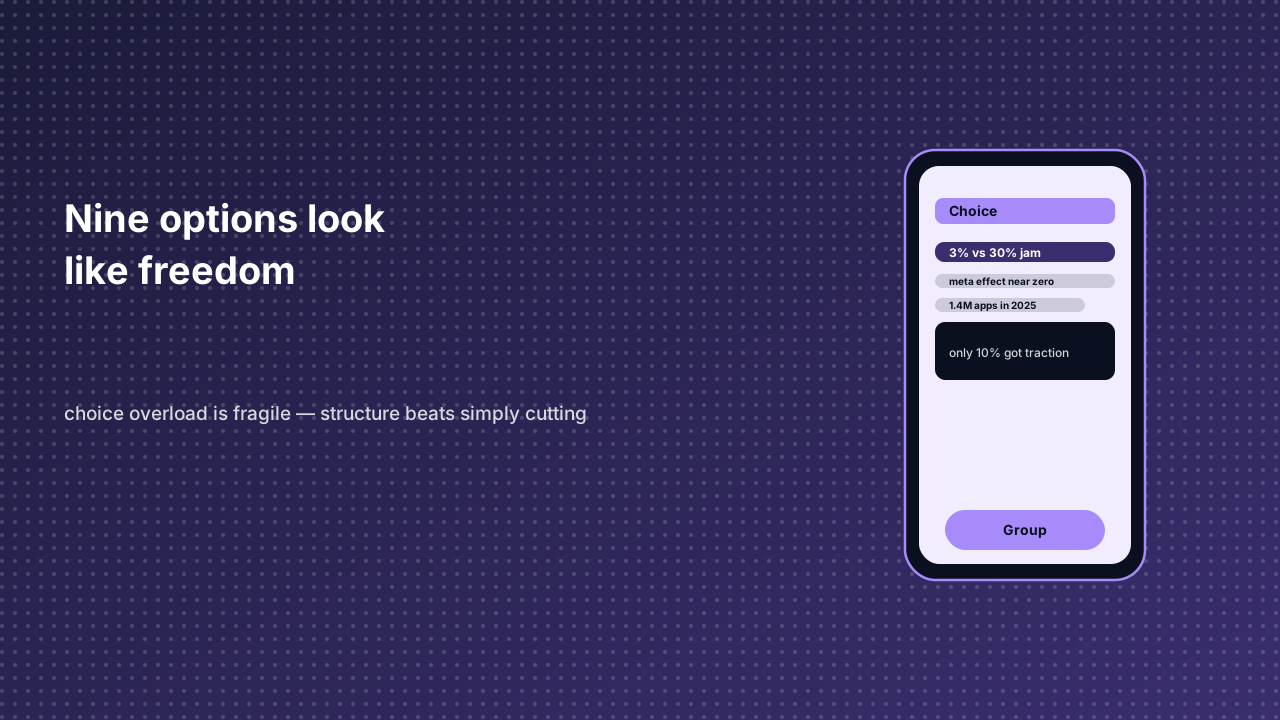
The uncomfortable fact for anyone who writes product copy is that the default keeps winning without saying anything. Jachimowicz, Duncan, Weber and Johnson (2019) pooled 58 studies with 73,675 participants and found a default effect of Cohen's d = 0.68 (95% CI 0.53–0.83). A separate summary of the same body of work expresses the effect as an odds ratio of about 3.5. Both descriptions circulate in the literature, and both reach this article through a secondary relay rather than off the original table — but the underlying source is the 2019 meta-analysis, not the relay. They are also not interchangeable: a standardized mean difference and an odds ratio answer different questions, so treating d = 0.68 and an odds ratio of 3.5 as two spellings of one statistic is a mistake.
A second meta-analysis, by Zhao and colleagues in Advances in Psychological Science (2022), pooled 56 papers and 92 studies covering 112,212 participants. Opt-out defaults outperformed opt-in ones at d = 0.59 (95% CI 0.47–0.71, p < 0.001). The authors also report a stronger effect in Western cultures and in monetary domains; that particular finding is a between-group comparison, so it is a correlation and should not be retold as a demonstrated cause.
| Design choice | Surface it touched | Observed result | Source and year |
|---|---|---|---|
| Pre-checked subscription default | Sign-up rate | 11.3% control → 41.9% aggressive (+371%) | Luguri & Strahilevitz, 2021 |
| Opt-out versus opt-in default | Consent and enrollment | d = 0.59 (95% CI 0.47–0.71) | Zhao et al., 2022 |
| Hidden post-trial price | Acceptance of the trial | 30.1% hidden vs 14.8% clearly shown | CMA evidence review, 2022 |
| Self-reported awareness | Whether consent was noticed | 33.4% said yes, 16.7% realized | CMA evidence review, 2022 |
| Default effect, pooled across studies | 58 studies, 73,675 people | d = 0.68 (95% CI 0.53–0.83) | Jachimowicz et al., 2019 |
Where leverage turns into liability
The acceptance numbers carry their own problem. When the post-trial price was not prominent, acceptance hit 30.1%; shown clearly, it fell to 14.8%. In the same line of work, 33.4% of participants answered "yes" when asked whether they had subscribed, yet only 16.7% realized the default had enrolled them. That gap is a self-report bias, and it is exactly the sort of evidence a regulator points to when it argues that consent was never informed.
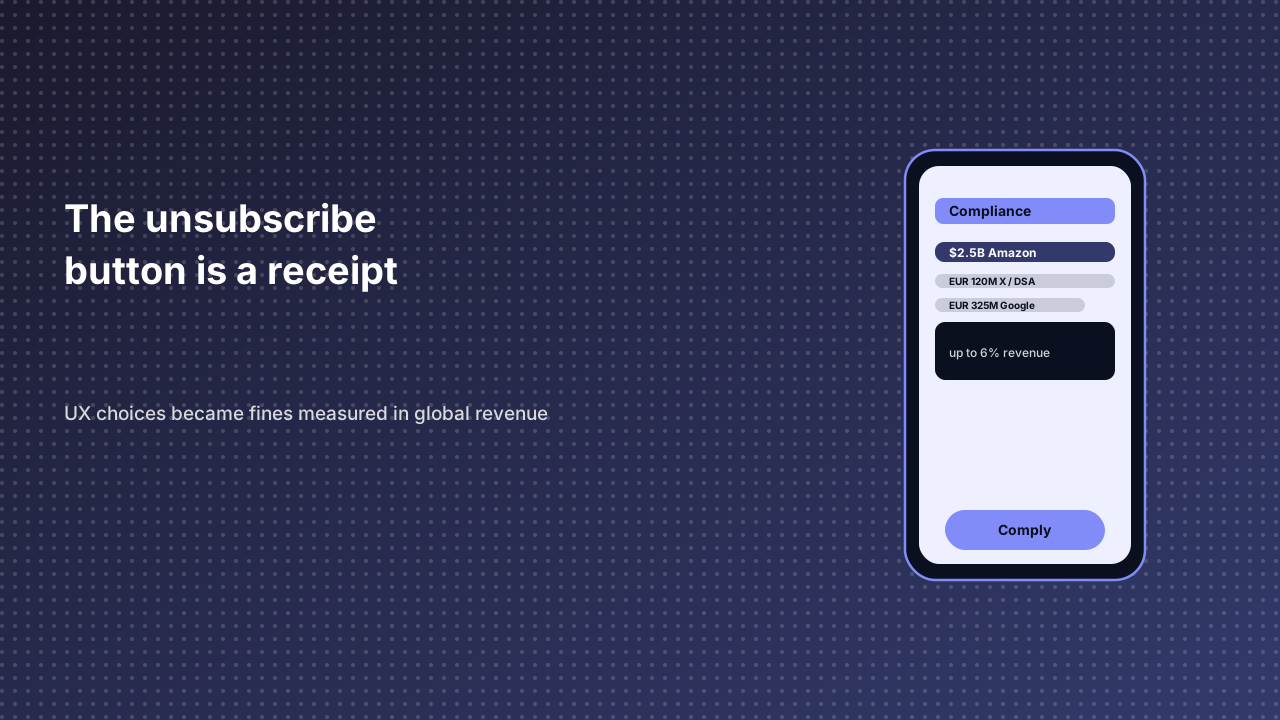
Regulators have stopped treating this as a matter of taste. EDPB Guidelines 03/2022 list six categories of dark pattern in social media interfaces, among them "Skipping" — pre-selected defaults — and "Too Many Options". Planet49 (CJEU, 2019) held that a pre-ticked box does not amount to valid consent. In the United States the FTC's Click-to-Cancel rule was vacated by the Eighth Circuit on 8 July 2025, but the agency kept enforcing under Section 5; the complaints it fielded climbed from about 42 per day in 2021 to more than 90 per day in 2025. A default that converts is no longer automatically a default that survives review.
The lever cuts both ways
A blanket ban would also be a mistake, because the same mechanism does genuine good. Opt-out organ-donation systems post registration rates above 90% — Austria around 99.3% — while opt-in systems sit below 30%, Germany near 12%. Yet actual transplant rates rise far less than those registration figures suggest, since signing a form is not the same act as donating. The honest reading is that defaults route behaviour powerfully but shallowly: they change the easy path, not necessarily the committed one. Even people who successfully resisted an aggressive design reported significantly more anger than those who simply complied, so the victory is not free when the default loses either.
What an open catalog should do with this
For an open catalog, the default is not neutral ground. A default sort order, a recommended-first tab, a pre-selected sharing toggle — each routes attention the way a pre-ticked box routes consent. Dimina runs a shared runtime in which thousands of miniature apps inherit the same surface, so a choice made once at the platform level propagates to all of them at once. That is a great deal of power disguised as a small piece of configuration.
The practical test is not whether defaults convert; d = 0.68 settles that. It is whether the exit is as short as the entrance. A catalog that can show the path back out in as few taps as the path in has a default it can defend. One that cannot is still asking the copy to take the blame for a decision the interface already made.