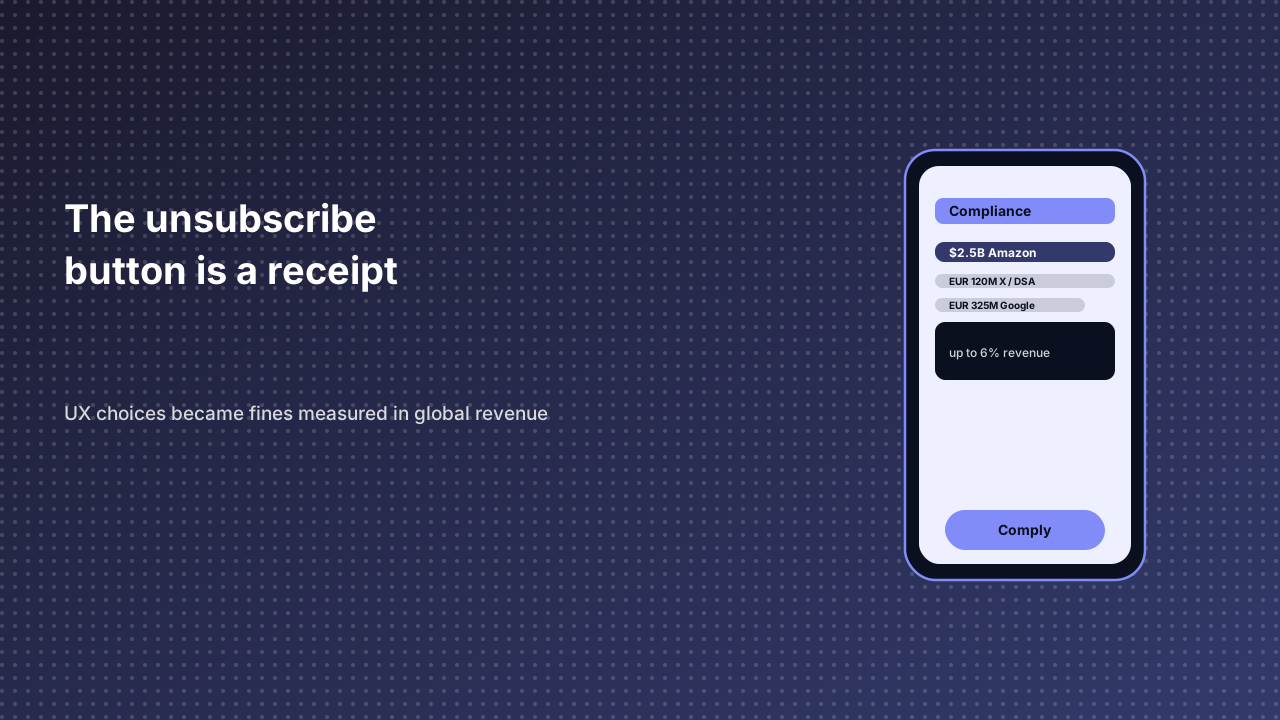
In September 2025 the Federal Trade Commission announced a $2.5 billion settlement with Amazon, the largest consumer-protection penalty in the agency's history. The number splits into $1 billion in civil penalties and $1.5 billion in refunds to roughly 35 million Prime subscribers, about $51 each. Two senior vice presidents were named as individual defendants, a detail that tends to concentrate the attention of anyone who signs off on a checkout flow. The case was not about a hidden fee or a defective product. It turned on the shape of a cancellation path, internally codenamed "The Iliad Flow," which the FTC described as lengthy and deliberately complex, stretching across multiple pages and repeated clicks.
The lesson landed with unusual force because it concerned something most design teams file under footnotes. An unsubscribe link is no longer a footnote. Across three continents during 2025, regulators converted interface details — default settings, consent banners, the relative prominence of accept and decline — into line items with nine-figure price tags. For a host embedding third-party mini programs, the cancellation path and the consent screen have stopped being pure UX questions. They are evidence, discoverable and quotable in a complaint.
Five data points, read together, sketch the boundary that now exists:
| Regulator and date | What was challenged | Finding | Penalty or ceiling |
|---|---|---|---|
| FTC, 2025-09 | Amazon Prime cancellation flow | Lengthy, deliberately complex path, codenamed "The Iliad Flow" | $2.5B ($1B civil penalty + $1.5B refunds), about 35M consumers |
| European Commission, 2025-12-05 | X blue checkmark design | Deceptive design; first DSA non-compliance fine | €120M |
| CNIL, 2025-09-01 | Google cookie consent | Violations across more than 74M accounts, 53M shown ads in breach | €325M (€200M + €125M) |
| CPPA, 2025-03-12 | Honda privacy choices | Choices presented asymmetrically; first dark-pattern enforcement under CCPA | $632,500 |
| DSA ceiling, FAQ updated 2025-12-19 | Platform obligations | Non-compliance plus periodic penalty payments | Up to 6% of global annual turnover; 5% of average daily turnover as periodic payments |
The ceilings make headlines, but the per-violation numbers matter more to a product team: the FTC's general civil penalty was adjusted to $53,088 per violation in 2025, while CPRA sets $2,663, rising to $7,988 when the breach is intentional or involves a minor. A defect repeated across a catalog is a defect multiplied.
Here the comfortable reading starts to fail. In July 2025 the Eighth Circuit vacated the FTC's Click-to-Cancel rule, finding that the agency had skipped a preliminary regulatory analysis. That sounds like a green light, and functions as the opposite. The Commission said enforcement would continue case by case under Section 5 of the FTC Act, ROSCA, and state law, and the Amazon settlement had already been assembled through precisely that machinery. A rule can vanish from the Federal Register while the theory behind it keeps producing settlements. Meanwhile the UK's CMA acquired direct enforcement powers in April 2025, with fines reaching 10% of global turnover, and opened its first DMCCA investigations on 18 November 2025. The direction of travel is toward more case law, not less.
The second trap is imagining that compliance means making the bad button ugly and hoping nobody finds it. That is simply a darker pattern wearing a lanyard. EDPB Guidelines 03/2022 name six categories of manipulative design, among them skipping pre-selected options and burying choices, and none of them depend on a conversion cliff to constitute a violation. The honest version is less theatrical: make the decline path as short as the accept path, keep the consent record, and let the product earn the subscription after the click instead of smuggling it in before. Aggressive designs do convert at remarkable rates, and the experimental literature is not in doubt on that point; the recoil is real too, and it arrives with the renewal cycle. Short-term gain and long-term liability are not opposing abstractions here. They sit on the same ledger.
That is what makes this a runtime problem rather than a legal memo. A host rarely authors every consent screen it serves, but it does decide which third-party flows receive distribution and which cancellation paths stay reachable after launch. An open directory that treats the unsubscribe route as a first-class surface — versioned, testable, as observable as onboarding — turns a compliance artifact into a property of the shared runtime instead of a last-minute fire drill. Cross Mini App keeps that surface in the open catalog for exactly this reason. What survives a regulator's screenshot is a flow whose behavior can be inspected and reproduced on an ordinary Tuesday, long after the launch deck has been forgotten.
Sources
- FTC — Historic $2.5 billion settlement with Amazon — September 2025; civil penalty, refunds, and the cancellation-flow findings.
- European Commission — DSA non-compliance decision on X — December 2025; the first fine issued under the Digital Services Act.
- CNIL — Google fined €325 million over cookies and advertisements — September 2025; consent and ad insertion between emails.
- CPPA — Honda settlement announcement — March 2025; first CCPA enforcement centered on asymmetric privacy choices.