

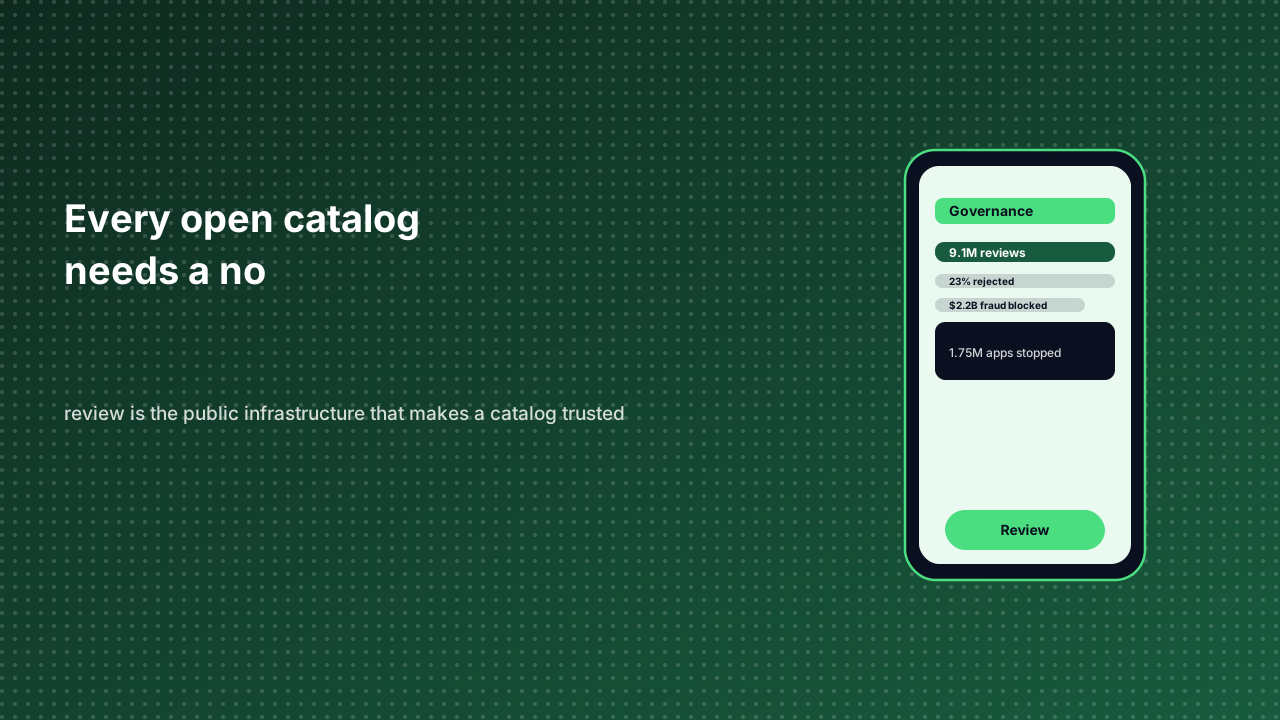
Apple's 2025 transparency report contains a number that platform operators tend to skip past. Of 9,100,620 app submissions reviewed that year, 2,093,244 were rejected — roughly 23 percent, down from 24.9 percent twelve months earlier. A further 387,087 submissions were rejected and then approved after appeal. That second figure matters more than the first. It says the gate is not a wall but a decision that can be reversed when it is wrong. A catalog that advertises itself as accepting everything is seldom truly open. It is unmanaged, and the bill for that arrives later, usually as a loss of trust that nobody can trace back to a single policy meeting.
The reflex in platform design is to treat openness as the absence of a gate. Remove review, let anyone list, and variety is supposed to follow on its own. The two largest app stores make that argument difficult to sustain. Apple refused more than 138,000 developer registrations and terminated 193,000 developer accounts in 2025, while turning away 1.1 billion attempts to create fraudulent accounts and blocking over 2.2 billion dollars in fraudulent transactions, against 11.2 billion dollars across six years. Google blocked more than 1.75 million non-compliant apps before they could be published, banned over 80,000 malicious developer accounts, and stopped 255,000-plus apps from collecting sensitive data beyond their stated purpose. None of these are vanity figures. They are the operating cost of a catalog that people are still willing to open.
| Review stage | The decision being made | Reported 2025 figure |
|---|---|---|
| Pre-listing submission | Whether an app ships at all | 9,100,620 reviewed, 2,093,244 refused |
| Post-refusal appeal | Whether a refusal was wrong | 387,087 approvals after rejection |
| Developer identity | Who is allowed to publish | 138,000 registrations, 193,000 accounts cut |
| Runtime scanning | What runs beyond the storefront | more than 350 billion apps scanned daily |
| Shelf quality | What stays visible in search | 195 million fraudulent reviews blocked |
Scale changes what governance is for. A catalog holding 2,172,472 apps took down 166,899 of them in one year, which is the quiet work behind any list that stays useful. Google Play Protect scans over 350 billion Android apps a day and identified more than 27 million new malicious apps outside the Play store in 2025, up from 5 million in 2023 and 13 million in 2024, while blocking 266 million risky installs. Inside the store, 1.3 billion ratings and reviews were processed, nearly 195 million fraudulent ones were blocked, 7,800 apps were pulled from search results and 11,500 from ranking charts. Discovery is a governance outcome, not a ranking algorithm. Where fake reviews and install farms are cheap, the best app loses to the loudest one, and users leave without ever filing a complaint.
Large-scale review is not a clean victory, and pretending otherwise would be dishonest. A 23 percent rejection rate also measures friction, and 387,087 overturned decisions are 387,087 first decisions that got it wrong. Strict gates have a well-documented edge effect: they favour teams with compliance staff and squeeze out hobbyists, quietly shrinking the variety that made an open catalog worth browsing in the first place. There is a more awkward point underneath. The operator that refuses a bad app also decides which apps get seen, and a system strong enough to remove 166,899 listings is strong enough to shape a market by accident. Refusal is necessary. Concentrating the power to refuse in one place, with no independent check on how that power is used, is a separate question that catalogs rarely put on the agenda.
One more objection deserves a hearing. Review numbers are impressive precisely because they are enormous, but enormous numbers can hide a slow decay in judgment. If a catalog starts measuring the team by how many apps it rejects, refusals become a target rather than a conclusion, and the appeals queue turns into the only place where good decisions survive. The healthy version treats rejection as a byproduct of clear rules, not as a score. That distinction is hard to see from outside a storefront, which is why the rules themselves need to be legible to anyone building against the catalog.
An open catalog that spans hosts cannot outsource that judgment to any single storefront. The refusal has to live at a layer every participant shares: a package signed at submission, an identity that can be revoked without waiting for a release, and an appeal path a host can audit rather than take on faith. Cross Mini App works at that layer, a shared runtime where the decision to say no travels with the app instead of expiring at one download page. The useful kind of openness is a gate with visible rules, reversible mistakes and authority that no single host holds on its own. Someone always says no. The only real choice is whether that someone answers to everybody.
Sources
- Apple 2025 App Store transparency report — submission volume, rejection rate and appeal approvals for the year.
- Apple's 2025 fraud prevention figures — blocked transactions, account rejections and terminations.
- Google on keeping Play and Android safe in 2025 — apps blocked before publication and malicious accounts banned.
- Google Play security report 2025 — daily scanning scale and malicious apps found outside the store.


