
The H5-in-app trap
You built a service as an H5 page because the web is universal. Then a partner app wants to embed it. So you wire it into a WebView, hand-roll the JS bridges for login and payment, and ship it inside their next release. Six months later three problems never go away:
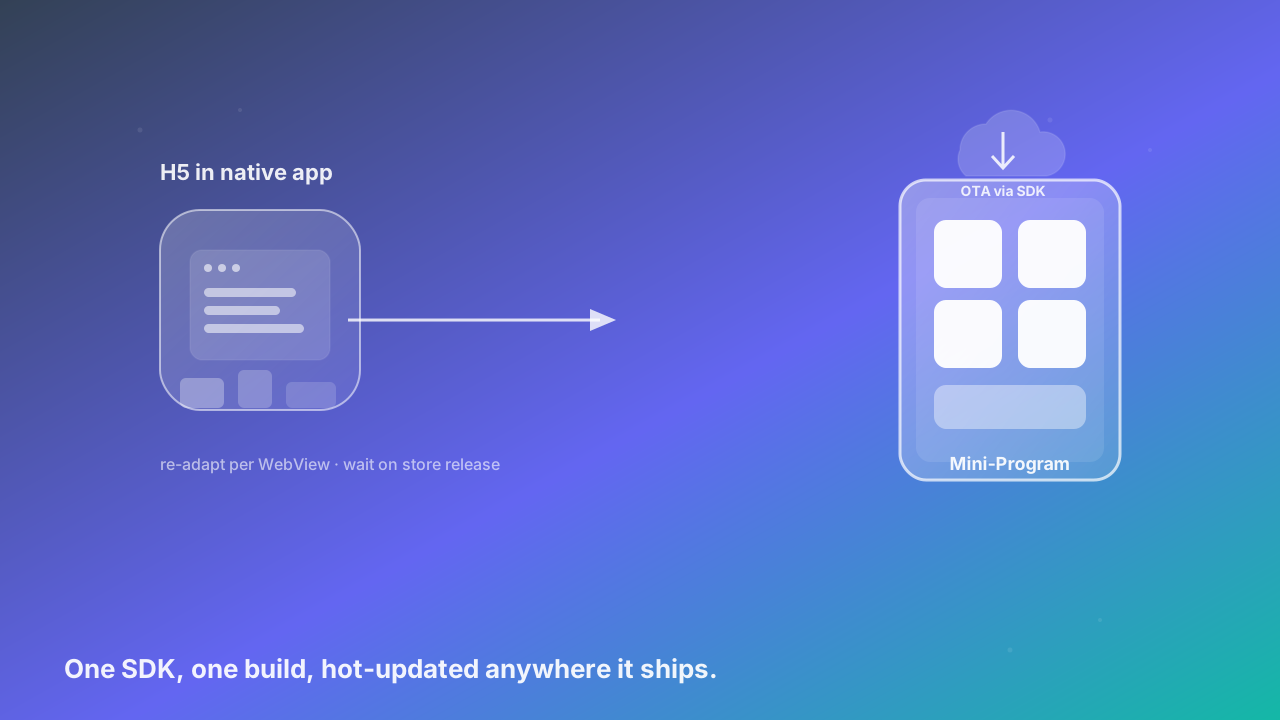
- Multi-end adaptation. Every host app brings its own WebView kernel — iOS WebKit, Android System WebView or Chrome, vendor forks — plus its own screen sizes, OS versions, and bridge quirks. A fix that works in one embed breaks in another, and you re-test per surface.
- Release-train coupling. Any content, copy, or flow change has to ride the host's native release, which means app-store review, staged rollout measured in days or weeks, and a rollback that is itself another release.
- Policy exposure. Apple's App Store Review Guideline 4.2 rejects apps that are essentially a repackaged website, and 2.5.2 bars apps from downloading or executing code that changes their functionality; Google Play similarly forbids apps from modifying their binary outside Play's update mechanism (Apple guidelines, Google Play policy). A bare WebView shell that pulls remote logic sits right in that danger zone.
The result is that the fast, cheap web surface you wanted becomes the slowest, most fragmented thing you ship.
What actually changes the equation
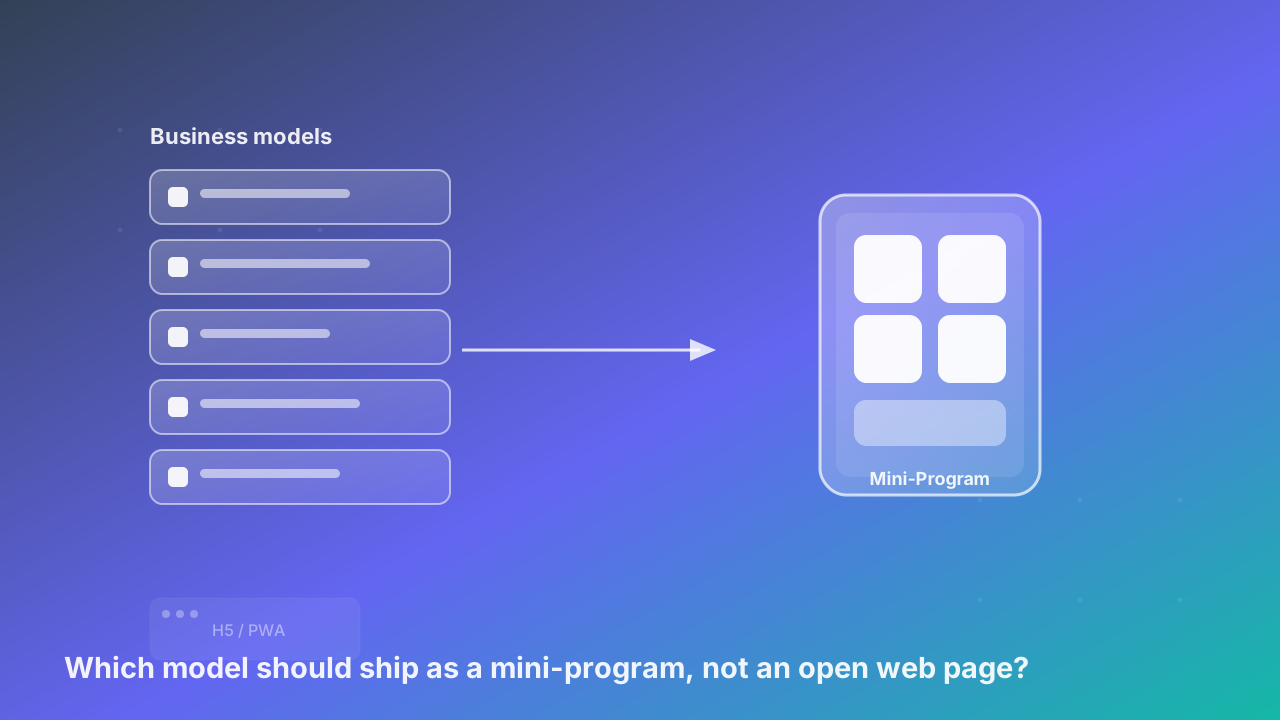
The fix is not a better WebView. It is changing what you embed and how it updates. Cross Mini App ships your web content as a governed mini-program that lives inside a universal runtime, integrated by the host through a single SDK, and updated over the air through that same SDK — no app-store release required for the content layer.
The SDK integration model
A host app integrates the Cross Mini App SDK once. From that point the runtime — not the host's engineers — absorbs the differences that used to be your problem:
- Identity and payment are inherited from the host. The mini-program receives a verified identity token and calls the host wallet in-context, instead of you building a per-platform bridge.
- Device and native capabilities are exposed through a governed bridge. Where a raw WebView makes you hand-roll Objective-C, Swift, or Kotlin bindings per platform, the SDK presents a single, sandboxed interface.
- One build, many hosts. You write the mini-program once against a standard API surface; it runs inside any integrating app that ships the SDK. The multi-end rework collapses from N hosts to one.
This is the structural opposite of H5-in-native: instead of you adapting your web code to each app, the runtime adapts the host to your program.
Over-the-air hot updates
The second half of the model is where the release-train problem disappears. Because the mini-program's logic and assets are delivered through the SDK, a change ships as an OTA update:
- No store review for content and features. Copy, layout, flows, and even logic updates push directly to the runtime. The native app version that carries the SDK does not have to move.
- Staged rollout and instant rollback. You can release to a percentage of users and pull the update in seconds if telemetry turns red — not by submitting a new binary.
- Differential delivery. Only changed chunks are fetched, keeping payloads small; a service-worker-style cache keeps the last good version available offline (MDN — Service Worker / Cache, web.dev).
- Version pinning and fallback. Each host can pin a known-good version; if an update fails to apply, the runtime falls back rather than breaking the embed.
The mental shift: the native release becomes a rare, infrastructure-level event, while the product surface iterates on its own clock.
How the SDK governs the program
Hot updates only work if they are safe. The SDK keeps the mini-program inside a sandbox and under vendor review:
- The program is audited and revocable — a host can take down a bad version without waiting on a store.
- It runs under policy rules aligned with the sanctioned models platforms already allow: Apple's Guideline 4.7 explicitly permits HTML5 and JavaScript mini-apps delivered outside the binary, provided the developer owns compliance; Google's Play policies govern what an embedded surface may do (Apple 4.7). The SDK's governance is what keeps an OTA update inside those lines instead of tripping 2.5.2.
- Capabilities are brokered, not open — the program reaches native payment and identity only through reviewed SDK endpoints.
Side-by-side
| Dimension | H5 embedded in native app | Cross Mini App SDK mini-program |
|---|---|---|
| Adaptation cost | Re-test per WebView / OS / bridge | Write once, runtime adapts |
| Release coupling | Bound to app-store release | OTA, decoupled from native train |
| Rollout speed | Days to weeks (review plus rollout) | Minutes to hours (staged) |
| Rollback | Another binary submission | Instant, inside the SDK |
| Policy risk | 4.2 / 2.5.2 / Play self-update | 4.7-sanctioned HTML5 mini-apps |
| Multi-host reuse | Rewrite per host | One build, many hosts |
Where it pays off first
The pattern is strongest for surfaces that iterate constantly and depend on trust: fintech and embedded finance (copy, offers, and flows change weekly), government and utility services (forms and eligibility rules update often), and retail and campaign pages (seasonal, A/B-tested). In each, the cost of riding a native release train is paid over and over; the SDK model pays it once.
Where Cross Mini App fits
Cross Mini App is the universal runtime plus the open catalog, delivered to host apps through one SDK. Your web content becomes a governed, hot-updatable mini-program: embedded anywhere the SDK ships, inheriting host identity and payment, updated over the air without a store release, and revoked in seconds if needed. For teams tired of re-adapting H5 for every WebView and waiting on every app release, that is the unit that finally decouples the web's speed from the native release's drag.