
"¿Me Nequi?" — In Bogotá, splitting a bill or paying a taxi often ends with those two words. Nequi and Daviplata have become the default wallet for tens of millions, yet sending money between them used to mean friction. That changed with Transfiya — and that combination is exactly why Colombia is such natural soil for mini-programs.
The opportunity is not another standalone banking app nobody will install. It is a lightweight program that rides Transfiya's open rail inside the closed hosts Colombians already live in — Nequi, Daviplata, Rappi — and reaches the unbanked without forcing them through a native-app wall. And it is governable, because the regulator is writing the rules, not chasing them.
The six dimensions, scored on Colombian ground
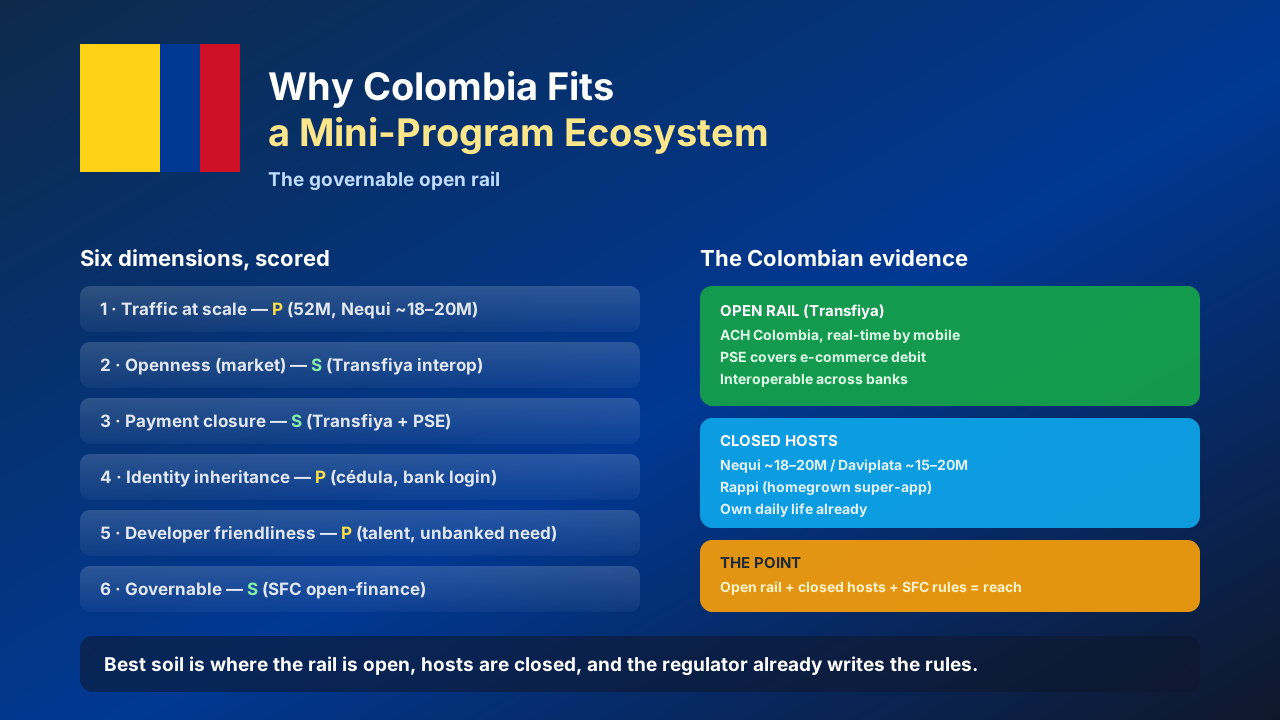
1. Traffic at scale. Colombia has ~52 million people, high smartphone and internet penetration, and a young, urban, digitally active population. Nequi alone reports ~18–20 million users; Daviplata ~15–20 million. A daily-attention market — if smaller than Brazil or Mexico.
2. Openness, at the market level. Transfiya — the interoperable instant-payment rail run by ACH Colombia — lets any participating wallet move money in real time by mobile number. PSE handles online bank-debit for e-commerce. The rail is genuinely open and interoperable.
3. Payment closure. A mini-program inherits Transfiya plus PSE plus the host wallets. Real-time, low-cost settlement is already live across the banking system.
4. Identity inheritance. This is the moderate link. The cédula (national ID) is near-universal, but mini-app login still leans on wallet or bank credentials rather than a single universal handoff. Workable, not yet WeChat-class.
5. Developer friendliness. A strong Spanish-speaking engineering community, a dense fintech hub in Bogotá and Medellín, and high app-fatigue among the unbanked make lightweight distribution the obviously right call.
6. Governable. The SFC (Superintendencia Financiera de Colombia) is actively building the open-finance framework, with KYC, consumer protection, and even government subsidy disbursement (e.g. through Daviplata) already enforced. A younger but serious rulebook.
| Dimension | Score | Colombian evidence |
|---|---|---|
| Traffic | P | 52M people, Nequi ~18–20M / Daviplata ~15–20M |
| Openness | S | Transfiya interoperable rail, PSE |
| Payment | S | Transfiya + PSE + host wallets |
| Identity | P | cédula, wallet/bank login |
| Developer ease | P | Strong talent, unbanked need |
| Governance | S | SFC open-finance, KYC, subsidies |
Why the "governable open rail" is the whole point
Colombia pairs an open, interoperable payment rail with a regulator that is deliberately writing the open-finance rules ahead of adoption. Closed hosts (Nequi, Daviplata, Rappi) already own daily life. A universal runtime that rides Transfiya inside those hosts is the cheapest path to reach the unbanked and underbanked — without the native-app wall.
The CrossMiniApp angle
CrossMiniApp is a universal runtime plus an open catalog. You build the mini-program once and it runs inside Nequi, Daviplata and Rappi surfaces — inheriting each host's identity and payment, sandboxed and governable, updatable over the air. Colombia's governed-open-rail structure is the argument: the rail is open, the hosts are closed and ready, and the value is in a runtime that reaches users under a rulebook that already exists.
The rule
The best mini-program soil is where the rail is open, the hosts are closed, and the regulator is already writing the rules. Colombia checks all three.