
Most of the world reads China's mini-program story through games and shopping carts. But the quiet workhorse is the category that asks the least of the local environment: content and tools. A phone top-up, a bill payment, a translation, a document, a book — opened in one tap, finished in one tap, no app install, no account, no payment setup. This is the most borrowable pattern in the entire stack, because it depends on almost nothing but a runtime and some content.
Why content & tools is the purest borrow
Games need content production. Social commerce needs a payments rail. Government services need a national ID. Content and tools need none of these to function. A calculator, a translator, a top-up flow, a reading app — they are pure logic plus rendering. That is exactly what a universal runtime is built to host.
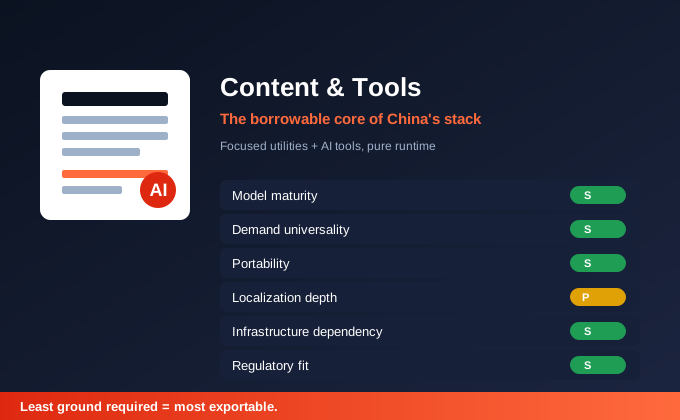
| Dimension | Rating | What the evidence says |
|---|---|---|
| Model maturity | S | 949 million WeChat mini-program users in 2024, ~70 sessions per user per month; phone top-up leads the TOP50 at 740M MAU, bill payment 490M, Tencent Docs 200M+, WeChat Reading 210M+ registered across 200+ countries |
| Demand universality | S | Every market needs focused utilities — top-up, bill pay, translate, docs, reading, knowledge — regardless of income level |
| Portability | S | Pure logic and rendering; basic tools run before any local rail or identity system exists |
| Localization depth | P | Reading and knowledge content must be localized; AI tools need local language models and cultural tuning |
| Infrastructure dependency | S | Only a runtime and content; no payments, logistics or national ID required for core functions |
| Regulatory fit | S | Basic utilities need no financial license and no cross-border data flows |
The three moves worth copying
- One tap, one job. The highest-traffic mini-program in China is a single-purpose phone top-up at 740 million monthly users. The lesson: ship a focused utility that does one thing instantly, not a Swiss-army app.
- Content as a runtime. WeChat Reading (210M+ registered) and Tencent Docs (200M+ MAU) proved that books, documents and knowledge can live entirely inside a mini-program — no install, instant resume across devices. Content becomes a service, not a download.
- AI-native tools. China's AIGC-native apps reached ~80 million users in 2024; Alibaba's Tongyi platform hosts 16,000+ agents; Alipay's Zhixiaobao AI assistant reached 59.7 million ecosystem users. The runtime is becoming an AI agent host — translation, writing and search happen inside the mini-program, on demand.
The CrossMiniApp angle
A universal runtime makes focused content and tools available to anyone, anywhere. A small business, a school, a publisher — each can ship a single-purpose utility or an AI tool at near-zero cost, and the open catalog distributes it across markets. Write once, and the same runtime serves a top-up in one country and a reading app in another. That is the universal-runtime-plus-open-catalog thesis applied to the most portable category of all.
The rule
The most exportable software is the software that needs the least from the ground it lands on. Content and tools proved it at 949 million users; a universal runtime can reproduce it on any shore.