
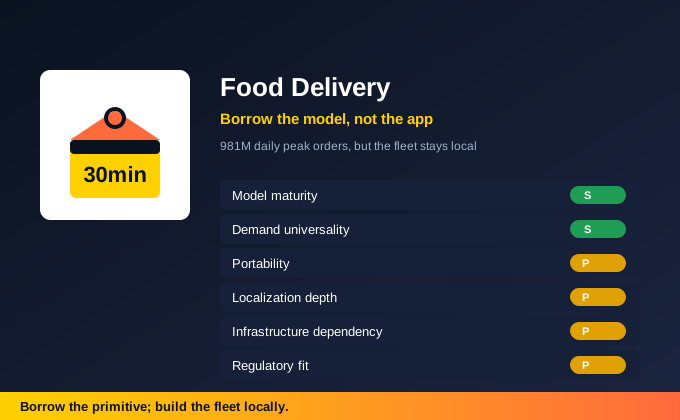
The world's most advanced on-demand delivery machine is in China. Meituan alone peaked at 98 million delivery orders in a single day — the "Start of Autumn" food festival — and China's instant-retail market reached 781 billion RMB in 2024, up 20%. But this is also the category where "copy China" fails hardest if you copy the wrong layer. The app is unrepeatable. The model is gold.
Why food delivery is the hardest P-level
Games travel on a runtime. Social commerce travels as a pattern plus a local rail. Food delivery and instant retail sit at the opposite end: the value is built on the ground, not in the code. The right move overseas is to borrow the software pattern — request, dispatch, track, pay, rate — and rebuild the physical layer locally: merchants, riders, geography, payment.
| Dimension | Rating | What the evidence says |
|---|---|---|
| Model maturity | S | Meituan 2024 revenue 337.6B RMB (+22%); 770M annual transacting users; 14.5M active merchants; 48.28B on-demand delivery orders in 2024; instant-retail market 781B RMB (+20.15%) |
| Demand universality | S | Every dense urban market wants 30-minute convenience; emerging markets are leapfrogging straight to on-demand |
| Portability | P | The operational stack — rider network, geo-grid, merchant acquisition — is local and does not transfer across borders |
| Localization depth | P | Must rebuild merchant supply, rider fleet, local geography and local payment rail for every market |
| Infrastructure dependency | P | Requires a dense merchant network, a delivery fleet, geo-mapping and a payments rail to function at all |
| Regulatory fit | P | Gig-worker labor rules, food-safety licensing and data-localization differ by country and are rarely portable |
The three moves worth copying
- On-demand fulfillment as a runtime service. The dispatch loop — request, assign, track, pay, rate — is pure software. Host it inside a universal runtime and plug in any local fleet, instead of cloning the asset that took Meituan a decade and a million riders to build.
- The dark-store supply node (闪电仓). A ~200m² micro-warehouse holding 6,000–10,000 SKUs and doing 30-minute delivery. China already runs 30,000+ of them, with a plan to pass 100,000 by 2027. That is a replicable local supply blueprint, not a Meituan-specific trick — any market can seed its own nodes.
- Marketplace mechanics inside the runtime. Two-sided merchant onboarding, dispatch, ratings and subsidy logic are the borrowable engine. Run them on local rails — local merchants, local riders, local payment — so the catalog carries the pattern while each market supplies the fleet.
The CrossMiniApp angle
A universal runtime plus an open catalog lets a local operator ship a fulfillment mini-program that runs on top of that market's own delivery fleet and payment rail — the Meituan logic without the Meituan asset. This is exactly the "universal runtime + open catalog" thesis in its hardest test: the catalog carries the proven pattern, and each market contributes its own rails. The runtime constrains what third-party code can do; the catalog distributes the fulfillment pattern; the local fleet does the rest.
The rule
The most valuable thing China proved here is not an app — it is that on-demand fulfillment can be a software primitive. Borrow the primitive. Build the fleet locally.