
Walk into a corner padaria in São Paulo and the owner scans a PIX QR from their personal account — no card machine, no fee, settled instantly. Brazil did something no rich economy managed: it built a central-bank real-time rail, made it free, and opened it through APIs. That is why the country is the single best soil for mini-programs outside China.
The opportunity is not another banking app. It is a lightweight program that opens inside WhatsApp or a wallet, already logged in via CPF, already able to pay through PIX — and distributed through the one app every Brazilian already has open.
The six dimensions, scored on Brazilian ground
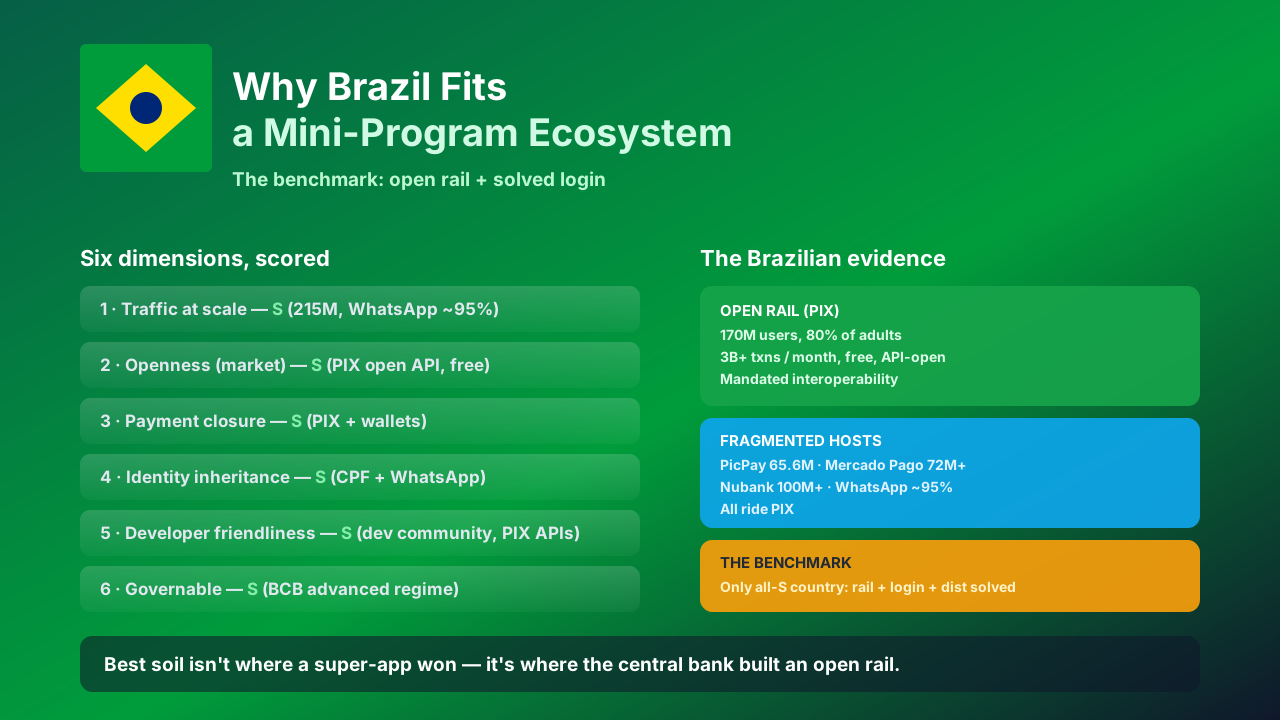
1. Traffic at scale. Brazil has 215 million people, 88% smartphone penetration, and WhatsApp coverage near 95% of the population. That is daily attention at a scale few markets match.
2. Openness, at the market level. This is the differentiator. PIX, run by the Banco Central do Brasil, is instant, free, and API-open, with mandated interoperability across every bank and wallet. The rail is open by design and by regulation — the opposite of the closed-host pattern elsewhere.
3. Payment closure. A mini-program inherits PIX plus PicPay (65.6 million users in 2025), Mercado Pago (72 million-plus across eight countries, ~40% of e-commerce wallet share), or Nubank (100 million-plus). Real-time, zero-fee settlement is the default.
4. Identity inheritance. This is Brazil's quiet superpower. The CPF is a universal tax ID every adult has, and WhatsApp is near-universal — so a mini-program opened through either starts pre-authenticated. Closer to the WeChat class than any market we have scored.
5. Developer friendliness. A large, Portuguese-speaking engineering community and mature API culture make builds cheap and well-supported. PIX's open APIs mean a developer can wire payment in days, not quarters.
6. Governable. The BCB runs one of the world's most advanced real-time payment regimes, with KYC, licensing, and fraud monitoring enforced rigorously. A sandboxed, takedown-capable runtime fits cleanly inside it.
| Dimension | Score | Brazilian evidence |
|---|---|---|
| Traffic | S | 215M people, 88% smartphone, WhatsApp ~95% |
| Openness | S | PIX open API, free, interoperable |
| Payment | S | PIX + PicPay / Mercado Pago / Nubank |
| Identity | S | CPF + WhatsApp, pre-auth |
| Developer ease | S | Large dev community, PIX APIs |
| Governance | S | BCB advanced regime |
Why Brazil is the benchmark
Every other market on this list pairs a strong rail with closed hosts. Brazil paired a strong rail with an open one — and then handed developers the APIs. For a universal runtime, that is the cleanest possible soil: the identity, the payment, and the distribution are all already solved, and the regulator already knows how to govern a real-time ecosystem.
The CrossMiniApp angle
CrossMiniApp is a universal runtime plus an open catalog. You build the mini-program once and it runs inside WhatsApp, Mercado Pago, and the wallet surfaces — inheriting each host's identity and payment, sandboxed and governable, updatable over the air. Brazil's open-rail structure is the argument: when the rail is already open and the login already solved, the value is in a runtime that reaches every host without rebuilding the ecosystem each time.
The rule
The best mini-program soil is not where a super-app won. It is where the central bank built an open rail — and in Brazil, that rail is PIX.