
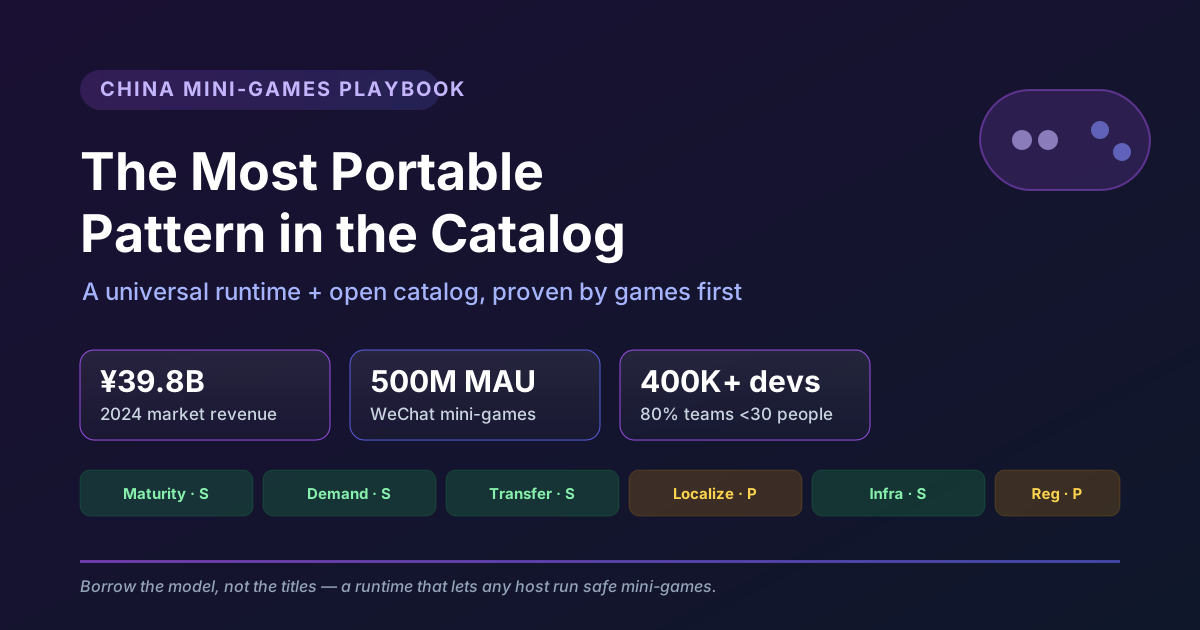
China's mini-program story is usually told as a payments or commerce story. The quieter, more important lesson for the rest of the world is the mini-game. In 2024 the domestic mini-game market reached RMB 39.8 billion in revenue, up 99% year over year, with RMB 27.4 billion from in-app purchases alone. WeChat mini-games alone report 1 billion cumulative users, 500 million monthly actives and 100 million daily actives. More than 400,000 developers have shipped on the platform, over 80% in teams of fewer than 30 people.
Why does this matter outside China? Because mini-games are the category that depends least on local infrastructure. They need a runtime, a screen, and a way to bill — not a merchant network, not a logistics layer, not a national ID, not a local payment rail. That makes them the cleanest canvas to port, and the strongest evidence that a universal runtime plus an open catalog is a real business, not a theory.
Six dimensions, applied to mini-games
| Dimension | Rating | Why |
|---|---|---|
| Model maturity | S | Proven at RMB 39.8B scale, 500M MAU |
| Universal demand | S | Play is human; casual and social formats cross cultures |
| Transferability | S | Pure logic + rendering; no host-specific graph required |
| Localization intensity | P | Art, language, themes and monetization need tuning |
| Infrastructure dependence | S | Only a runtime + IAP/ad SDK; no rails to swap |
| Regulatory fit | P | Age ratings, gacha/loot-box and ad-to-minor rules vary |
What actually transfers
The takeaway is the model, not the titles. Three mechanics proven in China are worth borrowing everywhere:
- Instant play. No install, no app-store wall. A tap opens the game. This is the single biggest adoption lever and it is pure runtime behavior.
- Social distribution. Shared links, group challenges and revive mechanics turn players into a distribution channel. You need a local social host to recreate it, but the pattern is host-agnostic.
- Hybrid monetization. In-app purchases plus rewarded ads. In China IAP is 68.7% of revenue and ads 31.3%; overseas you may weight that mix by market, but the dual engine is the lesson.
What to localize
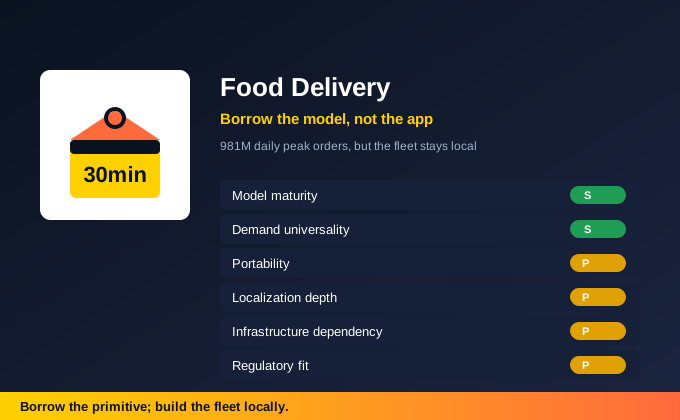
Mini-games are light to localize compared with delivery or government services, but not free. Expect to redo: art and copy for language and cultural fit; theme and narrative for local taste (what works in one market can feel generic elsewhere); the monetization mix (IAP-heavy in paid markets, ad-heavy where willingness to pay is lower); and compliance — age ratings, gacha-disclosure and advertising-to-minors rules differ by jurisdiction and must be designed in, not bolted on.
The runtime is the real export
None of this works without a safe way to run untrusted game code inside a host. China's lesson here is the sandbox: game logic runs in an isolated JavaScript context, network calls go only to reviewed domains, storage is namespaced per app, and sensitive APIs are gated. That is exactly what a universal runtime like CrossMiniApp provides — which is why mini-games should be the first wave in any open catalog aimed at the fragmented markets we profiled.
The rule
The world doesn't need China's games. It needs China's proof that instant, safe, viral mini-games scale — and a runtime that lets any host run them.