
The store became a line of code
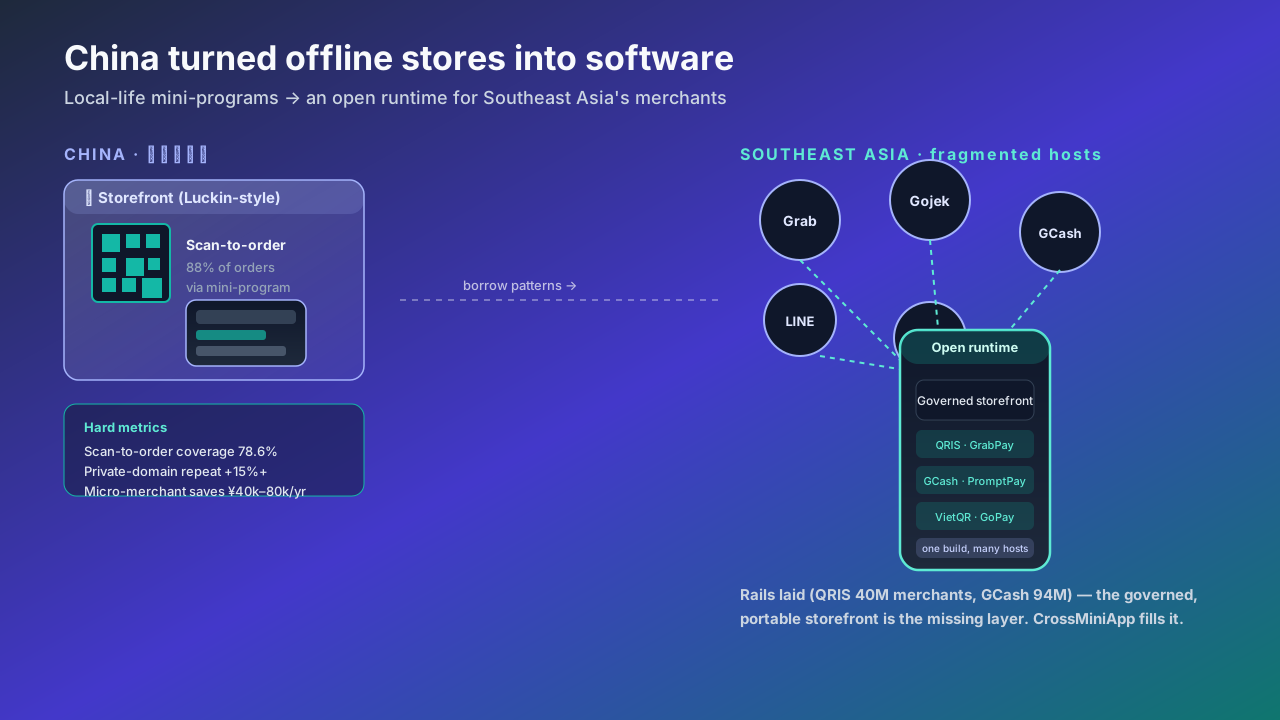
China's local-life economy did not move online by asking people to install more apps. It moved into the host. In 2025 China's local-life services market reached about ¥35.3 trillion, with online penetration near 31%, while the restaurant sector alone took in ¥5.8 trillion and counted 42% of that as digitally enabled. The physical layer — scan-to-order coverage at 78.6%, online ordering penetration at 91.7%, mobile payment usage at 98.7% — is now the default, not the upgrade.
Three plays that turned offline into software
Not every merchant digitised. The ones that did share a shape.
| Play | Standout | Hard metric | Pattern that won |
|---|---|---|---|
| Scan-to-order as infrastructure | Luckin Coffee | 2024 revenue ¥34.5B (+38.4%), ~20,000 stores; mini-program/app order share 88% (2024, up from 52% in 2021); ~45% pick-up orders; app MAU 45M; ~20M private-domain users on WeCom; repeat rate >28% | Cashier-less entry; store traffic digitised at near-zero marginal cost |
| Private-domain membership & repeat | Luckin / chain F&B | Digital ordering users repurchase 4.2×/month vs 1.8× offline; membership-enabled scan-to-order lifts repeat another 15%+ | Host graph + wallet turn one visit into a recurring relationship |
| Instant retail & in-store booking | Meituan / Yonghui / JD Daojia | Meituan in-store orders +40% YoY in Q2 2025; Yonghui online orders 35%, 30-min delivery 68% | Lightweight host-resident entries for pickup, delivery, booking |
Two rows carry hard, citable numbers (Luckin); the instant-retail row is described at the pattern level because the chains do not publish per-mini-program GMV — but the mechanism is identical and equally instructive.
China's secret: it was never the app
Strip away the Chinese context and the real engine is a three-part stack inside a trusted host:
- Zero-install, scan-to-use. A table QR code replaces a menu and a cashier. Trying a service costs a tap, not an install.
- Inherited identity and payment. The program inherits the host's verified wallet. No re-entered card, no cold-start onboarding.
- Private-domain data + platform governance. Every order is a data point; the program updates in days and can be taken down at the platform level — a property both regulators and users trust.
For micro-merchants the economics are brutal in the right way: stores using scan-to-order save 1–2 front-desk staff and ¥40k–80k per year in labour. That is why the pattern scaled from Luckin to the corner noodle shop.
Southeast Asia: rails laid, merchant surface missing
The region already has the payment rails. Indonesia's QRIS connected 40 million merchants and 57 million users by August 2025, cutting cash's share of POS value from 77% (2019) to 36% (2025). GCash links 94 million users to 6M+ merchants in the Philippines. Thailand's PromptPay drives 44% of e-commerce and 43% of POS value via account-to-account. Vietnam's VietQR grew 62% in volume and 151% in value in 2025. ASEAN-6 digital payment GTV hit US$1.41 trillion in 2025 and is projected at US$2.4–2.6 trillion by 2030.
But the merchant-facing surface is fragmented. Grab's 2025 Grab Asenso and Gojek's merchant tools each rebuild the same storefront for their own walled garden, locking small businesses into one ecosystem. The demand is enormous yet unmet: more than 70% of the region's 400M consumers are unbanked or underbanked, 64 million SMEs sit in the same gap, only 30% of firms already accept digital payments, and 46% say they will within two to three years. The rails are ready; the governed, portable storefront is not.
What Southeast Asia can actually borrow
- Borrow Luckin's scan-to-serve — zero/low-code, three-day onboarding storefronts for micro-merchants, instead of rebuilding a POS.
- Borrow the private-domain loop — keep repeat purchases inside the host relationship graph (GrabPay, GCash) rather than cold-starting every time.
- Reuse the rails already laid — QRIS, GCash, GrabPay, PromptPay — don't build another clearing layer.
- Break the merchant-tool wall with an open runtime — build once and distribute into Grab, Gojek, LINE, and GCash simultaneously, instead of being locked to one gatekeeper's Asenso program.
- Treat governance as trust — a governed, auditable, revocable in-store surface is the compliance feature, not the tax.
Where CrossMiniApp fits
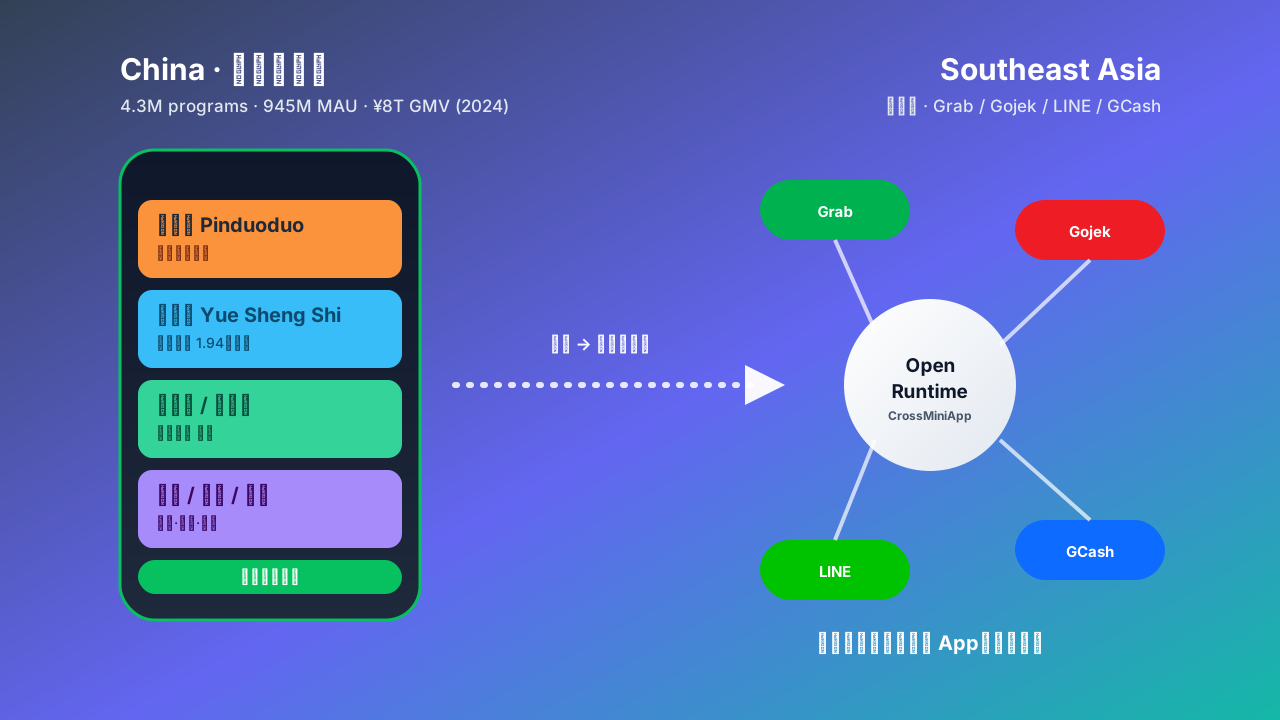
CrossMiniApp is the universal runtime plus the open catalog. It does what Grab Asenso and Gojek's merchant tools do not: it lets a governed, host-resident storefront travel across many hosts, not just one. China's local-life casebook shows the patterns that win; the open runtime makes them portable across Southeast Asia's fragmented ecosystem — one build, many super-apps, no wall.
Sources
- Luckin Coffee Investor Relations — new retail model, 100% cashier-less, 20,000+ stores
- China Catering Digitalization Report 2025–2026 — scan-to-order coverage 78.6%, market size
- Grab — Grab Asenso launches merchant digitalization program in the Philippines (2025)
- ASEAN Exchanges — Fintech and Embedded Finance 2025 (QRIS, GCash, ASEAN payment GTV US$1.41T)
- FintechNewsSG — Southeast Asia Payment Methods 2026 (GCash 94M, QRIS, PromptPay, VietQR)