
Ask someone in Manila to pay for anything and the phone comes out before the wallet. Not because the banks won. Because GCash did — 94 million registered users as of 2025, more than the population, on a single app that became the country's de facto identity and payment layer at once. That is why the Philippines is such natural soil for mini-programs: the login and the rail already exist, locked inside one closed super-app.
The opportunity is not another app. It is a lightweight program that opens inside GCash or Maya, already logged in, already able to settle — and for the diaspora sending money home, already cross-border.
The six dimensions, scored on Philippine ground
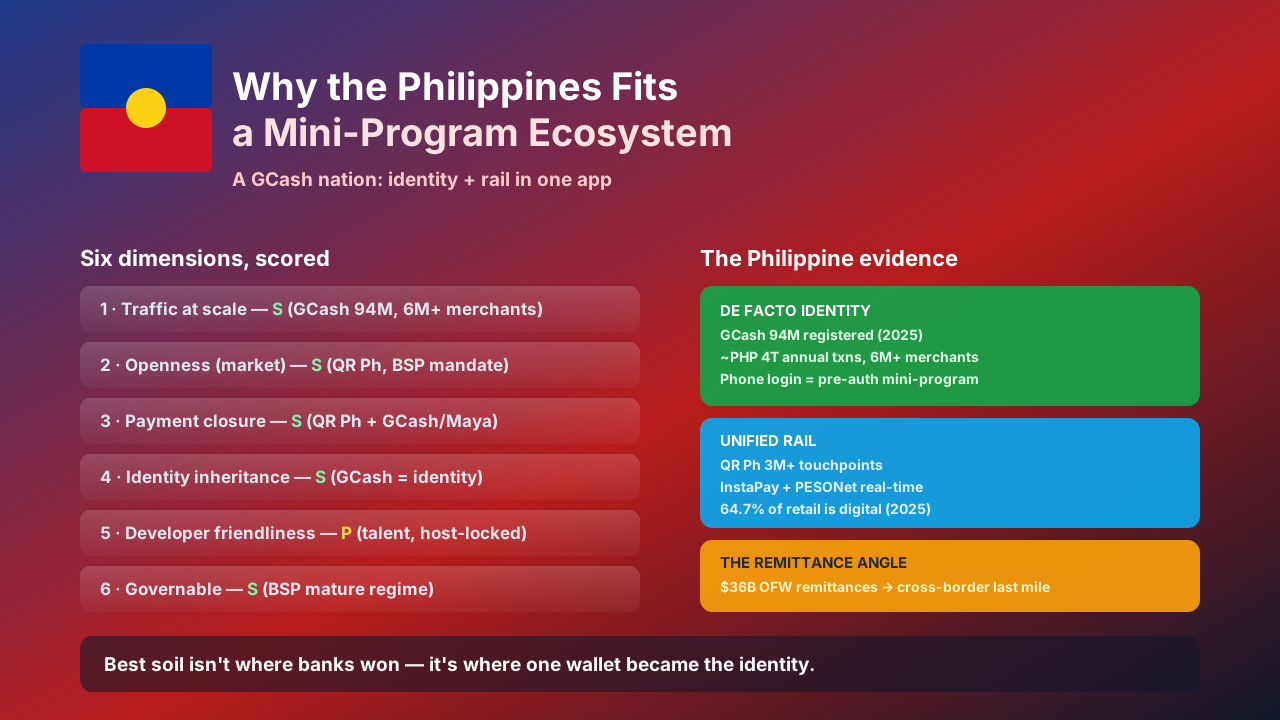
1. Traffic at scale. GCash alone carries 94 million registered users in 2025, processing around PHP 4 trillion in annual transactions across 6 million-plus merchant touchpoints. Maya adds 50–65 million. Smartphone use is high and Android-dominant, so the daily attention a developer can borrow is enormous.
2. Openness, at the market level. The Bangko Sentral ng Pilipinas forced interoperability: InstaPay and PESONet for real-time and batch rails, and QR Ph now accepted at 3 million-plus touchpoints. The rail is open by central-bank mandate even though the super-apps keep their mini-app surfaces curated.
3. Payment closure. A mini-program inherits QR Ph plus GCash or Maya — both real-time, near-free, and ubiquitous. Digital payments already account for 64.7% of retail transaction volume in 2025, so settlement is the default, not the exception.
4. Identity inheritance. This is the Philippine standout. GCash is the de facto identity for tens of millions who never opened a bank account; phone-number login means a mini-program opened inside it starts pre-authenticated. Closer to the WeChat class than most markets outside China.
5. Developer friendliness. Strong English-speaking engineering talent and low build cost, but the ecosystem is host-locked: GCash's GLife is a curated marketplace, not a self-serve platform. Lightweight distribution beats the native-app install wall.
6. Governable. The BSP runs one of the region's most mature e-money regimes, with KYC, consumer protection, and data rules enforced at the wallet level. A sandboxed, takedown-capable runtime fits cleanly inside it.
| Dimension | Score | Philippine evidence |
|---|---|---|
| Traffic | S | GCash 94M registered, 6M+ merchants |
| Openness | S | QR Ph / InstaPay / PESONet, BSP mandate |
| Payment | S | QR Ph + GCash / Maya, 64.7% digital |
| Identity | S | GCash de facto identity, phone login |
| Developer ease | P | Talent strong, host-locked |
| Governance | S | BSP mature e-money regime |
Why the remittance angle matters
The Philippines receives over $36 billion in overseas Filipino worker remittances a year. A mini-program that opens inside GCash and settles cross-border is not a convenience — it is the cheapest last mile for money already moving. Closed hosts plus a de facto identity layer make that last mile the obvious place for a universal runtime to win.
The CrossMiniApp angle
CrossMiniApp is a universal runtime plus an open catalog. You build the mini-program once and it runs inside GCash, Maya, and the wallet surfaces — inheriting each host's identity and payment, sandboxed and governable, updatable over the air. The Philippines' GCash-first structure is the argument: the identity and rail are solved, the hosts are closed, and the value is in a runtime that reaches them all without renegotiating each wall.
The rule
The best mini-program soil is not where banks won. It is where one wallet became the identity — and in the Philippines, that wallet is GCash.