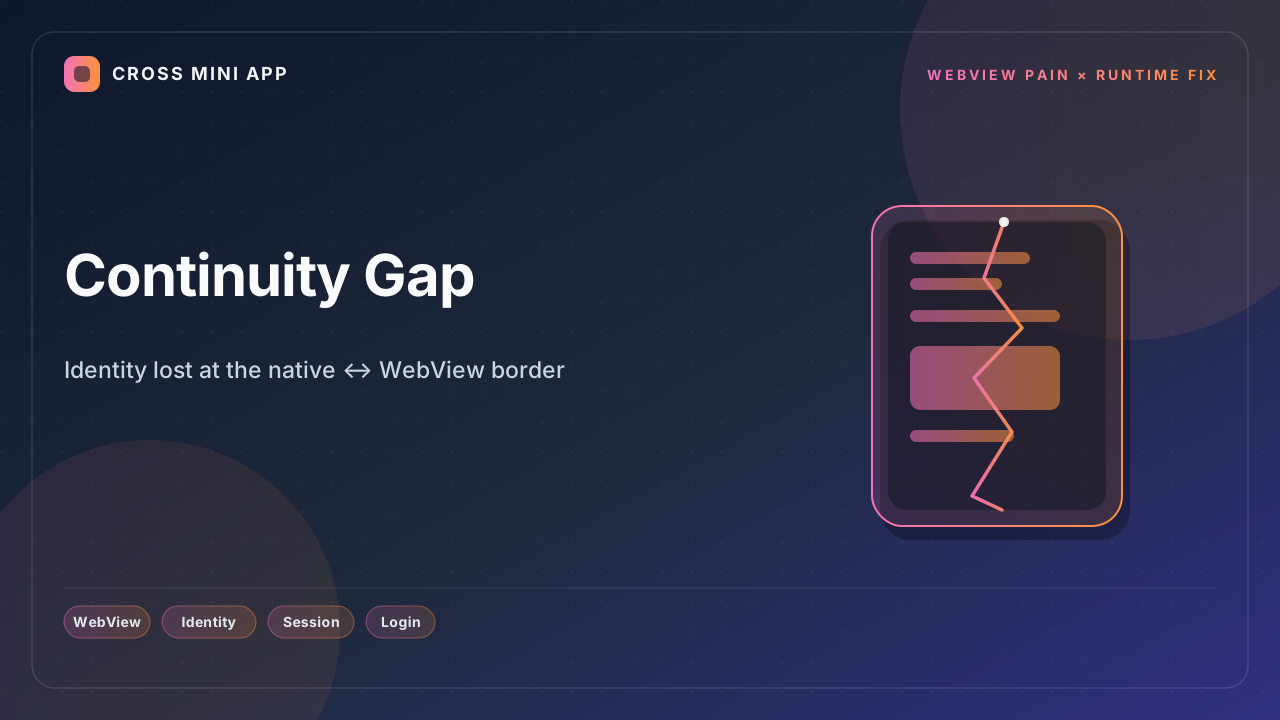
You think a logged-in user is a logged-in user. Then they tap into a WebView screen and are asked to log in again. Or they fill a cart inside WebView, return to the native shell, and the cart is gone. The border between your native code and the remote document does not just slow things down — it silently drops identity and state.
The border that forgets
A WebView stores its cookies and local storage in the host app's private data store, not the system browser's. An external browser cannot read that private store, so opening a link means a fresh login. Even inside the app, an in-app browser behaves like a brand-new incognito window that forgets everything when it closes. A user who signed in via Safari and arrives at your page from Instagram shows up as an anonymous visitor, and the session created there does not carry back. The documented consequences are blunt: login walls convert far worse in in-app traffic, cart contents and preferences do not carry over, and analytics counts one person as several.
Push the WebView into its own process — a common stability fix — and the problem hardens. Cookies, login state, and local storage stay in the WebView process; the host process must synchronize them explicitly or they are simply not shared.
The third-party-cookie collapse made it worse
The slow death of cross-site tracking raised the stakes. Safari began blocking third-party cookies by default in 2017 via Intelligent Tracking Prevention; Firefox followed in 2019; Chrome announced a phase-out in 2020, then reversed and shut down most of the Privacy Sandbox APIs by October 2025. By 2025 roughly 47% of web traffic was already cookieless. For an app leaning on WebView, that means the fragile bridges that used to stitch identity across contexts are being pulled out from under you, and the analytics that depended on them now report phantom new visitors.
A fraud and risk surface you did not sign up for
Embedded browsers that isolate cookies and local storage do more than annoy users. Fingerprint's analysis shows they fragment sessions and weaken attribution, and they create openings for fraud: attackers can clear state, switch contexts, or use manipulated devices while moving through onboarding, checkout, or promo flows. The governance question stops being browser convenience and becomes whether identity and risk controls can survive context switching inside your own app. The recommendation from that analysis is the right instinct: persist the link between user, device, and journey in a governed backend system, not in cookies or local storage that a WebView border can wipe.
What a first-party runtime changes
A host-owned runtime runs the mini-program as a signed, first-party component, with identity and state managed by the host rather than abandoned at the document border. The native shell and the runtime share one governed identity anchor, so a login performed once is honored everywhere, and a cart or progress survives the move across screens. Identity continuity stops being a cross-context gamble and becomes a property of the platform you control.
| State crossing | WebView default | Host-owned runtime |
|---|---|---|
| Native → WebView login | Re-asked; private store not shared | One governed identity anchor |
| WebView → native cart | Lost at the border | Survives across screens |
| Cross-context identity | Fragmented, cookieless gap | Persisted in backend, not cookies |
| Fraud resilience | Easy state-clearing, weak anchor | Durable identity link, risk-aware |