
In Nairobi, "send me on M-Pesa" is the default. M-Pesa (Safaricom) isn't an app feature — it is the rails of daily life: ~30 million active users and an agent on nearly every corner. That is why Kenya is such natural soil for mini-programs.
The opportunity is not another app to install. It is a lightweight program that rides M-Pesa inside the surfaces Kenyans already use — reaching everyone, including the feature-phone-era resilience that made mobile money work here in the first place.
The six dimensions, scored on Kenyan ground
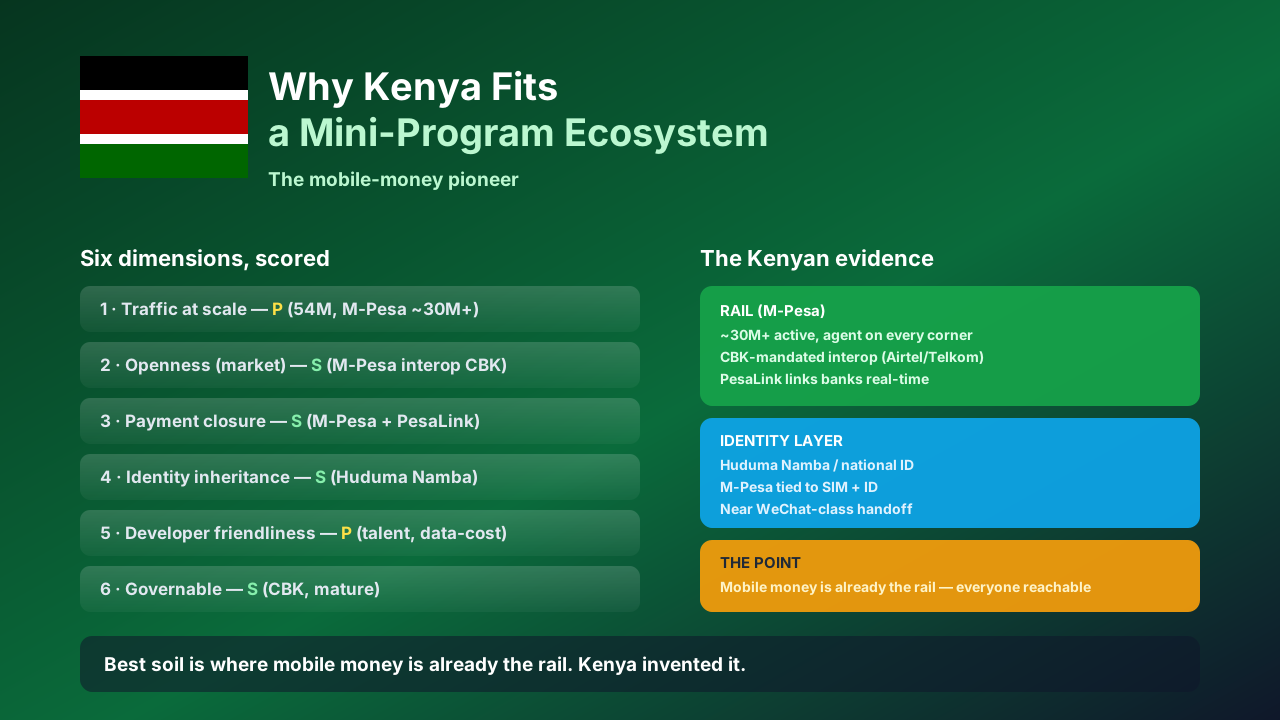
1. Traffic at scale. Kenya has ~54 million people, near-universal mobile penetration — with a device mix that still includes feature phones, which is exactly why lightweight, data-light distribution matters. M-Pesa alone reports ~30M+ active users.
2. Openness, at the market level. The CBK mandated interoperability between M-Pesa, Airtel Money and Telkom; PesaLink connects banks in real time. The mobile-money rail is genuinely open and interoperable.
3. Payment closure. A mini-program inherits M-Pesa plus PesaLink plus interoperable mobile money. Real-time, agent-backed settlement is already ubiquitous.
4. Identity inheritance. This is a strong link. Huduma Namba / the national ID is near-universal, and M-Pesa is tied to SIM registration plus ID. A near-WeChat-class handoff is achievable.
5. Developer friendliness. Nairobi's "Silicon Savannah" is a strong English-speaking engineering community, but data costs and app-fatigue among the mass market make lightweight distribution the obviously right call.
6. Governable. The CBK actively regulates mobile money, interoperability and KYC under a mature framework — one of the most evolved in the region.
| Dimension | Score | Kenyan evidence |
|---|---|---|
| Traffic | P | 54M people, M-Pesa ~30M+ active |
| Openness | S | M-Pesa interop (CBK), PesaLink |
| Payment | S | M-Pesa + PesaLink + interop |
| Identity | S | Huduma Namba / national ID |
| Developer ease | P | Strong talent, data-cost mindful |
| Governance | S | CBK, mature mobile-money rules |
Why the "mobile-money pioneer" is the whole point
Kenya proved mobile money at national scale. A universal runtime that rides M-Pesa reaches everyone — including the feature-phone-era resilience that made it work. Closed hosts plus open interop plus strong identity equals textbook CrossMiniApp soil.
The CrossMiniApp angle
CrossMiniApp is a universal runtime plus an open catalog. You build the mini-program once and it runs inside M-Pesa and Airtel Money surfaces — inheriting each host's identity and payment, sandboxed and governable, updatable over the air. Kenya's mobile-money-first structure is the argument: the rail already exists, the hosts are closed and ready, and the value is in a runtime that reaches users without the native-app wall.
The rule
The best mini-program soil is where mobile money is already the rail. Kenya invented it.