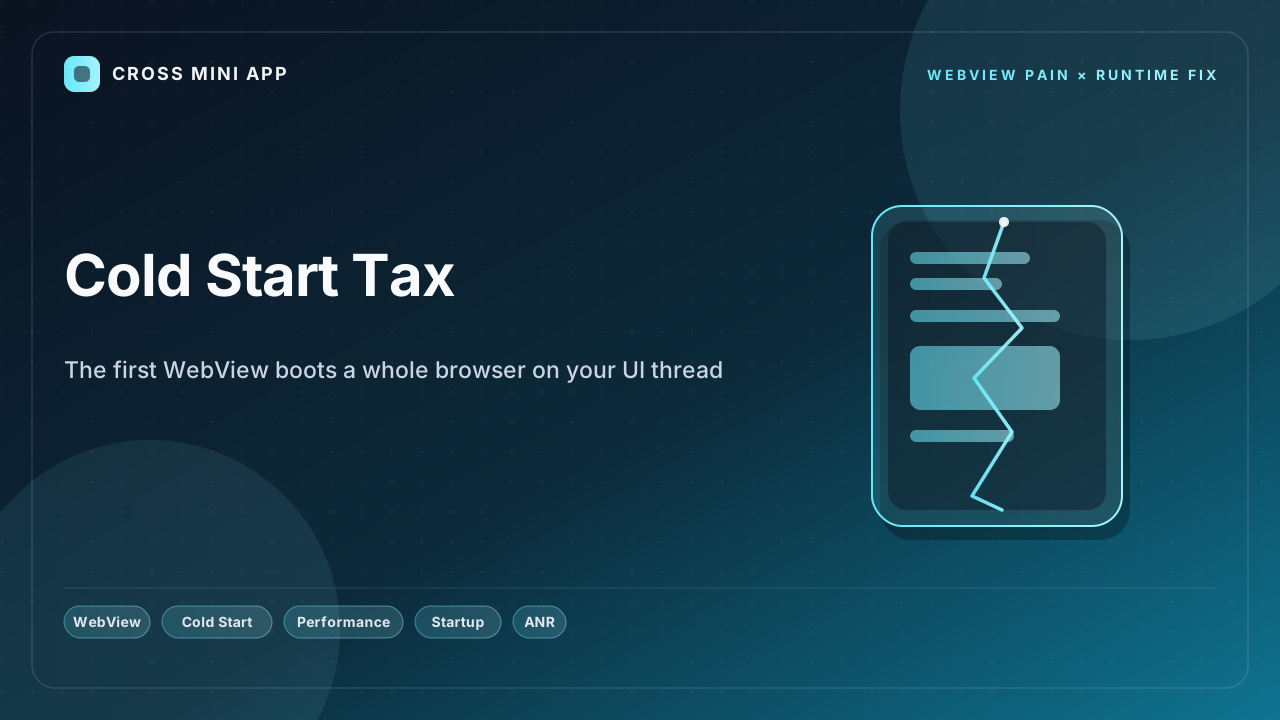
A WebView is not a view; it is a browser engine that has to boot before it can draw. The first time your app creates one, the whole Chromium stack — native library, V8, renderer process, network stack — initializes on the UI thread, blocking input and risking an ANR. On Android that first init runs 200–500 ms; on iOS the WebContent process launch alone can stall two seconds on a cold device. And the kicker: the engine is a system component updated independently through the Play Store, so a pending WebView update can quietly break your startup. A host-owned runtime warms, pools, and version-manages the engine instead of letting the OS surprise you.
The first WebView boots the whole engine
Unlike a browser, which may already be warm, an app's first WebView starts from nothing. Android's own developer docs warn that this implicit startup happens entirely on the main thread and «drastically increases the risk of ANR errors.» Internally it loads libwebviewchromium.so (~50 MB), initializes V8, forks the renderer sandbox, and brings up the network stack. Measured first-init cost is 200–500 ms on mid-range Android; Meituan measured iOS WKWebView first-init at 763 ms (second: 457 ms) and Android at 193 ms. The cost is paid before a single byte of your page loads.
iOS: the hidden two-second stall
On iOS the real bottleneck is not the WebView object — it is the WebContent process. One engineering write-up measured a 1,999 ms gap between webView.load() returning and navigation actually starting, entirely from launching the WebContent process; WebKit spins up a separate WebContent process per WKWebView instance, so naive pre-warming backfires — it added 2,797 ms of overhead instead of saving any. You cannot pre-warm your way out of WebKit's process isolation.
The system WebView update stall
Because Android's WebView is a system app updated via the Play Store, its version is outside your control. A device with a pending or partially-applied WebView update can crash or stall the renderer when your app first touches it. The engine your startup depends on is not the one you tested against — and you find out at launch.
The band-aid: hardcoded delay(300)
Developers respond with delay(300) before loading, or eager XML inflation that races Chromium's setup — both paper over the same truth: you are paying an engine boot tax you did not budget for, on the critical path, with no guarantee of how big it is. A hardcoded wait is too short on a slow device and too long on a fast one; either way the user stares at a blank frame.
The runtime fix
A host-owned runtime treats engine startup as a managed resource. It warms the engine off the critical path, pools and reuses a bounded set of views instead of forking N engines, and pins the runtime version so a stray system update cannot break startup. The page opens when the user taps, not after the OS finishes booting a browser.
| Dimension | WebView | Host-owned runtime |
|---|---|---|
| First init | 200–500 ms on UI thread (Android); 763 ms (iOS WKWebView) | Warmed off the critical path |
| iOS process | Separate WebContent per instance; launch up to ~2 s | Pooled, reused, not forked per view |
| Engine version | System component, updates via Play Store | Pinned by the runtime |
| Startup risk | ANR, renderer stall on pending update | Controlled, deterministic |
| Mitigation pattern | delay(300) band-aid, eager XML inflation | Managed warm-up + bounded pool |
The through-line of this series is control. A WebView makes your app pay a browser boot tax on the critical path, from an engine whose version you neither choose nor know, at a size you cannot predict. A runtime turns engine startup into a resource you schedule, pool, and pin. For a catalog of other people's pages that must open instantly inside your app, that is the difference between a tap that feels instant and a tap that boots a browser first.
Sources
- Android Developers — Optimize WebView startup: implicit startup on the UI thread increases ANR risk; use
startUpWebView(Jetpack Webkit 1.16.0) — official guidance to move WebView init off the main thread. - WebView internals (Tencent Cloud) — first init 200–500 ms: libwebviewchromium.so ~50 MB, V8 ~80 ms, renderer fork ~100 ms — why WebView preloading is the first performance lever.
- Meituan — WebView performance: iOS WKWebView first init 763 ms / second 457 ms; Android 193 ms first — measured init cost across platforms.
- catalyst-core discussion — WebContent launch up to ~2 s; naive pre-warming added 2,797 ms; iPhone X 294 ms vs iPhone 17 Pro 8.8 ms — WebKit process isolation cannot be bypassed by pre-warming.