China has the planet's busiest mobility layer. Didi alone completed 12.39 billion China-Mobility trips in 2024 — about 35.3 million orders a day — and 539 million Chinese used ride-hailing by December 2024. Shared bikes, aggregated hailing (Amap-style), rail and transit mini-programs move hundreds of millions daily. But this is also a category where "copy China" fails if you copy the wrong layer. The fleet is unrepeatable. The model is the lesson.
Why mobility is a hard P-level
Games travel on a runtime. Social commerce travels as a pattern plus a local rail. Mobility sits next to food delivery at the opposite end: the value is built on the ground. Maps, driver supply, local payment and transport licenses are all local and do not cross borders. The right move overseas is to borrow the software pattern — match, dispatch, track, pay, rate — and rebuild the physical and regulatory layer locally.
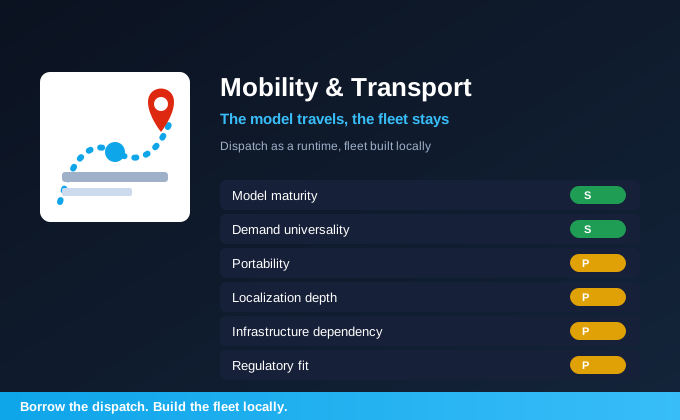
| Dimension | Rating | What the evidence says |
|---|---|---|
| Model maturity | S | Didi 2024 China-Mobility 12.39B trips, 35.3M daily orders, 677M annual active users; ride-hailing users reached 539M |
| Demand universality | S | Every dense market wants on-demand, mapped, paid transport; emerging markets leapfrog straight to app-based mobility |
| Portability | P | The operational stack — map data, driver network, fleet licensing — is local and does not transfer |
| Localization depth | P | Must rebuild local map, local driver supply, local payment rail and local transit data per market |
| Infrastructure dependency | P | Requires a map engine, a driver/payment ecosystem and transport licensing to function at all |
| Regulatory fit | P | Driver licensing, surge pricing rules and data-localization differ by country and are rarely portable |
The three moves worth copying
- Dispatch & matching as a runtime service. The request → match → track → pay → rate loop is pure software. Host it inside a universal runtime and plug in any local fleet, local map and local payment — instead of cloning the asset that took Didi a decade and millions of drivers to build.
- The aggregator, not the operator. Amap (高德) proved a neutral dispatch layer can sit over many local operators without owning a single car. The runtime is the perfect neutral host: it routes demand to whatever local supply exists, in whatever market.
- Light mobility & transit as pure mini-programs. Shared bikes, bus/subway QR passes and rail ticketing (12306-style) are runtime UIs over a local schedule and a local payment rail — no fleet of their own. They are the cleanest proof that transport front-ends are highly portable while the back-ends stay local.
The CrossMiniApp angle
A universal runtime plus an open catalog lets a local operator ship a mobility portal that runs on top of that market's own map, fleet and payment rail — the Didi logic without the Didi asset. Even Didi itself proves the model localizes: it runs profitably in Brazil and Mexico on local supply, not Chinese drivers. The runtime carries the proven dispatch pattern; each market contributes the wheels. The runtime constrains what third-party code can do; the catalog distributes the mobility pattern; the local fleet does the rest.
The rule
The most valuable thing China proved here is not an app — it is that mobility can be a software primitive. Borrow the dispatch. Build the fleet locally.
Sources
- DiDi Global — 2024 full-year results (12.39B China-Mobility trips, 677M annual active users)
- DiDi — Q4 and full year 2024 results (HKEX filing)
- CNNIC — The 55th Statistical Report on Internet Development in China (539M ride-hailing users)
- Dida Inc. — 2024 Annual Report (carpooling marketplace, HKEX)
- StatCounter — Platform and channel market share