
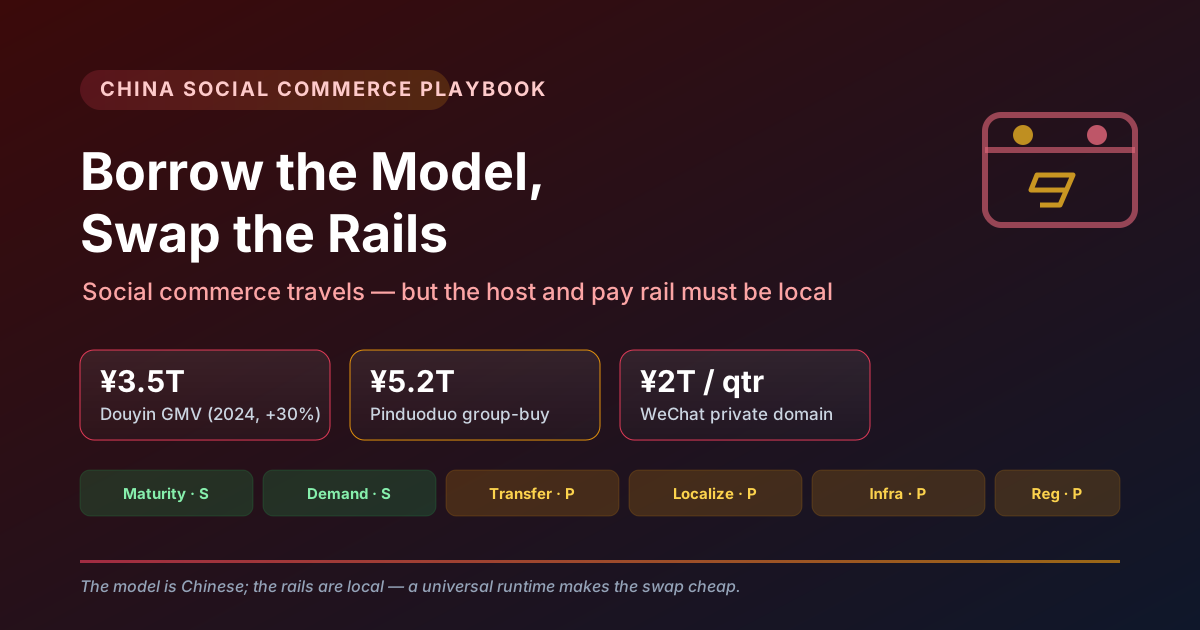
China's e-commerce didn't just move online. It moved into the social feed. Social commerce — buying that happens inside a chat, a short video or a group — is now a multi-trillion-yuan machine: Douyin's e-commerce GMV reached roughly RMB 3.5 trillion in 2024 (up 30% year over year, making it China's third-largest platform after Taobao/Tmall and Pinduoduo), Pinduoduo's group-buy model drove about RMB 5.2 trillion, and WeChat's private-domain commerce — stores running inside the super-app — passed RMB 2 trillion in a single quarter.
The rest of the world is still early. The smart move is to borrow the model, not the apps — and to swap in local rails.
Six dimensions, applied to social commerce
| Dimension | Rating | Why |
|---|---|---|
| Model maturity | S | Trillions in GMV; Douyin, Pinduoduo, WeChat proven |
| Universal demand | S | People buy from people and trusted feeds everywhere |
| Transferability | P | Needs a local social host + local payment rail |
| Localization intensity | P | Host, pay, creators, merchant base, selling culture |
| Infrastructure dependence | P | Leans on local social graph + local payments |
| Regulatory fit | P | E-commerce, livestream disclosure, data rules vary |
Three models worth borrowing
- Group-buy aggregation (Pinduoduo). Price drops as more friends join a buy. The mechanics — shared links, group thresholds, social pressure to invite — are pure runtime behavior and travel anywhere. What changes is the incentive currency and the local pay rail.
- Creator-led commerce (Douyin / livestream). Creators sell to audiences inside a feed; in 2024 over 40% of Douyin's GMV came from shelf/search and over 30% from merchant self-streaming, so it is no longer hostage to a few mega-streamers. The format is the lesson; the local host and creator ecosystem are what you build.
- Private-domain stores (WeChat). Merchants run a store inside the super-app and distribute through groups and share cards. This is the closest analog to a mini-program commerce runtime — and the easiest to port onto any host that has groups and a pay rail.
What you must swap
Unlike mini-games, social commerce does not travel on a runtime alone. Two local layers are mandatory:
- A local social host. China's graph is WeChat/QQ/Douyin. Overseas you plug into WhatsApp, LINE, Facebook, Telegram or a super-app already present in the market (the eleven we profiled each have one).
- A local payment rail. WeChat Pay and Alipay become QRIS, PromptPay, DuitNow, PIX, SPEI and the like.
That is the entire point of a universal runtime plus an open catalog: the commerce mini-program is written once, then dropped onto each market's host and rail. The model is Chinese; the rails are local.
The rule
Don't copy China's commerce apps. Borrow their social-commerce models, and swap in the local social host and the local payment rail. A universal runtime is what makes that swap cheap.