Every dollar of paid user acquisition is only as smart as the attribution data judging it. Spend on the wrong channel and you don't just lose that dollar — you feed the algorithm more bad signal and it finds you more of the same. So the measurement layer is not a back-office concern. It is the instrument panel of the whole growth engine.
And that is exactly where the WebView-first approach quietly breaks.
The cracks are where the native app meets the web
When a traffic app runs its core journey — onboarding, a purchase, a referral — inside a WebView pointed at a remote document, the analytics don't flow through one clean pipe. They fall into the seam between two worlds.
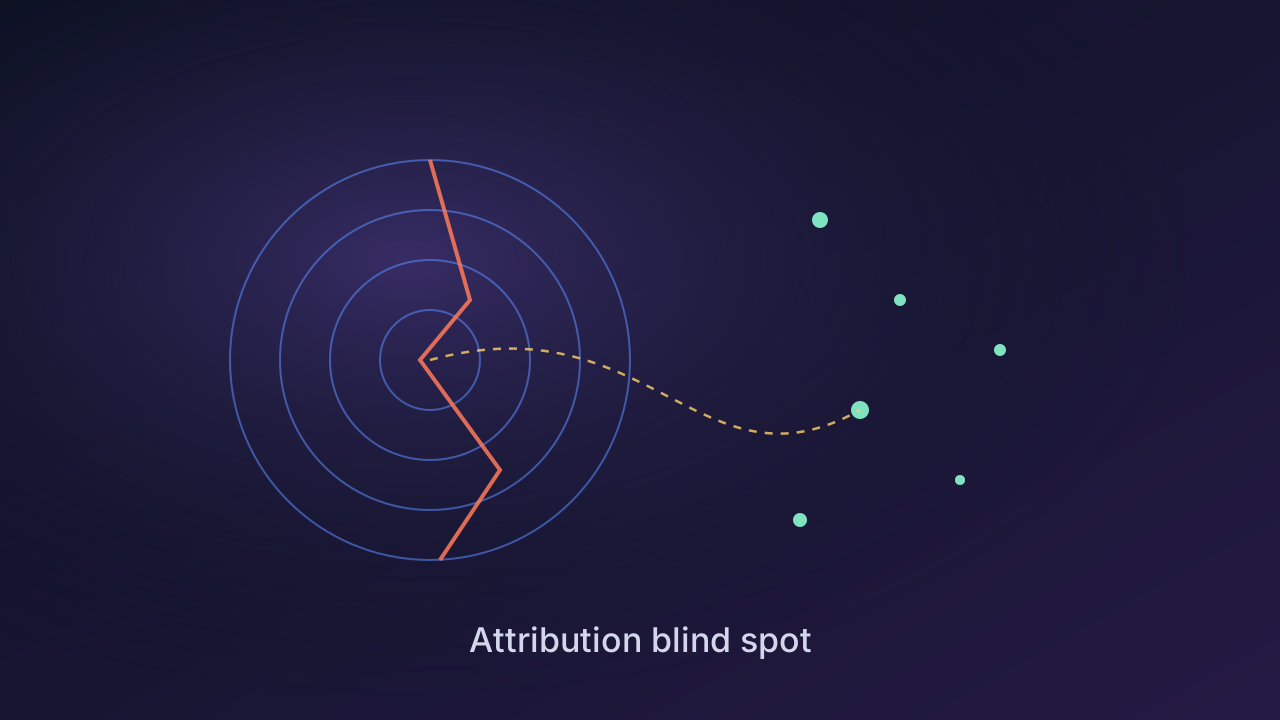
Google Analytics 4 makes the problem concrete. A native app and an in-app WebView are measured by two different data streams: an App Data Stream and a Web Data Stream. By default, GA4 does not unify sessions or users across them. The moment a user steps from a native screen into the WebView and back, the session splits. The native app identifies the person by an App Instance ID; the WebView identifies them by a Client ID. Unless everyone is logged in and you wire up User-ID, the same human is counted as two different people. Anonymous traffic — the majority of top-of-funnel visitors — gets double-counted by design.
It gets worse at the boundary with the outside world. Every in-app browser is effectively a fresh incognito window that forgets everything when it closes. Third-party cookies are usually blocked outright. The referring app often strips the HTTP referrer before the page loads. The result, well documented by analysts, is that a large share of in-app WebView traffic shows up in reports as «(direct) / (none)» — as if those users had memorized your URL. Your direct-traffic line is quietly inflated, and the social or email campaign that actually sent them is credited with nothing.
Why the distortion reaches the P&L
This is not a reporting curiosity. It reaches budget decisions.
Last-click attribution already over-credits the final tap and under-credits the channel that did the hard work of creating intent. AppsFlyer's own CEO called last-click «a big lie,» and industry surveys still find 45–75% of marketers leaning on it. Layer a WebView that loses referrers and splits sessions on top of that, and the distortion compounds: channels that drive cheap installs look efficient, channels that drive expensive installs with high lifetime value look wasteful, and budget migrates in exactly the wrong direction.
The waste is not hypothetical. In Q1 2024, 23% of programmatic mobile in-app traffic was classified as invalid — an estimated $1.4 billion of wasted spend in a single quarter. You cannot defend against what your own dashboard cannot see.
There is a second, quieter cost: experiments. A/B tests, referral-loop tracking, and cohort analysis all assume a stable identity for each user. When the same user is two people, your holdout group is contaminated and your viral coefficient is unknowable. You are optimizing against noise.
What a host-owned runtime changes
The fix is not a better dashboard bolted onto a leaky pipe. It is moving the journey out of the ungovernable WebView and into a runtime the host controls.
A host-owned runtime runs the mini-program as a first-party component inside the app, not as a remote document inside a browser shell. Instrumentation lives in one trusted boundary: events are not lost at an App-to-Web seam, sessions are not split by a stream mismatch, and referrers are not stripped by a browser you don't operate. The host keeps its own first-party event log — clean, complete, and reconcilable with backend revenue — instead of trusting a third-party container to report what happened inside it.
That single change restores three things growth teams desperately need: a stable identity per user, an unbroken session across the whole journey, and data sovereignty over the behavior happening inside your own product.
WebView measurement vs. runtime measurement
| Failure mode | WebView / H5 | Host-owned runtime |
|---|---|---|
| Session identity | App Instance ID ≠ WebView Client ID; anonymous users double-counted | One first-party identity across the whole journey |
| Referrer & cookies | Stripped at the in-app browser boundary; traffic lands as (direct)/(none) | Preserved inside the host's own boundary |
| Event loss | Events dropped at the native↔web seam; auto-events may not fire | Events captured in one trusted instrumentation path |
| Data sovereignty | Behavior reported by a third-party container you don't control | First-party event log owned and reconcilable by the host |
| Experiment integrity | Contaminated holdouts, unknowable viral coefficient | Stable identity enables clean A/B and cohort analysis |
The point is not that WebViews are evil. It is that every layer you don't control is a layer where your measurement can silently lie. For a traffic app whose entire strategy is "buy users efficiently and keep them," running the journey inside someone else's browser shell is handing the instrument panel to a black box.
Own the runtime, and you own the truth about whether your growth engine actually works.
Sources
- AppsFlyer — Marketing attribution: what it is and how to measure it (last-click bias, multi-touch models). https://www.appsflyer.com/blog/measurement-analytics/marketing-attribution/
- VentureBeat — AppsFlyer decries last-click ad attribution as «a big lie.» https://venturebeat.com/marketing/appsflyer-decries-last-click-ad-attribution-as-a-big-lie-offers-first-multi-touch-tracking/
- Ayudante — How to Track In-App WebViews in GA4 (App vs. Web data streams do not unify sessions/users). https://ayudanteinc.com/?p=2916/
- gotoapp.store — Cookies and sessions in in-app browsers (fresh incognito per open; third-party cookies blocked). https://gotoapp.store/blog/cookies-in-app-browser
- Graphed — Android WebView traffic appears as (direct)/(none) when referrers are stripped. https://graphed.com/blog/what-is-android-webview-in-google-analytics
- Remerge — A guide to ad fraud: 23% of Q1 2024 programmatic in-app traffic invalid, ~$1.4B wasted. https://bit.ly/4mR89V3