

Insurance at the Moment of Need: Why Embedded Cover Ships as a Mini-Program
Insurance is bought when it is needed, not when it is sold. Embedded insurance puts the policy at the point of need — and the governed mini-program is the unit that delivers it inside the app the customer already uses.
Cross Mini App Team
August 8, 2026 · 4 min read
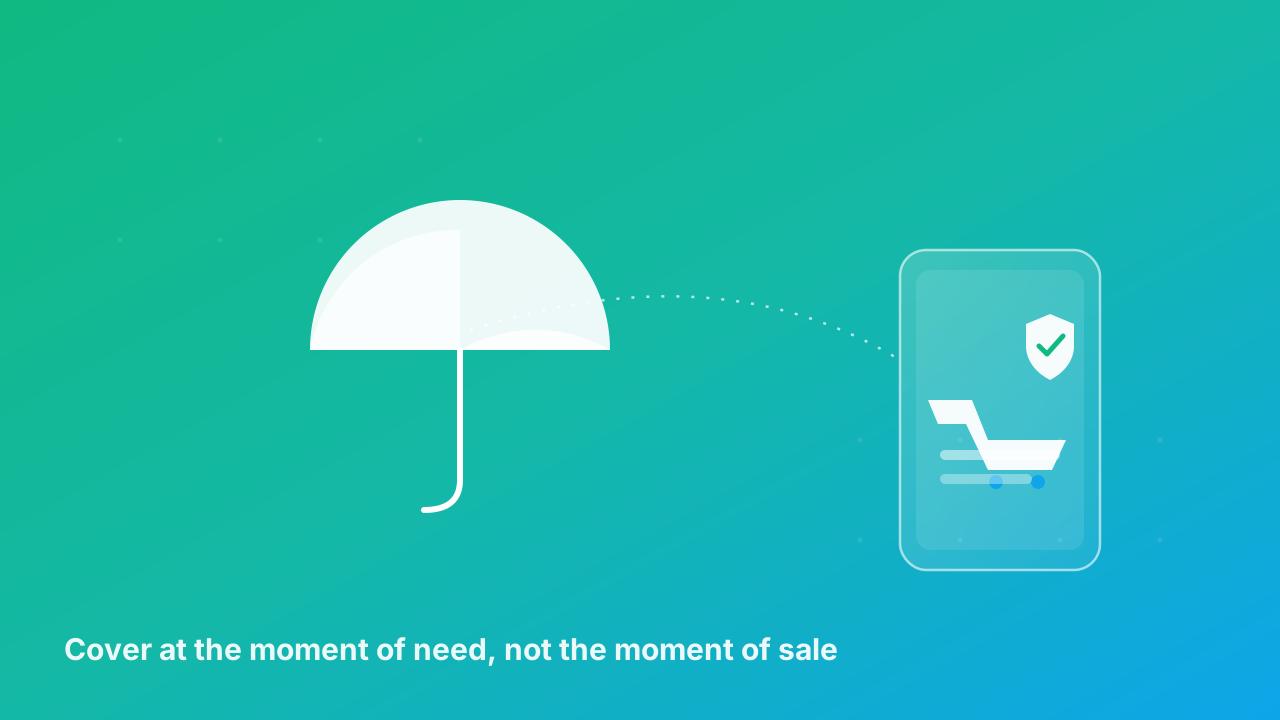
People buy insurance at the moment of need, not the moment of sale
A traveler insures the trip when they book it. A rider covers the ride when they hail it. A shopper protects the phone the moment the cart closes. Traditional insurance distribution inverts this: it acquires cold, then prays the customer remembers to buy at the right moment. Embedded insurance fixes the sequence itself — the policy appears exactly where and when the risk is created. And the governed mini-program is the unit that lets a host deliver that cover inside the app its customer already trusts.
The market is scaling fast
The numbers show a structural shift, not a fad:
- The Business Research Company sizes embedded insurance at US$116.05 billion in 2025, rising to US$277.67 billion by 2030 at a 19.1% CAGR.
- Swiss Re projects embedded premium to reach roughly US$700 billion in GWP by 2030, and about 15% of global GWP — some US$1.1 trillion — by 2033, up from an estimated 3–5% today.
- 94% of insurance executives now view embedding as a critical distribution channel.
- Asia-Pacific is the largest region in 2025; North America is the fastest-growing — but the highest-velocity, most inclusive adoption is happening where smartphone penetration is high and insurance penetration is low: emerging-market super-apps.
Why embedded, and why now
The old model pays to find a stranger, then to persuade them. Embedded insurance is consent at the point of need:
- Relevance is maximal. The customer is already in the booking, the ride, the purchase. The risk is concrete, not abstract.
- Acquisition cost collapses. There is no cold funnel — the host's own flow carries the offer, and the host's identity and payment rails settle it in one tap.
- Inclusion rises. Micro-duration, micro-premium products reach people a traditional agent never visits — and who would never open an insurer's app.
Real embedded programs already run
- Airbnb embeds travel protection with Generali / Aon / Europe Assistance, offered at checkout per booking rather than as a separate purchase.
- Walmart wraps protection plans around the products it already sells.
- Across Asia, ride-hailing and e-commerce platforms embed micro-insurance for underinsured, high-smartphone-penetration populations — parametric cover triggered by the event itself, not by a claims form.
These are not pilots. They are the distribution backbone of the next decade of protection.
The delivery problem nobody talks about
Embedding a policy inside a host app sounds easy until compliance arrives. A host will not accept a full native app with deep device access and an unaudited data scope. What it will accept — across jurisdictions, currencies, and languages — is a bounded, sandboxed, compliant mini-program that inherits the host's identity, payment, and consent flow.
Why a mini-program, not another app
The governed mini-program is the natural delivery unit for embedded cover:
- It inherits the host's trust. Login, KYC, and consent already happened in the host. The insurer rides them — no new account, no new trust decision.
- It is instant and lightweight. No install funnel, no app-store review, no storage tax on a cheap Android. The offer appears in-context, one tap to bind.
- It is provably compliant. An audited sandbox with explicit scope and consent flows is exactly what a bank, a super-app, or a carrier will approve across markets.
What this means for insurers and hosts
If your 2026 plan assumes customers will find and install your insurance app, reconsider:
- Meet the customer at the point of need — inside the travel, ride, shopping, or wallet app they already open — instead of fighting for a home-screen slot an insurer will never win.
- Ship a governed unit the host will embed. A sandboxed, compliant mini-program — not a native app — is the unit a Grab, a GCash, or a marketplace will actually accept across jurisdictions.
- Design for low-bandwidth, multi-currency, multilingual reality. The next hundred million insured are on cheap Android with patchy data. Lightweight, instant, localized cover is the only cover that reaches them.
Where Cross Mini App fits
Cross Mini App is the runtime and the open catalog for the post-install era of protection. You build a governed insurance mini-program once and drop it into every trusted host — a super-app, a wallet, a travel platform, an e-commerce marketplace. Pre-compliant, sandboxed, and localized, these experiences deliver cover at the moment of need without asking the customer to install anything. Hosts get vetted protection they can embed in a single line; insurers stop rebuilding per store and per country; customers get a policy exactly where the risk is created. For insurance — where consent, licensing, and local regulation make sandboxing non-negotiable — a governed cross-app runtime is the only safe unit to distribute at scale.
Cover follows the need, not the sale
For decades the default was "build an insurance app, acquire cold, hope they remember." In 2026 the growth is on the in-app surface, delivered as a governed mini-program through a cross-app runtime. Cross Mini App is building the shelf so the next policy reaches the customer at the moment they actually need it — inside the app already open.
Related Posts
Telemedicine is a $152B market growing 20% a year, yet billions still cannot reach a clinician. The bottleneck is not technology — it is distribution. Here is why the mini-program, not the native app, is how care crosses the last mile.
App downloads stalled in 2025 while in-app spending climbed. Attention is concentrated, the install barrier is high — and the next billion users are not in the app store at all. Here is why install-free mini-program distribution is the growth market.
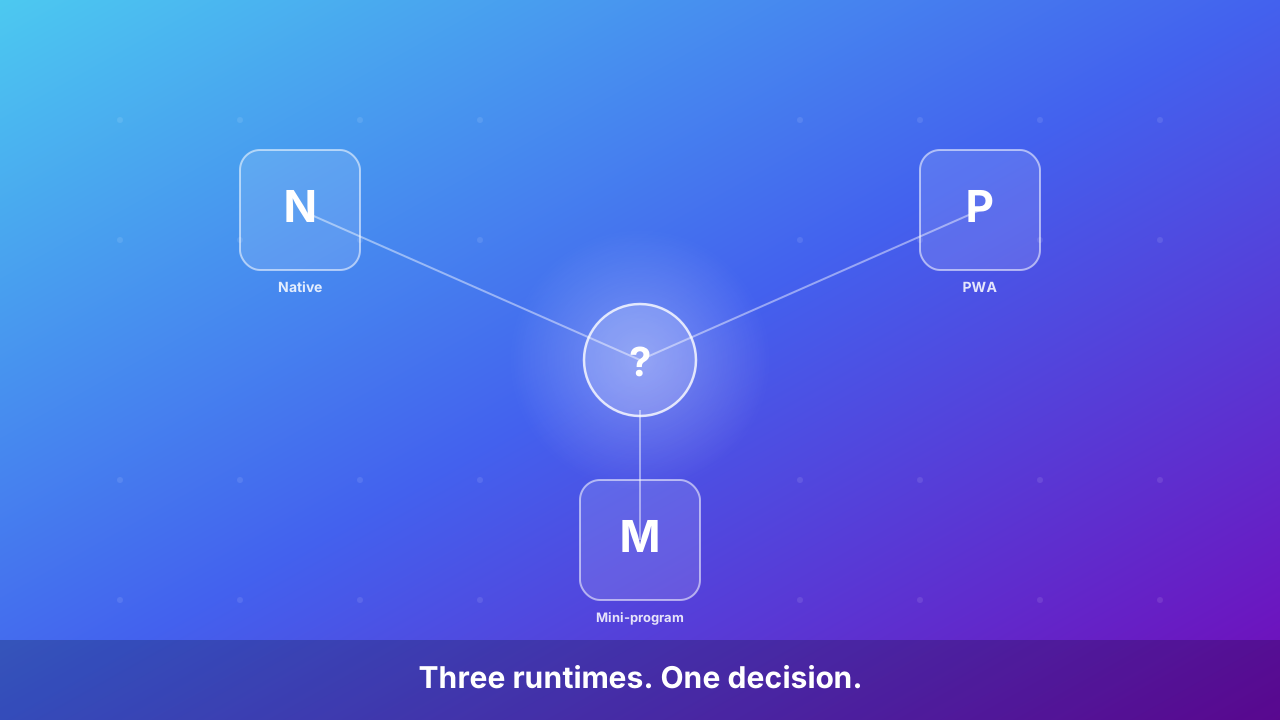
Three runtimes compete for your mobile experience in 2026: native apps, progressive web apps, and mini-programs. Here is a decision framework built on real deployment data — and why a cross-app runtime changes the math.