
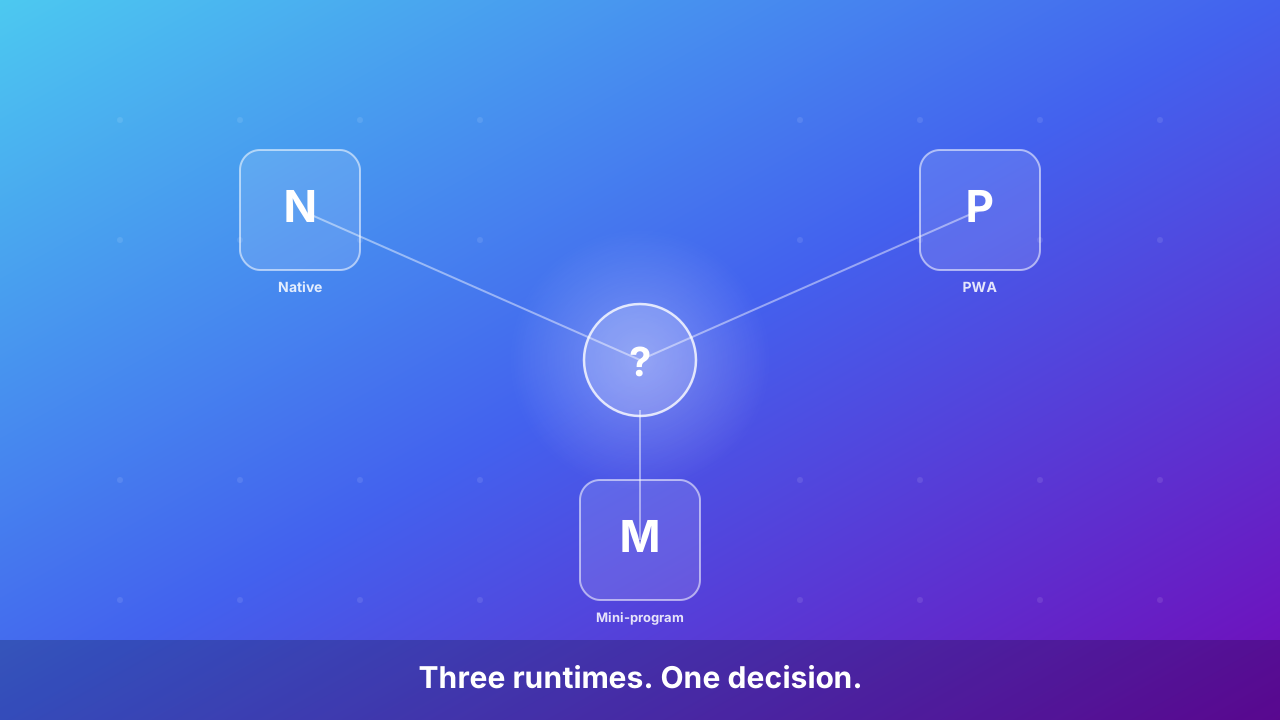
You have three runtimes. Pick wrong and you pay twice.
Shipping a mobile experience in 2026 is no longer a question of "app or web." You have three distinct runtimes, each with a different cost structure, distribution model, and ceiling: the native app, the progressive web app (PWA), and the mini-program. Most teams still default to the native app by habit — then watch 90% of their acquisition budget disappear into App Store friction. This guide compares all three on the numbers that actually move a roadmap, and shows where a cross-app runtime flips the equation.
The three runtimes, in plain terms
- Native app — installed from an app store, runs on the OS, full access to camera, Bluetooth, notifications, secure enclave. Highest performance ceiling, highest build and maintenance cost.
- PWA — a website that behaves like an app: installable to the home screen, works offline, push-capable. No store, one codebase for all platforms, but capped by what the browser sandbox allows.
- Mini-program — a lightweight app that runs inside a host super-app or runtime rather than the OS. No install, governed sandbox, shared identity and payments. Discovery happens inside the host's ecosystem, not a store.
Native: still the performance king, still the distribution sink
Native wins where it matters most technically: fluid 120fps graphics, background sync, deep OS integration. For a game engine, an AR camera, or a bank's secure enclave, there is no substitute. But the native app is also where distribution goes to die. Users simply are not installing new apps. The top five apps alone now capture 49% of all mobile time, and the top 25 capture 69% RealityMine / Global Statistics. When attention is this concentrated, an organic App Store listing is a lottery ticket.
Then there is the toll. Apple's App Store commission on in-app purchases ran at 30% for years; under the EU's Digital Markets Act it dropped to 26% in October 2026, with alternative payment processing at 20% and external-link purchases at 15% FunnelFox. The Core Technology Fee — €0.50 per install beyond a million — was scrapped and replaced with a 5% Core Technology Commission BetaNews. The direction is welcome, but the fees still exist, and outside the EU the 30% gate stands.
PWA: the web's comeback, with real receipts
PWAs close much of the native gap without a store. The deployment data is not anecdotal:
- AliExpress cut new-user-to-purchase conversion by double digits and more than doubled pages per session after going PWA Google Web Dev.
- Twitter Lite delivered +75% more tweets sent, +65% more pages per session, and −20% bounce Google Web Dev.
- Pinterest saw +40% time spent and +44% ad revenue Pinterest Engineering.
- Starbucks shipped a PWA roughly 99.8% smaller than its iOS app, turning a 400 MB install into a few-hundred-KB web app BrowserLab.
For content, commerce, and utility surfaces, a PWA is often the right call: ~70% lower development cost than parallel native builds, instant updates, no review queue. The catch is iOS. Apple only opened PWA and alternative-runtime support under DMA pressure, and key capabilities (NFC, background execution, some notifications) remain restricted outside the EU. A PWA is global on Android; on iPhone it is a second-class citizen.
Mini-program: distribution without the install
The mini-program inverts the model. Instead of asking a user to install your app, you plug your experience into an app they already trust — WeChat, Alipay, a messaging platform, a bank. There is no install step, no store review, and the host supplies identity, payments, and audience. In China, mini-programs inside WeChat alone power ride-hailing, food delivery, government services, and billions in transactions daily. The unit is governed: the host knows exactly what the mini-program can read and do, which is precisely the consent-and-scope model modern privacy rules demand.
The weakness has always been fragmentation — every host rebuilds its own silo, so a service team re-integrates per platform. That is the N×M problem that breaks at scale.
The decision framework
| If your priority is… | Choose | Why |
|---|---|---|
| Max performance, OS depth, offline-heavy | Native | Full hardware access, no sandbox limits |
| Content, commerce, broad reach, low cost | PWA | One codebase, no store, ~70% cheaper |
| Instant reach inside a trusted audience | Mini-program | Zero-install distribution, shared identity + payments |
| One build for every host | Cross-app runtime | Avoids N×M re-integration |
Where Cross Mini App fits
Cross Mini App is the runtime that removes the mini-program's one real weakness. A single cross-app runtime plus an open catalog means you build a mini-program once and embed it everywhere — a super-app, a bank, a messaging platform, a merchant checkout — without per-host rebuilds. Pre-compliant, sandboxed, localized mini-programs drop into global hosts the way a web component drops into a page. Developers stop re-integrating per runtime. Hosts stop rebuilding per service. Users get the experience inside the app they already open.
The runtime you pick is the audience you can reach
In 2026 the constraint is no longer engineering. It is distribution. Native apps are gated by stores and attention; PWAs are gated by the iOS sandbox; mini-programs are gated by host fragmentation — until a cross-app runtime removes that gate. Pick the runtime by where your users already are, not by where your engineers are comfortable. Cross Mini App is building the shelf so the best experience wins regardless of which app it lives in.