
H5 vs Mini-Program vs PWA: The Three Mobile Delivery Models, Compared
The mobile web is not one thing. It is an open H5 page, an installable PWA, and a governed mini-program. This deep comparison shows where each one wins in 2026.
Cross Mini App Team
September 19, 2026 · 6 min read
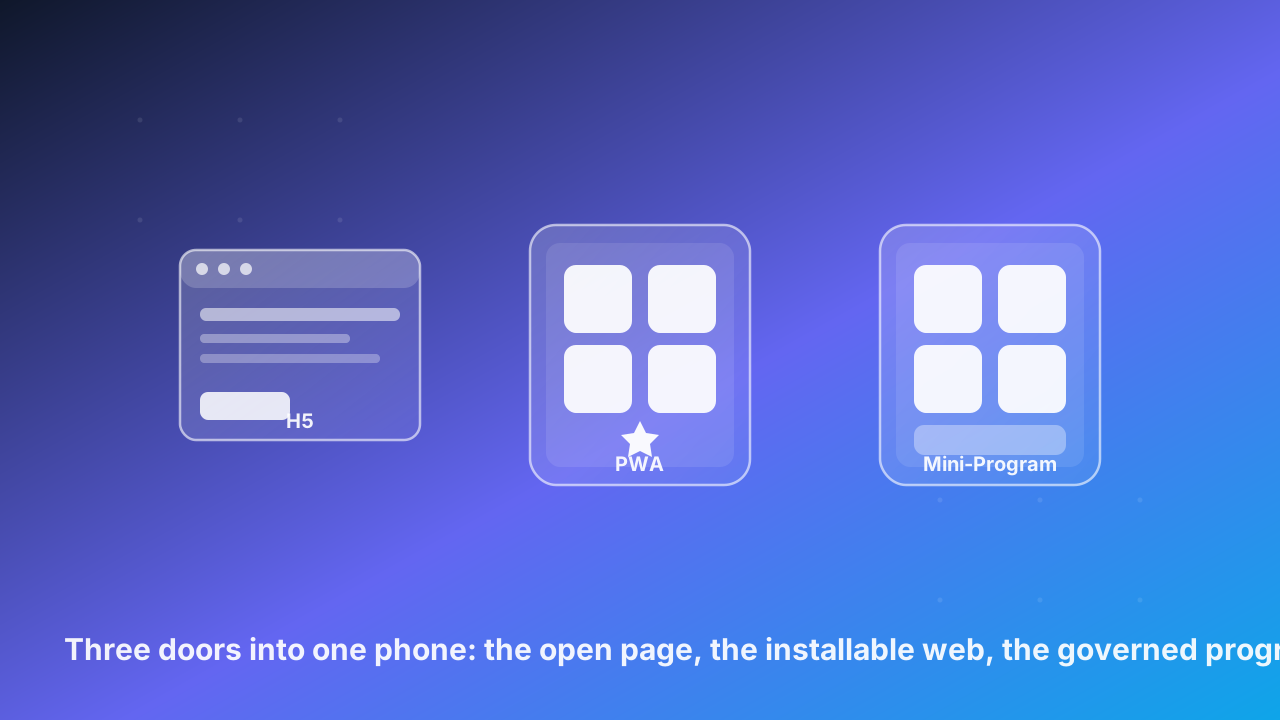
Three doors into the same phone
Open a phone and you can reach a business three completely different ways. You scan a QR code and a browser loads an H5 page. You tap 'Add to Home Screen' and a PWA installs from the web. You open a super-app and tap a mini-program. Same pocket, same screen — three different contracts about who controls distribution, identity, payment, and trust.
Most teams pick one without realizing the other two exist, or assume 'web' covers all of them. It doesn't. This article compares H5, PWA, and the mini-program on the dimensions that actually move conversion, compliance, and cost — so you can choose with eyes open.
What each model actually is
H5 is the open document. Pure HTML, CSS, and JavaScript served from a URL and rendered by a browser or webview. No install, no review gate, no owner beyond the domain. It is the native unit of the open web.
A PWA is the installable web app. It is still a website, but with a web app manifest and a service worker that add offline caching, push notifications, and an 'Add to Home Screen' install path. It tries to feel native without the app store.
A mini-program is the governed runtime. It is not the open web at all. It runs against a curated API surface inside a host — WeChat, Alipay, Telegram — behind a review gate, inheriting the host's identity and wallet.
The mental model: H5 is publish anywhere, PWA is install from the web, mini-program is register inside a host.
Runtime and execution
H5 and PWA share the same engine — the browser. PWA only differs by layering a service worker and manifest on top. Both answer to web standards and to no single platform owner.
The mini-program runs in a host-provided runtime with a limited, audited API set. You trade the web's raw freedom for a guarantee the host can verify. That guarantee is exactly what lets a bank, a telco, or a marketplace admit your program at scale.
Distribution and discovery
H5 wins on openness. A URL is universal — message, QR, ad, search result. Discoverability flows through search engines. Mobile already accounts for about 55.9% of global web traffic (StatCounter, March 2026), so an H5 page meets most users on the device they hold.
A PWA is discovered the same way as H5 — it is a website — but it adds the hope of an install. In practice that hope underdelivers: only about 3.5% of mobile sites and 3.3% of desktop sites ship a complete PWA (manifest plus service worker) according to the 2025 Web Almanac, and a 2025 study found only 12% of visitors who land on a PWA-enabled site ever install it. The install prompt is real; the install behavior mostly isn't.
A mini-program is discovered inside a host ecosystem — a search box in WeChat, a category in Alipay, a tile in Telegram. You don't fight for a home-screen slot; you appear where the user already is. China's mini-program economy runs on roughly 4.3 million programs reaching about 945 million monthly users on WeChat alone; Alipay hosts around 4 million programs with ~650 million mini-program monthly users; Telegram Mini Apps, launched in 2023, already sit atop a 1-billion-user surface.
Identity and payment
This is where the money is decided, and where the three diverge sharply.
H5 must build its own login and its own checkout — email, phone, OAuth, a payment gateway redirect. Every step is a form, a redirect, a drop-off.
PWA inherits the web's identity problem but can cache and feel faster. Payment still routes through web gateways and redirects; there is no host wallet to inherit.
Mini-program inherits the host's identity and payment. The user is already logged into WeChat, Telegram, or the wallet; your program receives a verified token with one tap and settles payment in context — WeChat Pay, Alipay, or the host wallet. That in-context settlement is the single biggest conversion advantage the mini-program holds over both web models.
Device APIs and capability
H5 and PWA sit at the mercy of the browser permission model — camera, location, notifications, bluetooth — gated and inconsistent. PWA adds background sync and push, but iOS still lags: Safari trails Chrome in service-worker capability, push reliability on iPhone is inconsistent, and the install flow hides in the Share menu.
The mini-program exposes a richer, host-provided API set — location, camera, file system, bluetooth, NFC, even hardware-scanner access — always within the sandbox scope the host approved. For a regulated business, that bounded power is the feature that lets the host say yes.
Performance and offline
H5 is network-bound; first paint waits on the connection. PWA's service worker changes the math — aggressive caching gives repeat visits an instant app shell. Starbucks' PWA is 99.84% smaller than its native iOS app (about 233 KB vs 148 MB) and still lets users browse the menu offline. Pinterest's PWA cut load time from 23 seconds to 5.6 seconds and lifted time spent by 40% and ad revenue by 44%.
Mini-programs ship pre-cached packages — the framework and first screen arrive before the tap. Offline is designed in, not bolted on. The honest caveat: like most PWAs, a mini-program's offline mode usually covers reading cached content; live transactions still need a connection.
Compliance and governance
H5 and PWA put the full liability on you. The open web vets no one; for regulated industries you carry KYC, data residency, and content control alone. A bad actor in the same ecosystem is not your host's problem to contain.
A mini-program is reviewed and bounded. The host sets rules, audits scope, and can revoke a program that breaks them. Compliance becomes a shared, enforceable contract instead of a solo burden — the only model a super-app will admit at scale.
Ownership and platform risk
H5 and PWA give you the domain and the relationship; no platform owner can revoke your page. That independence is real and valuable.
The mini-program trades some independence for distribution you could never buy. You depend on the host's policies and reach — but you also inherit the host's trust, which is the harder thing to earn.
Side by side
| Dimension | H5 | PWA | Mini-Program |
|---|---|---|---|
| Delivery unit | URL / webpage | Installable website | Registered, vetted program |
| Discoverability | Search engines, links | Search engines, links | In-host search, catalogs |
| Identity | Self-built login | Self-built login | Inherited host identity |
| Payment | Gateway redirect | Gateway redirect | In-context host wallet |
| Offline | None (partial via SW) | Service worker cache | Pre-cached packages |
| Compliance | Publisher liability | Publisher liability | Host-reviewed, enforceable |
| Install reality | n/a | ~12% of visitors install | Appears inside host |
| Platform risk | None | None | Host policy dependency |
When to choose H5
- You need universal, search-engine-friendly reach on any device.
- Your content is read-only or lightly interactive — a landing page, docs, a campaign.
- You want zero platform dependency and full control of the domain.
When to choose a PWA
- You already have a web property and want app-like speed, offline, and push without a native build.
- Your audience is Android-leaning, where PWA support is strongest.
- You want to avoid app-store fees and review without leaving the open web.
When to choose a mini-program
- You are embedding a transactional flow inside a super-app users open daily.
- You want inherited identity and payment instead of rebuilding them.
- You operate in a regulated space and need a vetted unit a host will accept.
- Installs are expensive and storage is scarce — emerging-market Android especially.
The hybrid reality
Mature products rarely pick one. They use H5 or a PWA for the open-web surface — the marketing page, the shared link, the email — and a mini-program for the in-host transactional core. The skill is assigning each surface its job and wiring them so a user falls from a web link into a governed program without a login wall.
Where Cross Mini App fits
Cross Mini App is the runtime and the open catalog for the governed-program model. You build a mini-program once against a standard API surface and drop it into any trusted host — a messenger, a wallet, a super-app — instead of rewriting it per platform. Pre-compliant, sandboxed, and localized, these programs inherit the host's identity and payment and run where the user already is, with no install. For teams weighing the open web against a governed runtime, Cross Mini App is the shelf that lets one build reach every host that will embed it. H5 and PWA stay the door; the mini-program is the room behind it.
The decision, restated
The question is not 'web or app.' It is 'who owns the relationship at the moment that matters.' H5 and PWA give you the open web and make you earn everything — including an install most users never complete. A mini-program gives you the host's trust and asks you to play inside its rules. Build for the moment of intent, pick the model that meets the user there, and stop treating three different contracts as one screen with a different label.
Related Posts
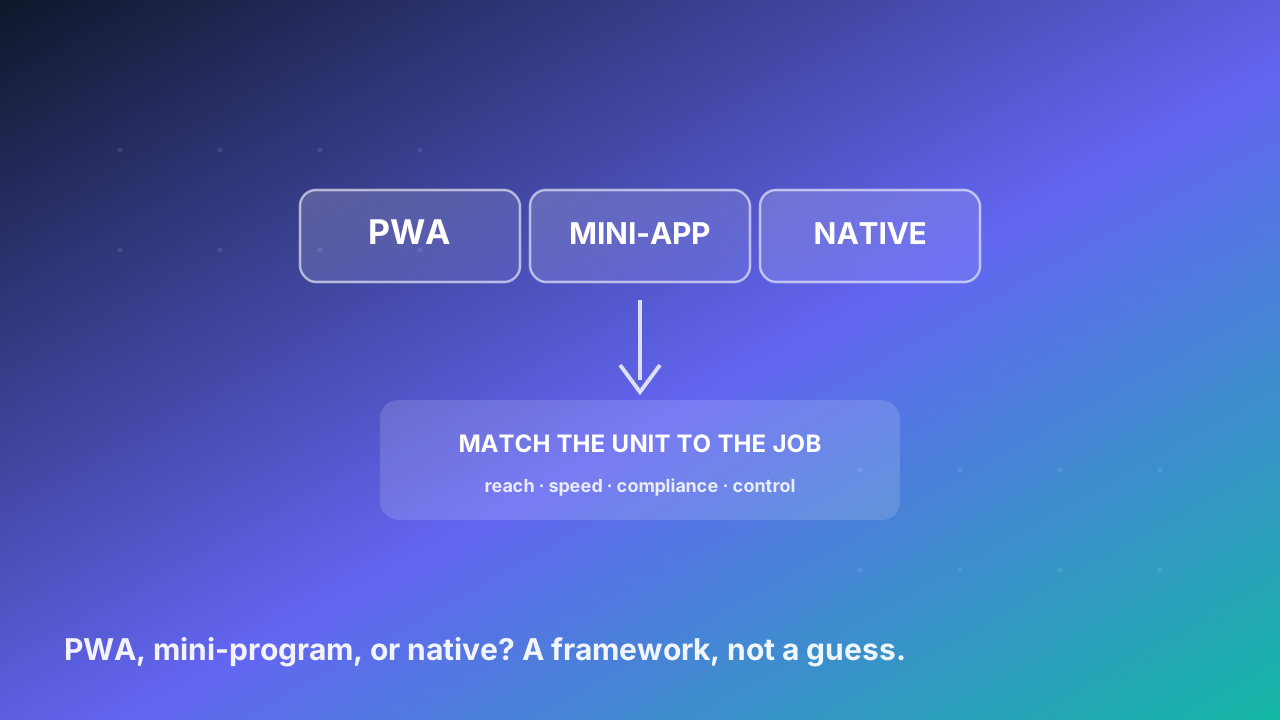
Stop guessing which app form to build. A practical 2026 framework maps your real constraints — reach, time-to-market, compliance, payment, control — to the right unit: PWA, native, or a governed mini-program.
Generosity is a moment — a story, a disaster, a friend's fundraiser. The gift is won or lost inside the app the donor already trusts, and a governed mini-program delivers it with proof.
China didn't adopt mini-programs — it built an alternative internet on top of them. WeChat alone runs ~4.3 million programs with ~945M monthly users and over ¥8 trillion in 2024 GMV. Here's how the model works and why it scales.