
The two-minute errand
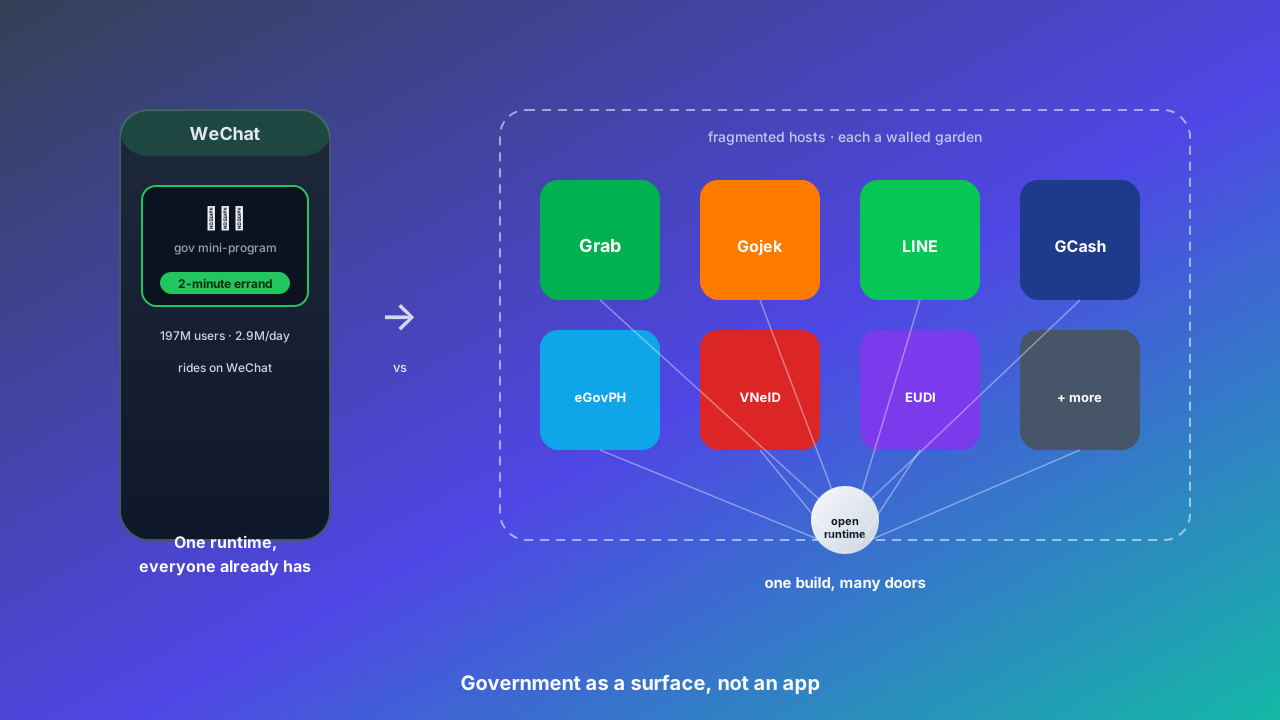
Here is something that happens in Guangdong every few seconds. Someone needs a social-security record pulled, a permit renewed, a tax status checked. They open WeChat — the app they already have open — tap 粤省事, and it is done in about two minutes. No new account. No queue. No trip downtown.
粤省事 is not an app. It is a mini-program that lives inside WeChat. Since it launched in May 2018, it has gathered roughly 197 million verified users and now clears around 2.9 million transactions a day. Zhejiang's 浙里办 pulls the same trick at province scale: 130 million registered users, 3 million active on an average day.
Notice what China did not do. It did not ask 1.3 billion people to download a new government app. It parked the government inside the app they already use. That is the whole trick.
What Southeast Asia is actually building
Now look at what is happening next door, because it is going a different way — and it is worth being honest about which way works.
The Philippines launched eGovPH in June 2023. A real achievement: over 13 million users, more than 150 million transactions, 75 national services and 1,300 local-government sites wired into one entry point. Vietnam went further and harder with VNeID — live since 2021, now 83.5 million registered accounts (about 63% of the population), 2.1 billion transactions by September 2025, and from July 2025 effectively mandatory for online public services.
Both are genuinely impressive. But read the fine print: each is a native, sovereign app. eGovPH is a download from Google Play or the App Store. VNeID is mandatory because the state can make it so. Vietnam's bigger number looks the way it does partly because showing your digital ID became something you are required to do.
Here is the uncomfortable part. A government can force its own citizens to install an app. A public-service provider, a utility, a health nonprofit, a cross-border service — they cannot. And even governments hit a wall the moment they step outside their own border. eGovPH stops at the Philippine shoreline. VNeID stops at Vietnam's. There is no shared surface.
The walled-garden tax
This is the line the "just build an app" crowd misses. Southeast Asia does not have one WeChat. It has Grab, Gojek, LINE, GCash, and a dozen government apps that do not talk to each other. If you are a service that wants to reach people across the region, you do not get to ride one runtime. You rebuild a native integration for every host, in every country. That is the walled-garden tax, and it is paid in engineering weeks and abandoned projects.
China dodged that tax at home because one runtime — WeChat — was everywhere. Southeast Asia has no such runtime. So the lesson from 粤省事 is not "copy the mini-program." It is sharper: a public service should ride inside the app the citizen already trusts, not demand a new one. And in a fragmented market, "the app they trust" is plural.
What a governed surface actually buys you
Mini-programs get waved off as a China-only quirk. They are not. The world is quietly converging on the same idea — a portable, governed surface that holds your identity and credentials and lets you share only what a transaction needs.
The European Union is building exactly this. Under eIDAS 2.0 (Regulation (EU) 2024/1183, in force since May 2024), all 27 member states must offer a European Digital Identity Wallet by the end of 2026 — free, open-source, able to issue qualified electronic signatures, and built so you share a driving licence or a diploma selectively, not the whole file. Privacy-by-design, not privacy-by-policy.
That is the same bet 粤省事 made six years earlier, just at treaty scale. The pattern is identical: do not make people come to you; go to where their identity and trust already live, inside a surface you can govern and, when needed, take down.
The opening for an open runtime
So here is where Cross Mini App fits — and it is not the obvious "mini-programs are coming to Southeast Asia" pitch.
That pitch assumes there is a WeChat to plug into. There is not. What exists is a patchwork of hosts: Grab's 46 million transacting users, Gojek, LINE, GCash's 94 million wallets, and the government apps above. Each is a walled garden. The value is not in becoming another one. It is in being the layer that lets a governed service — a public-information widget, a benefits check, a verified-credential step — run inside all of them from a single build.
That is the part 粤省事 cannot teach Southeast Asia directly, because China had a monopoly runtime to lean on. The region needs the thing China got for free: a neutral, governed runtime any host can embed and any service can ship to once. One build, many doors. Auditable, takedown-able, and portable across borders a single government app will never cross.
The errand, again
Back to the two-minute errand. The win was never the technology. It was that the government met the citizen inside the app already in their hand. Southeast Asia's governments are building excellent apps that sit one icon away from being opened. The next move is not another download. It is learning to live inside the apps people actually open — and building the runtime that lets a service do that everywhere at once.
| Surface | Lives in | Verified scale | Locked to |
|---|---|---|---|
| 粤省事 (Guangdong, China) | WeChat mini-program | ~197M users, 2.9M txns/day | One province |
| 浙里办 (Zhejiang, China) | Native app + mini-program | 130M users, 3M daily active | One province |
| eGovPH (Philippines) | Standalone native app | 13M+ users, 150M+ txns | One country |
| VNeID (Vietnam) | Standalone native app (mandatory) | 83.5M accounts, 2.1B txns | One country |
| EUDI Wallet (EU) | Sovereign wallet app | 27 states by end-2026 | EU, cross-border |
Sources
- Guangdong Provincial Government Services and Data Administration — 粤省事 monthly figures
- Zhejiang Provincial DICT — 浙里办 130M registered users
- Manila Bulletin / DICT — eGovPH passes 13M users
- VietnamNet — Vietnam's digital revolution runs on VNeID
- European Commission — eIDAS 2.0 and the European Digital Identity Wallet