
The four markets, and the two questions
Cross Mini App's thesis is simple: a universal runtime plus an open catalog ports proven mini-program content into the overseas apps users already live in. But 'overseas' is not one market. The pattern wins first in places where the phone already is the bank, the mall, and the government window - and where a home-screen app you build from zero cannot buy the surface it needs.
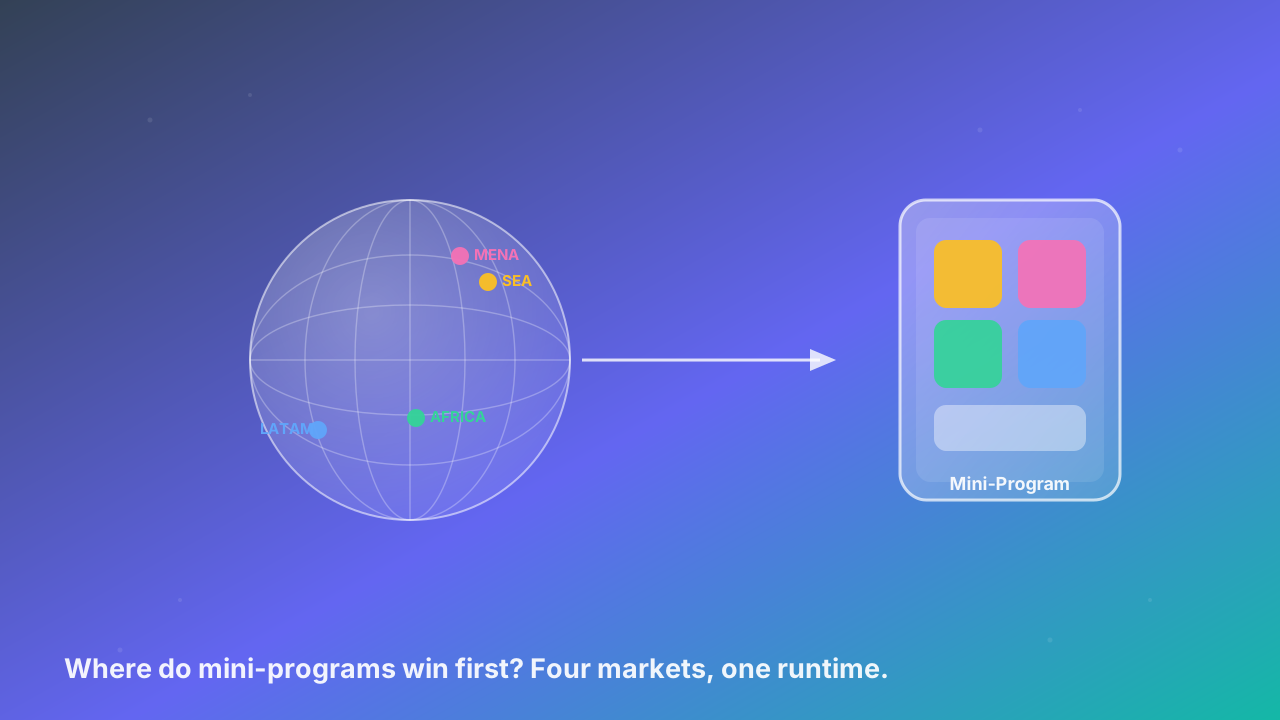
Four regions fit that description today: Southeast Asia, the Middle East and North Africa, Sub-Saharan Africa, and Latin America. Each has a booming app market in the sense that matters - not a crowded App Store, but a daily super-app, wallet, or messenger that owns the relationship with the user. We treat India and the US-EU as counterexamples at the end, because the same playbook does not transfer cleanly there.
Before the regional breakdown, lock the two decisions every team actually faces:
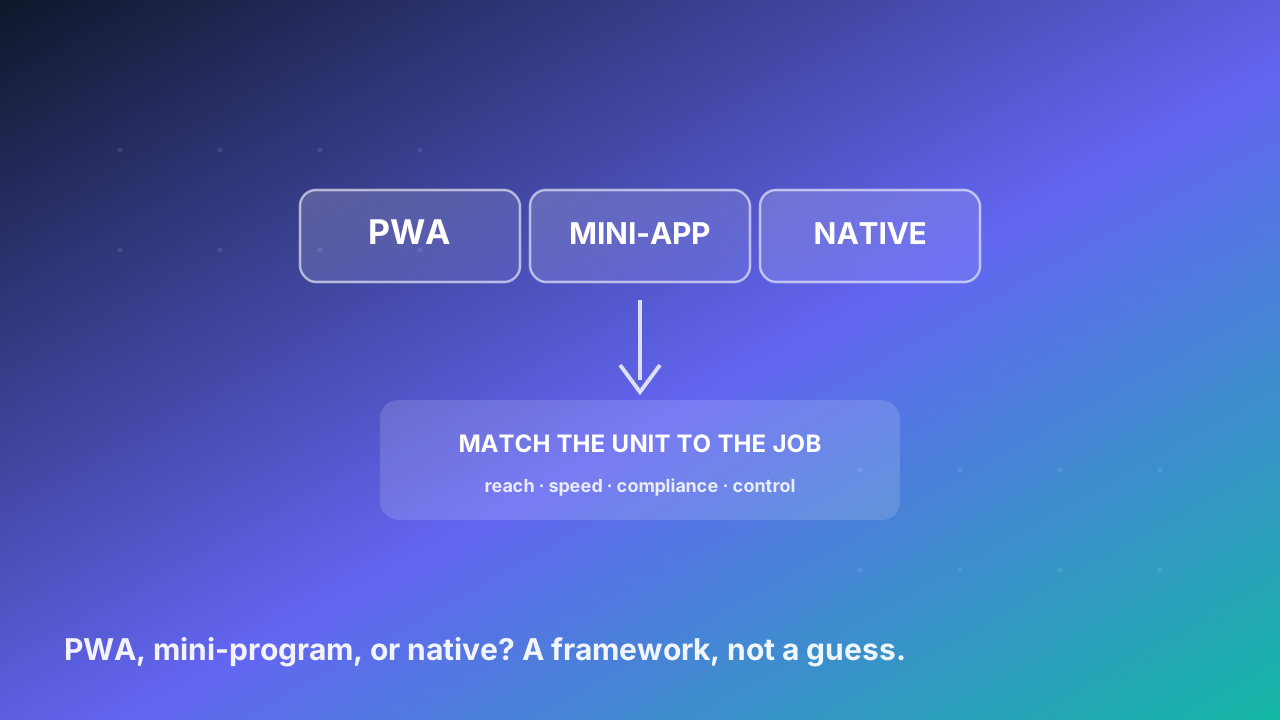
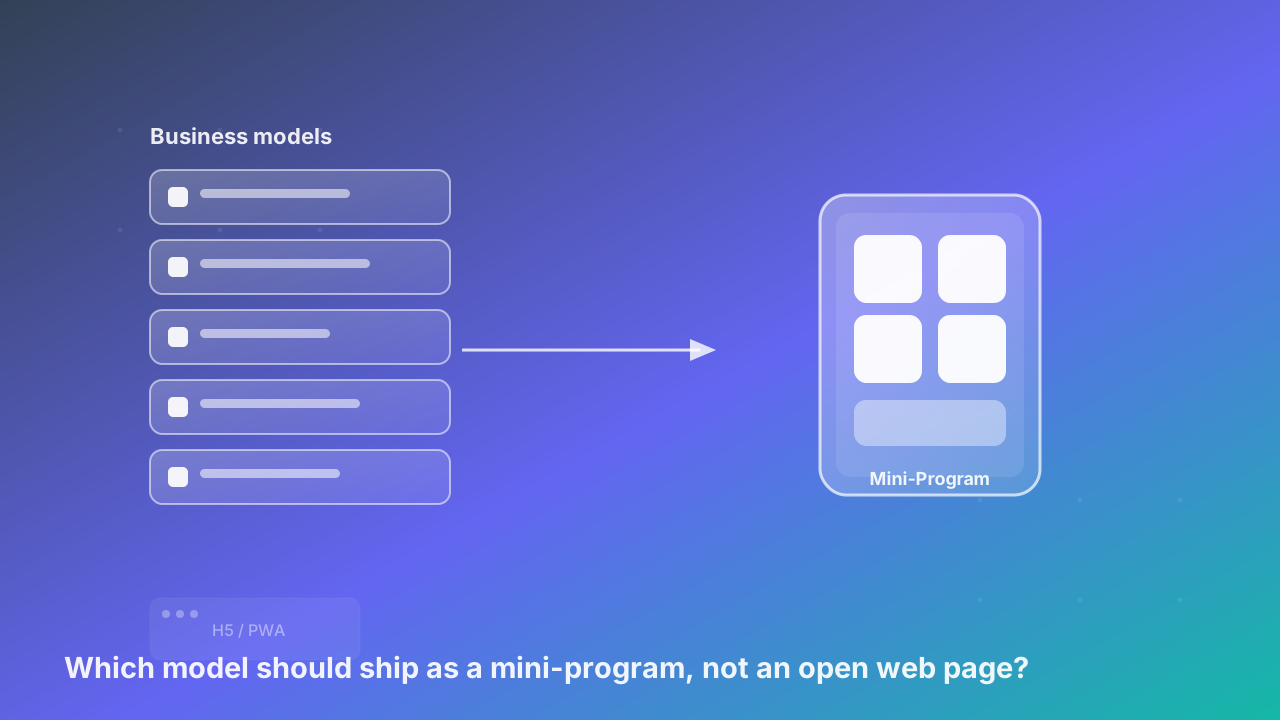
- Mini-program or independent app? Build as a governed program inside a host when distribution, trust, and acquisition are cheaper to borrow than to earn. Build a standalone app when you are a destination brand, need deep OS integration, or operate where no host dominates.
- Mini-program or cold-start H5 or PWA? Build a mini-program when payment and identity must settle in context and the host is the trust source. Build an H5 page or PWA when you need universal, search-friendly reach with zero platform dependency, or offline-capable app-like speed on an existing web property.
A market belongs at the top of your list when both answers point the same way: not an app, and not a bare web page - a hosted program.
Why these four, specifically
These regions share a structural shape that the US and Western Europe do not:
- A host owns the daily surface. Grab, Gojek, GCash, MoMo, regional wallets, M-Pesa, OPay, WhatsApp, Mercado Pago, and Nubank are opened more than the browser. Your service appears where the user already is.
- Trust is borrowed, not built. Payments, lending, and government services need a regulated entity vouching for you. A host with tens of millions of users is that voucher; a new icon is not.
- Acquisition is expensive on your own. Installs cost money, storage is scarce, and data is metered. A program reached through a host carries zero install and zero storage tax.
- But the host layer is fragmented. Unlike China's single WeChat, these markets have a constellation of parallel hosts - different logins, wallets, and review cycles. That is exactly why a universal runtime, not a per-host rebuild, wins.
The rest of this guide turns that into a carrier decision per market.
Southeast Asia: embed in the super-app
The daily surface is a super-app or a wallet. Grab and Gojek cover ride-hailing, food, and hyperlocal services across the region; GCash and MoMo are de facto banks in the Philippines and Vietnam; GoPay, OVO, and DANA sit on top of commerce.
Priority models as mini-programs, not apps:
- Merchant ordering and hyperlocal booking inside Grab or Gojek - a salon, a mechanic, a restaurant reorder rides the host's logistics and payments.
- Bill pay, airtime top-up, and micro-lending inside GCash or MoMo - trust- and frequency-driven, not destination-driven.
- Government and utility services via the host, where the wallet is the only formal digital front door for most users.
Carrier: mini-program inside the dominant host. A standalone app cannot buy Grab's surface or its near-zero acquisition cost.
Middle East and North Africa: ride, retail, and the wallet
MENA is the least-covered of the four, and the most underrated. Careem and Talabat run regional super-apps across ride-hailing, food, and payments; Noon anchors e-commerce; and a layer of bank-led and telecom wallets (STC Pay, Etisalat, and others) carries daily transfers. Government digital services are consolidating into national apps and wallets.
Priority models:
- Ride and delivery adjacencies - fuel, parking, toll, and package services built around the Careem or Talabat journey.
- Wallet-led finance - bill pay, remittance, and micro-lending inside the regional wallet rather than a separate finance app.
- Government and retail services - utilities, telecom top-up, and merchant checkout where the host is already the entry point.
Carrier: mini-program inside the regional super-app or wallet. The trust and reach arrive in one vetted unit.
Sub-Saharan Africa: the mobile-money native
Africa skipped the desktop and the card era at once. M-Pesa in Kenya and East Africa, OPay and PalmPay in Nigeria and West Africa, and a spread of operator wallets make the phone the financial system. Distribution runs through agents and USSD as much as smartphones, but smartphone mini-programs ride the same rails.
Priority models:
- Airtime and bill top-up, agent-assisted pay inside the mobile-money wallet.
- Micro-lending and micro-insurance - the host's identity and wallet do the underwriting and settlement a cold web page cannot.
- Merchant and utility payments where the wallet is the settlement rail.
Carrier: mini-program inside the mobile-money host. A standalone app starts from zero trust and loses the conversion at payment.
Latin America: meet the user inside WhatsApp and PIX
LatAm inverts the super-app story: the daily surface is the messenger. WhatsApp reaches 85 to 95 percent of smartphones in Brazil; Brazil's central-bank instant payment PIX touches over 90 percent of adults; Mercado Pago and Nubank run continent-scale fintech. The hosts are parallel, not unified.
Priority models:
- Conversational commerce - catalog, order, and pay without leaving the WhatsApp chat.
- PIX-native checkout - settle inside the conversation or the wallet, not via a gateway redirect.
- Group-buy and reseller networks, micro-lending, and micro-insurance on top of Mercado Pago or Nubank identity.
Carrier: mini-program inside WhatsApp, Mercado Pago, or Nubank. A cold H5 page or a fresh app install cannot win the in-chat moment.
The master carrier table
| Market | Dominant host | Priority models | Preferred carrier |
|---|---|---|---|
| Southeast Asia | Grab, Gojek, GCash, MoMo | Merchant ordering, top-up, micro-lending | Mini-program in host |
| MENA | Careem, Talabat, regional wallets, Noon | Ride adjacencies, wallet finance, gov/retail | Mini-program in host |
| Sub-Saharan Africa | M-Pesa, OPay, PalmPay | Top-up, agent pay, micro-lending/insurance | Mini-program in host |
| Latin America | WhatsApp, Mercado Pago, Nubank, PIX | Conversational commerce, PIX pay, group-buy | Mini-program in host |
In every row the independent app and the cold-start H5 or PWA lose the same thing: the host's surface, trust, and payment rail. Use the app when you are a destination brand; use H5 or PWA for the open-web share link and offline reading.
Where the playbook does not transfer
India and the US-EU prove the rule by exception. India has UPI and massive digital payments, but also a dominant independent-app and Play-Store culture, price-sensitive data norms, and strong domestic super-apps that already fill the shelf - so a fresh hosted program competes harder for attention. The US and Western Europe default to a home-screen app or a strong web property: card rails are universal, trust is earned through brand and store review, and no single messenger or wallet owns the daily surface. In those markets the independent app or a well-built H5 or PWA is often still the right first carrier. Read the four markets above as the wedge, not the whole map.
Where Cross Mini App fits
Cross Mini App is the universal runtime and open catalog for the hosted-program model. The hosts in this guide - Grab, MoMo, Careem, M-Pesa, OPay, WhatsApp, Mercado Pago, Nubank - each speak their own format. Build a mini-program once against a standard API surface and drop it into any trusted host instead of rewriting per platform. Pre-compliant, sandboxed, and localized programs inherit the host's identity, payment, and daily surface with no install. For these four markets, that is the unit that reaches the next billion users - built once, embedded wherever their host already is.