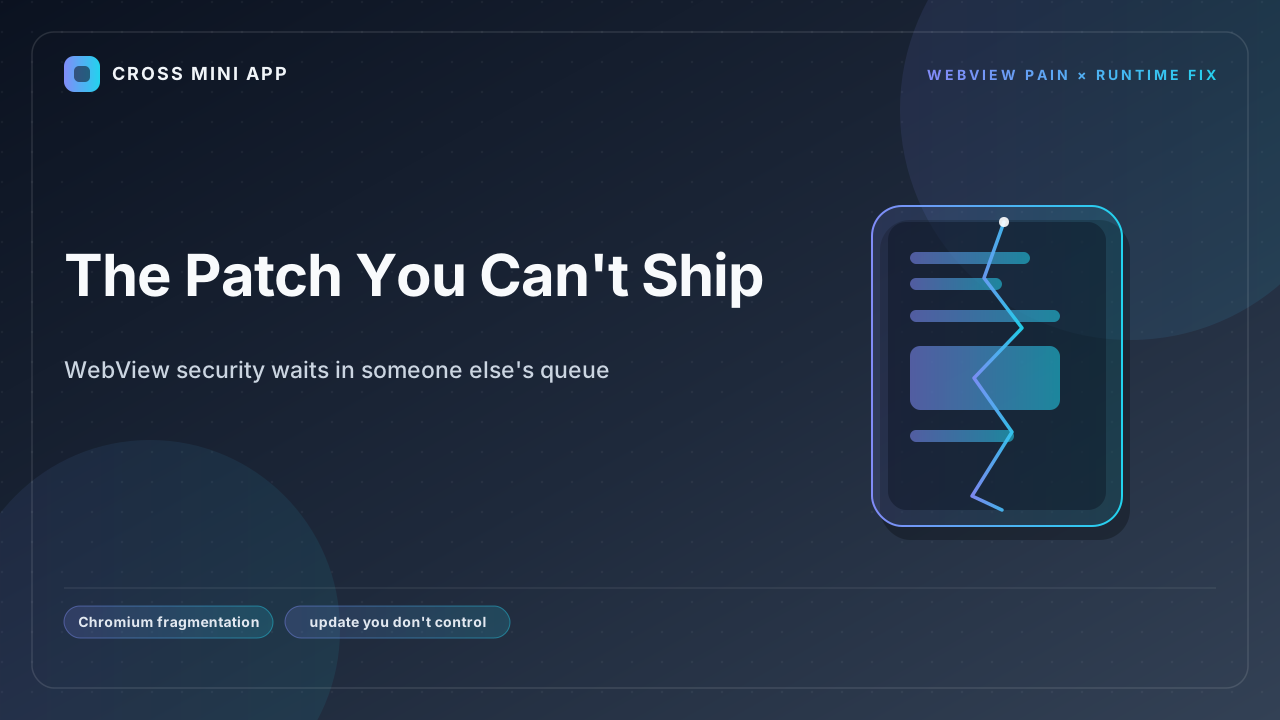
You ship a fix for a WebView vulnerability the same way you ship any other fix — except you don't. The browser engine rendering your in-app checkout, login, and forms is Chromium, and on Android that engine lives in a system component updated by Google and the Play Store, not by your team. The security of some of your most sensitive screens is decided by a piece of software whose version you neither control nor can pin.
The engine you don't own
Since Android 5.0, Google decoupled WebView from the operating system and began shipping it as an updatable app through the Play Store. On Android 7.0 and later, when Chrome is installed, the system often uses Chrome itself as the WebView provider. The practical consequence is simple: the version of the rendering engine behind your WebView is whatever the user's device happens to have, updated on Google's schedule, not yours. Your signed binary can carry a fixed native library; the WebView engine is someone else's binary on someone else's clock.
Fragmentation is the default, not the exception
The idea that «everyone is on a recent Chromium» is a comforting fiction. Device makers customize WebView, system updates lag, and some vendors restrict switching back to the Google WebView. On devices without Google Mobile Services — a meaningful slice of the Asian market — Play Store updates don't reach WebView at all. Public distribution data shows WebView builds at Chromium 110 or newer reached about 89% of Android devices in 2024 Q2, which means a double-digit percentage still runs older branches, some of them twenty or more versions behind. Huawei's WebView tops out near Chromium 114; older Honor devices sit near 116. Your «one H5» runs across an engine matrix you will never fully test.
When the shared component breaks, everyone breaks
This dependency cuts both ways. In March 2021, a defective WebView update pushed through the Play Store caused immediate launch crashes across dozens of apps that depended on it — Gmail, Google Pay, Samsung Pay, and numerous banking apps became unusable for millions of users worldwide. The fix required Google to pull the bad build and ship a patched one, while affected users waited. Your app's stability was hostage to a component you didn't author, on a day you didn't choose.
Your security patch waits in their queue
Suppose you discover that a class of WebView-based attacks is being exploited against your users. What can you ship? Largely nothing on the engine side. You can harden your own code, but the underlying Chromium patch arrives only when Google releases it and the user actually updates the component — gated by device, region, carrier, and whether automatic updates are on. Google's own security bulletins list WebView-related CVEs as a recurring high-severity category (roughly 17% of high-risk vulnerabilities in one 2023 bulletin). The patch exists; its arrival on your users' phones is not yours to command.
The runtime fix
A host-owned runtime renders mini-programs with the platform's native UI toolkit instead of a borrowed browser engine. There is no second Chromium whose version you must track across a thousand device profiles. Your business logic ships inside a versioned, signed package you control, so a security fix travels with your release cadence — not Google's, not the carrier's. You stop waiting in someone else's update queue, and you stop wondering which of your users is running the engine branch you never tested against.
| Dimension | WebView | Host-owned runtime |
|---|---|---|
| Engine version control | Decided by Android / Play Store / device maker | Decided by you, in your signed package |
| Security patch arrival | Gated by Google release + user update | Ships with your release |
| Device fragmentation | Dozens of Chromium branches in the wild | One runtime you build and test |
| Shared-component outage | A bad WebView update can crash many apps at once | Isolated to your app |
| What you can pin | Nothing on the engine | The entire runtime version |
The pattern repeats across this whole series: the moment a critical path leaves your signed binary and becomes «a document fetched from your server,» control leaves with it. With a WebView you lose even the ability to guarantee which engine renders it. A runtime hands that guarantee back.
Sources
- Android Developers: WebView — WebView renders web content and has been updated independently via Google Play since Android 5.0.
- Google Play: Android System WebView — the component other apps use to display web content; 10B+ installs.
- The 2021 Android WebView crash — a faulty WebView update took down Gmail, Google Pay, and banking apps for millions.
- WebView version distribution, 2024 Q2 — WebView builds at Chromium 110+ reached about 89.3% of Android devices; older branches persist.
- Android Security Bulletin — WebView-related CVEs remain a recurring high-severity category.