
When Silicon Valley talks app fatigue, Latin America builds super-apps
The West is obsessed with "app fatigue" — users download fewer apps each year, and the home screen is a graveyard of forgotten icons. But in Latin America the opposite is happening. A continent of super-apps is forming quietly, and it is one of the largest untapped distribution channels for digital services on the planet. The region skipped the desktop era and went straight to mobile, so the phone is the bank, the mall and the post office. The catch is subtle: these super-apps have the users and the payments, but they do not have the content. That gap is exactly where mini-programs win — and exactly where an open catalog changes the game.
The numbers do not lie
This is not a forecast. It is already live in 2026:
- WhatsApp sits on 95%+ of Brazilian smartphones with roughly 169 million monthly active users. In May 2026, Meta rolled out a native in-chat marketplace (up to 500 products per business) and Pix payments that settle without leaving the conversation. Early benchmarks show cart abandonment down ~47% and add-to-cart conversion up ~41% (Meta for Developers, AeroChat country status).
- Mercado Pago, the fintech arm of Mercado Libre, reached 162 million active users across 18 countries in 2025, processing about $28 billion in monthly transaction volume by December 2025 (Mercado Libre investor relations).
- Nubank now serves 130M+ customers — over 60% of Brazil's adult population — and is pivoting to an "AI-native bank," with Pix-with-AI alone above 10 million monthly actives (Euromoney, Latin America's best digital bank 2026).
- Rappi runs a 35M-monthly-active super-app spanning delivery, fintech (RappiPay) and travel across Spanish-speaking LatAm (Rappi business model breakdown).
- The market itself: LAMEA super-apps are forecast to grow from $8.7B in 2026 to $42.91B by 2036 at a 19.4% CAGR (MarkWide Research).
That is a balance sheet, not a vision board.
Structurally different from China
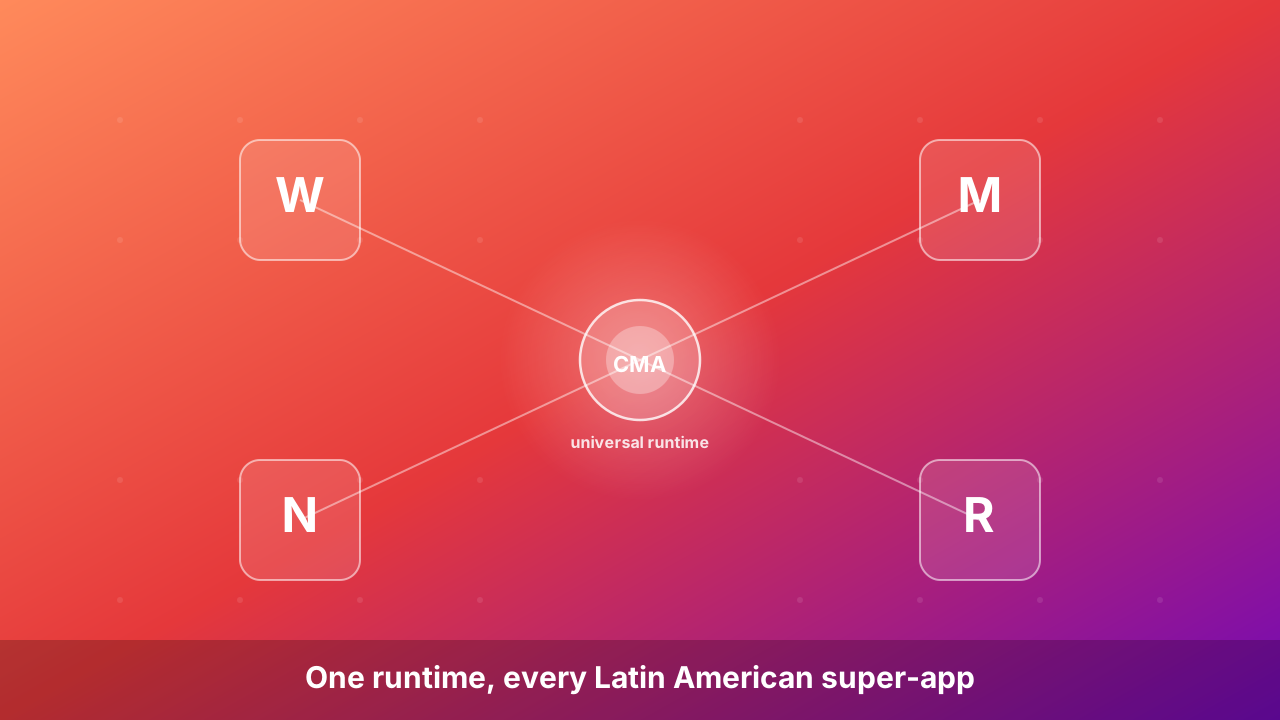
China's mini-program story is a single-app story: one WeChat, one identity, one payment rail, one social graph that doubles as a distribution engine. Latin America has no WeChat. It has a constellation of parallel super-apps — WhatsApp for conversation, Mercado for commerce, Nubank for banking, Rappi for delivery — each with its own users and its own fragmented payment rail (PIX in Brazil, PSE in Colombia, OXXO Pay in Mexico). Rebuilding your service once per host, per market, per payment method is a tax no growth-stage team can afford. The winning architecture is not "one more super-app." It is a runtime that sits above all of them and speaks each host's language.
The content gap is the real opportunity
Here is the insight most people miss: these super-apps are hungry for supply, not demand. They already own the traffic, the wallet and the daily habit. What they lack is a filled service shelf — local services, content, utility tools — compared with the decade of accumulation inside China's mini-program ecosystem, where millions of mini-programs cover everything from hospital queues to street-food ordering. Latin American hosts are years behind on that supply side, and the developer base that could fill it is still thin. Rappi's own strategy admits it: "Don't build the next super-app. Become an ingredient in theirs." The hosts want third-party services to plug in; they do not want to build everything themselves. That is the opening for a catalog of ready-made mini-programs.
Why a catalog beats bespoke integration
The naive approach is to integrate point-to-point: a separate SDK, a separate review cycle and a separate payment wiring for every super-app. With four major hosts and three payment rails, that is an N×M problem that quietly eats a year of engineering. An open catalog collapses that to N×1. You build the mini-program once against a universal runtime; the runtime handles the host-specific plumbing — identity, payment, embedding — and the catalog handles discovery. The super-app gets a richer shelf overnight; you never re-platform. This is the same leverage that made China's mini-program ecosystem explode: a shared runtime plus a shared directory, not a thousand custom deals.
Where Cross Mini App fits
Cross Mini App is a universal runtime plus an open catalog. You build a mini-program once and drop it into any Latin American host — chat, commerce, banking or delivery — without store review and without re-platforming. The catalog is the lever: proven Chinese mini-program content (commerce, lifestyle, utilities) flows straight into the service gaps of LatAm super-apps, localized for Spanish/Portuguese, PIX and local currencies. The host gets a richer shelf; the developer reaches every cooperative app from one build; the user gets zero-friction access inside the app they already live in.
A three-step playbook
- Pick proven content. Start from mini-programs already validated by millions of users in China — don't invent from a blank page.
- Adapt, don't rewrite. Swap copy to Spanish/Portuguese, wire PIX/PSE/OXXO Pay, and localize currency and UX for low-end devices and patchy 4G.
- Distribute across hosts and monetize. Ship once, embed in multiple super-apps, and earn through revenue share and in-app advertising.
The future is not a cloned WeChat
The next chapter of Latin American super-apps will not be a copy of China. It will be mature mini-program content, re-hosted through a cross-app runtime, blooming simultaneously inside WhatsApp, Mercado, Nubank and Rappi. Traffic apps get a content flood. Developers stop rebuilding market by market. Users stop downloading. Cross Mini App is the runtime that makes that possible — turning Latin America's quiet super-app boom into an open catalog anyone can join.