
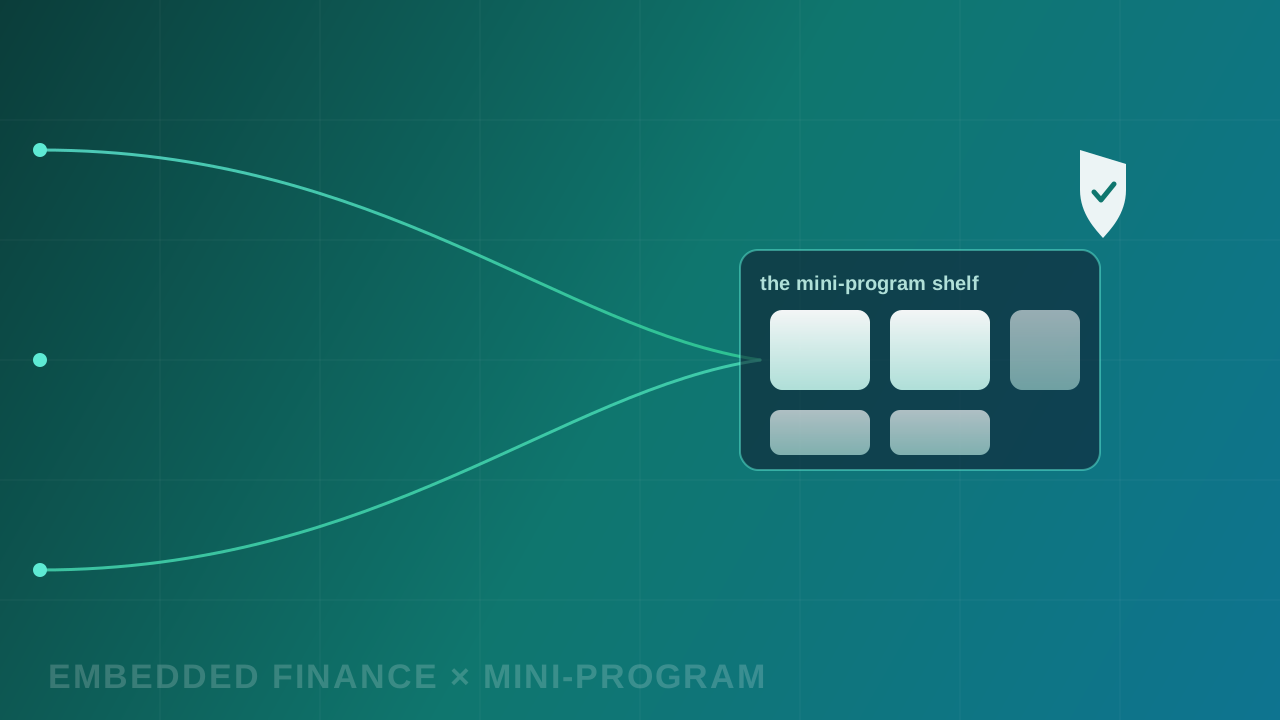
Everyone is laying pipe. Nobody is stocking the shelf.
The fintech story of 2026 is a story of infrastructure. Real-time payment rails now move money in seconds across India, Brazil, the US and the eurozone. Open banking rules are prying customer data loose from the institutions that hoarded it. Embedded finance — the idea of offering loans, insurance and investments inside the apps people already use — is projected to be a $138 billion market this year, up from $43 billion in 2021, a 215% leap Juniper Research. On paper, the plumbing for a new financial internet is finished.
And yet open almost any bank app or super-app and the experience is thin: a balance, a transfer, maybe a clumsy insurance upsell. The rails are world-class; the storefront is empty. Embedded finance's real bottleneck in 2026 is not the pipe. It is the front-end — the composable, trustworthy surface where a financial service actually meets a human. That surface is a mini-program.
The pipes really are done
Start with payments. India's UPI processed 228.3 billion transactions worth about $3.4 trillion in 2025 and now handles more real-time volume than Visa Axis Intelligence. Brazil's Pix cleared roughly $6.3–6.7 trillion the same year and reaches over 90% of adults Axis Intelligence. The US caught up fast: FedNow settled more than $853 billion in 2025, a near-460% jump in volume Axis Intelligence. In Europe, the EU's Instant Payments Regulation made receiving instant euros mandatory for banks in January 2025 and sending them by October 2025, pulling SEPA Instant from niche to default Axis Intelligence.
Then the data. The EU's PSD3/PSR reform reached political agreement in November 2025 and is expected to apply from 2027, folding e-money and payment rules into one framework Taylor Wessing. Sitting beside it, the Financial Data Access (FIDA) regulation extends open banking beyond payment accounts to savings, investments, mortgages, insurance and pensions — with customer-controlled consent and shared rulebooks called Financial Data Sharing Schemes advisori. Money and data can now both move on demand. The network layer is solved.
The shelf is still empty
So why does embedded finance feel theoretical? Three gaps, and mini-programs sit in the middle of all of them.
Banks have the license, the trust and the rail — but weak distribution. Their apps are where money lives, not where services are discovered. The banking mini-apps platform market was already about $2.8 billion in 2025 and is growing at a 16.8% CAGR, yet most deployments are inward-facing dashboards, not open marketplaces Dataintelo.
Super-apps have the users but fragmented services. A ride-hailing super-app can move money and people, but it does not natively offer a travel-insurance widget or a micro-investment product. Building each one is a bespoke integration project.
Merchants want embedded finance at checkout — BNPL, embedded insurance, instant lending — but integrating a regulated financial product into a storefront means KYC, licensing, fraud and compliance work most teams cannot absorb.
The missing object is a standardized, governed, sandboxable unit of financial experience: a lending widget, an insurance widget, an investment widget that can drop into any host and behave. That unit is a mini-program.
Why mini-programs are the missing layer
A mini-program is the right shape for embedded finance for three reasons a raw API or a full native app is not.
It is a bounded capability, not a black box. The host knows exactly what the service can read and do — which is exactly the consent-and-scope model FIDA and PSD2 demand. Compliance becomes a property of the unit, not a negotiation with every integrator.
It ships with identity and payment built in. The rail is already there — UPI, Pix, SEPA Instant. The mini-program just calls it, so a credit decision can end in a settled payment in the same session. A service that can only recommend is a search box; a service that can settle is a channel.
It is composable and updatable. One team ships a vetted insurance mini-program; a thousand hosts embed it; a regulatory change ships as an update, not a re-platform. Juniper expects embedded payments transaction value to reach $2.5 trillion by 2028 — every dollar of that still needs a front-end Juniper Research.
This is why banks are already treating mini-apps as strategy. Bank of America's Life Plan surfaces personalized financial mini-apps to over 35 million digital customers; HSBC, JPMorgan, Santander and others have publicly earmarked mini-app platforms as core to digital transformation Dataintelo. The front-end is becoming the product.
The cross-app problem
There is a catch the industry keeps rediscovering: every bank and super-app rebuilds its own mini-app silo. That is N×M integration — N services × M hosts — and it breaks at scale. Fragmentation also creates risk. In China, where bank mini-programs exploded, regulators twice in 2025 named institutions for leaking personal information through mini-program channels. The lesson is not "avoid mini-programs." It is "govern them once, centrally, compliantly — then distribute."
Where Cross Mini App fits
Cross Mini App is the universal shelf for this moment. A single cross-app runtime plus an open catalog means a financial mini-program is built once, vetted once, and embedded everywhere: a bank, a super-app, a messaging platform, a merchant checkout. Pre-compliant, sandboxed, localized mini-programs — including China-validated lending, insurance and investment modules — drop into global hosts without a bespoke rebuild. Developers stop re-integrating per rail. Hosts stop rebuilding per service. Users get a financial service in the app they already trust, with a settlement that lands in seconds.
The rails are global. The shelf should be too.
Embedded finance's next decade will not be won by whoever owns the pipe — UPI, Pix and FedNow are utilities, and utilities commoditize. It will be won by whoever owns the composable front-end: the trusted, governed layer where a rail becomes a service a person actually uses. Mini-programs are that layer. A cross-app runtime is the shelf that finally stocks it. Cross Mini App is building that shelf so the financial internet can finish what its plumbing started.