
Most people remember China's mini-program story through commerce and games. The quietest and most portable invention is simpler: a square pattern printed on a restaurant table, a bus stop, a museum wall. Scan it, and a complete service opens — no app install, no account, no payment setup. That flow is the lowest-friction digital entry point humanity has mass-produced, and it is the cleanest canvas a universal runtime can offer.
Why scan-to-use is the purest pattern
A mini-program opened by a code is the only category that needs almost nothing from the local environment. Compare it with the others in this playbook: games need content production, social commerce needs a payments rail, government services need a national ID. Scan-to-use needs a camera, a screen and a runtime. Nothing else.
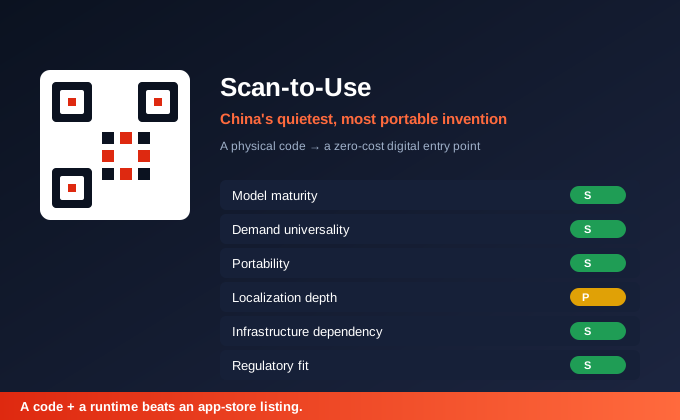
| Dimension | Rating | What the evidence says |
|---|---|---|
| Model maturity | S | 945 million WeChat mini-program users in 2024, ~70 sessions per user per month; offline scan-based transactions reached RMB 62.76 trillion in 2024, QR aggregate acquiring hit RMB 68.6 trillion |
| Demand universality | S | Any market with smartphones and printed codes benefits: menu ordering, bus schedules, museum guides, event check-in |
| Portability | S | Pure runtime behavior — scan, resolve, open, finish — with no hard dependency on local payments or identity; payment can be layered on later |
| Localization depth | P | Codes must be generated locally and merchants onboarded, but the pattern itself is language- and currency-neutral |
| Infrastructure dependency | S | Requires only a camera and a renderer; lightweight interactions run before any local rail exists |
| Regulatory fit | S | No cross-border data, no financial license — a pure utility |
The three moves worth copying
- Code as a universal pointer. A QR is just a URL that works without typing. China turned every physical surface into a launch button. The lesson is not "use QR codes" — it is "make the entry point free."
- Zero-account opening. The first scan opens a usable service. Accounts, wallets and payments appear only when the task needs them. Friction is deferred, not removed.
- Progressive payment. A menu viewer needs no money. A pay-by-code checkout does. The same runtime graduates from utility to commerce without a new app.
The CrossMiniApp angle
A universal runtime makes scan-to-use available to anyone, anywhere. A small shop, a bus stop, a festival — each can publish a lightweight, scan-opened mini-program at near-zero cost. The open catalog then lets one generated code point to any published program in the directory. Write once, generate a local code, and it is scannable everywhere. That is the universal-runtime-plus-open-catalog thesis in its most tangible form.
The rule
The cheapest digital entry point is a code and a runtime, not an app-store listing. China proved it at 945 million users; a universal runtime can reproduce it on any shore.