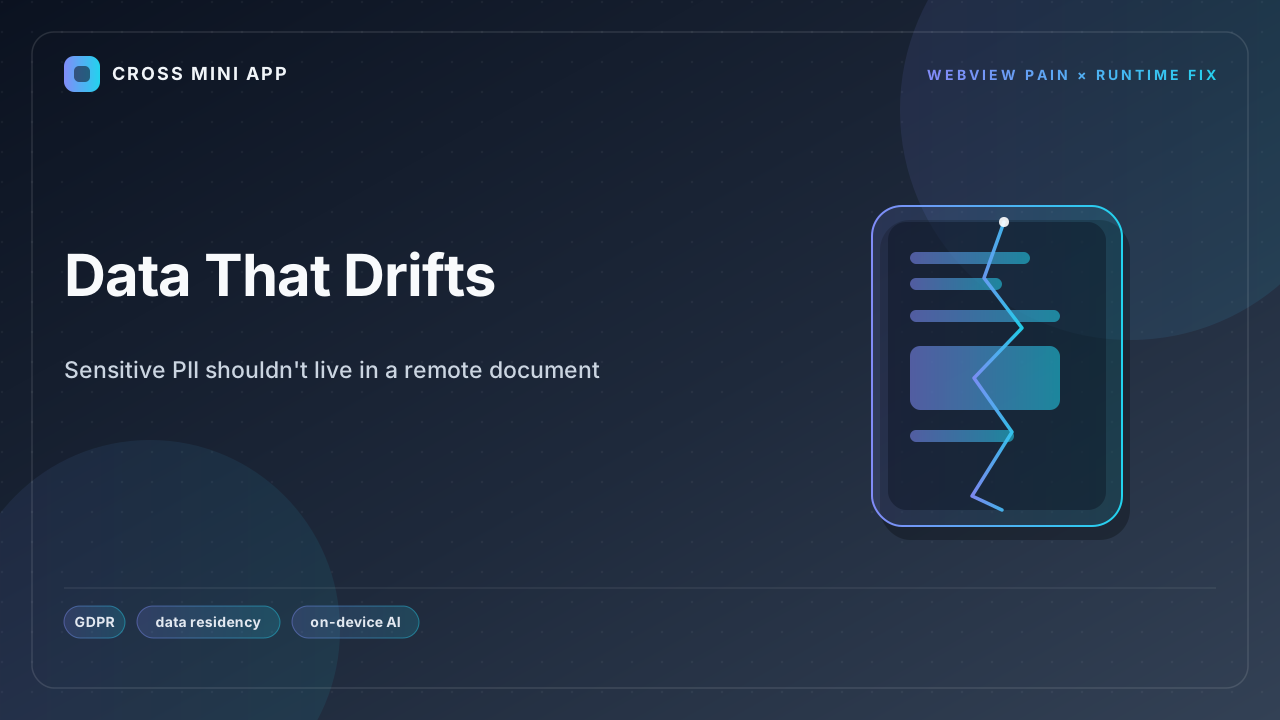
Putting a checkout or intake form inside a WebView feels fast — until you realize the user's name, payment details, and health data are traveling through a document fetched from your server, and often onward to third parties. That drift collides head-on with GDPR's data-minimization and data-residency rules, and with the cloud-AI default of training on whatever crosses the network.
The document that travels
A WebView screen is not a screen you drew. It is a document your server sends to the device at session time, rendered by a borrowed engine. Every field the user types is entered into that remote document and posted back across the network to your backend — and frequently to the analytics, payment, and identity SDKs embedded in it. The data does not stay where the user is; it moves, and each move is a copy with its own exposure.
Cross-border by default
For a multinational user base, that movement is rarely domestic. Regulators have made the point with fines, not guidance. In 2023, Meta was fined €1.2 billion by the Irish DPC for transferring EU users' data to the United States without adequate protection — the largest GDPR penalty on record. In April 2025, TikTok was fined €530 million for the same family of failures, including remote access to EEA user data from personnel in China. GDPR Articles 44–49 govern transfers to third countries; Article 5 requires that personal data be «adequate, relevant and limited to what is necessary.» A form that floats as a remote document makes both harder to honor, because you no longer know exactly where each copy lands.
Cloud AI trains on it by default
The drift continues past your own servers. A Stanford HAI study released in October 2025 examined how six major U.S. AI companies handle chatbot conversations and found that all of them use user conversations to improve their models by default, with retention periods that run long — in some cases indefinitely — and that data from a chat is often combined with other information the company holds about you. When a WebView ships user input to a remote model endpoint, it enters exactly these defaults. The upload step that on-device AI removes is the same step that creates the copy regulators and researchers are worried about.
The on-device counter-move
The industry's answer to that exposure is to keep the data local. Apple's own privacy documentation states that Apple Intelligence models «run entirely on device so that a task can be completed without data leaving your device» where possible, escalating to Private Cloud Compute only for heavier requests. Google's Gemini Nano runs through the Android AICore system service and, per Google's developer docs, delivers generative AI «without needing a network connection or sending data to the cloud.» This is the same instinct as data minimization in GDPR Article 5 — but achieved by architecture, not by promise.
The runtime fix
A host-owned runtime renders mini-programs locally, with sensitive data staying between the device and your governed backend rather than drifting through a document fetched from a third tier. Where on-device capability exists, inference and processing run locally; where it must go to your servers, the path is one you defined and can audit. Data minimization becomes a property of the architecture — fewer copies, fewer borders crossed, fewer silent third parties — instead of a clause you hope your remote document honors.
| Dimension | WebView | Host-owned runtime |
|---|---|---|
| Where PII lives | In a document fetched from your server, often onward to SDKs | Between the device and your governed backend |
| Cross-border transfer | Easy to lose track of every copy's location | Path you define and can audit |
| Third-party model training | Reachable by default when data crosses the network | Local or governed; no silent cloud copy |
| Minimization guarantee | A hope applied to a remote document | A property of the architecture |
| What you can prove | Hard to enumerate every copy | Fewer copies, by design |
The through-line of this series is control. A WebView hands your most sensitive input to a document you regenerate on someone else's schedule; a runtime keeps it in a boundary you own. In a regulatory environment where the fine for losing track of a copy is nine figures, that boundary is not a nicety.
Sources
- GDPR — Regulation (EU) 2016/679, Articles 5, 44–49 — data minimization and the rules for transfers to third countries.
- Data Protection Commission: Meta fined €1.2 billion (2023) — record GDPR penalty for moving EU user data to the US.
- DPC: TikTok fined €530 million (April 2025) — EEA user data accessed remotely from China.
- Stanford HAI: how six AI companies handle chatbot data (Oct 2025) — most train on user conversations by default with long retention.
- Android Developers: Gemini Nano / AICore — on-device model inference that keeps data off the network.