
Walk into a warung in Jakarta and watch how people pay. One customer scans a QRIS code through GoPay. The next taps OVO at a convenience store. A third settles ShopeePay inside a messaging thread. Nobody opened a banking app. Indonesia didn't crown one payments winner — it built a dozen, all running on a single rail the government forced everyone to share.
That is exactly why Indonesia is near-perfect soil for a mini-program ecosystem. It has enormous daily traffic, a unified national payment rail, and a cluster of closed super-apps that will not open up on their own. The opportunity is not another super-app. It is a runtime that rides the ones already there.
The six dimensions, scored on Indonesian ground
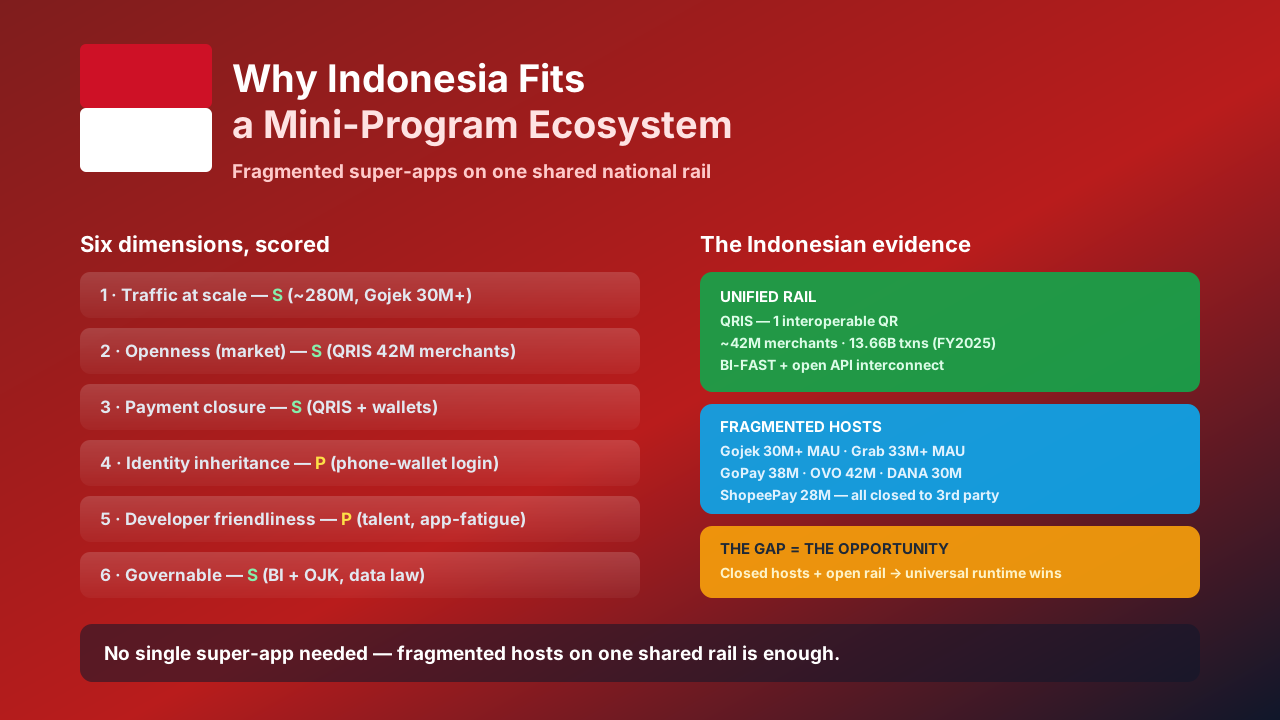
1. Traffic at scale. Indonesia is the world's fourth-largest country at roughly 280 million people, with smartphone penetration above 75% and internet use near 77%. Gojek serves 30 million-plus monthly users, Grab Indonesia another 33 million-plus, and Shopee and Tokopedia own the commerce layer. This is not dormant sign-ups — it is daily attention a developer can borrow.
2. Openness, at the market level. This is the trap. Bank Indonesia mandated QRIS, a single interoperable QR standard now accepted at around 42 million merchants and clearing 13.66 billion transactions in FY2025. BI-FAST and open-API rules push banks and wallets to interconnect. The market is open at the rail level even though each super-app keeps its mini-app surface closed to outside developers.
3. Payment closure. Any mini-app built for Indonesia inherits QRIS plus a wallet of choice: GoPay (170 million registered, 38 million MAU), OVO (185 million, 42 million MAU), DANA (150 million, 30 million MAU), or ShopeePay (130 million, 28 million MAU). Real-time, near-free settlement is the default, not a feature you bolt on.
4. Identity inheritance. This is the weakest link. Indonesia has no single national digital identity a mini-app can call directly. The e-KTP exists but integration is uneven; most apps fall back to phone-number login through the dominant wallet. Workable, but not the zero-friction WeChat-class handoff — yet.
5. Developer friendliness. A deep pool of IT outsourcing talent and English-friendly frameworks make builds cheap. App-fatigue is real: convincing 100 million users to install yet another native app is the expensive path, which is precisely the opening for lightweight mini-programs.
6. Governable. Bank Indonesia and OJK run a mature regulatory regime, data-localization rules (GR 71/2019) are in force, and KYC is enforced at the wallet level. A runtime that sandboxes and can take down bad actors fits cleanly inside this framework.
| Dimension | Score | Indonesian evidence |
|---|---|---|
| Traffic | S | ~280M people, 75%+ smartphone, Gojek 30M+ MAU |
| Openness | S | QRIS 42M merchants, BI-FAST open API |
| Payment | S | QRIS + GoPay / OVO / DANA / ShopeePay |
| Identity | P | Phone-wallet login, e-KTP uneven |
| Developer ease | P | Strong talent, high app-fatigue |
| Governance | S | BI + OJK, data-localization law |
Why the closed hosts are the opening, not the problem
Gojek, Grab, and the Shopee ecosystem each sit on tens of millions of daily users and a real payment rail — but none offers a self-serve mini-program platform for third parties. That is the same gap scored across the region: huge potential, closed door. For a developer, rebuilding inside each wall means duplicating the work eleven times.
The CrossMiniApp angle
CrossMiniApp is a universal runtime plus an open catalog. You build the mini-program once and it runs inside Gojek, Grab, and the wallet surfaces — inheriting each host's identity and payment, sandboxed and governable, updatable over the air. Indonesia's fragmented-hosts-on-one-rail structure is the single best argument for that layer: the hosts won't merge, the rail already did, and the value is in the runtime that reaches all of them without renegotiating each wall.
The rule
A mini-program ecosystem does not need one super-app to win. It needs fragmented super-apps on top of one shared rail — and Indonesia already built exactly that.