There's a risk that doesn't show up on any roadmap. A consumer app embeds a third-party H5 to deliver a service — payments, lending, insurance. The page works. But the code running inside your app is a black box you didn't write, can't read, and can't stop from changing. If that box leaks a user's card number, or serves a phishing form, or gets tampered with in transit, the regulator and the user both show up at your door. Not the provider's.
I've sat in enough post-incident reviews to know how this plays out. The host carries the brand, the license, and the liability. The embedded page carries none of it, and was never designed to.
Why H5 is opaque by construction
An H5 page inside a webview executes code from the provider's origin. You don't control its content, its dependencies, or its update cadence. The provider can push a new build at 2 a.m. and your app is serving it an hour later. There is no signature you verify, no review gate it passes through on your side, no inventory of what scripts it pulls.
That opacity is exactly what the security frameworks flag. OWASP's Mobile Top 10 calls out weak code quality and code tampering as first-order mobile risks; cross-site scripting, the classic web attack, lives natively inside an H5 surface because it is, after all, a web page. A webview does not sandbox the page from itself — it runs whatever the origin serves.
The compliance exposure is concrete, not theoretical. Payment flows touching card data fall under PCI DSS, which expects you to know where cardholder data goes and to constrain it. Financial apps in most jurisdictions answer to a regulator that wants evidence of control over every component handling customer data — the EU's DORA (Digital Operational Resilience Act, 2022/2554) makes operational resilience and third-party risk a board-level obligation. When the risky component is a third-party H5 you can't audit, you're answering those questions with «we trust them.»
Side by side
| Dimension | Embedded third-party H5 | Mini-program runtime (host-controlled) |
|---|---|---|
| Code visibility | Unauditable third-party origin | Signed, reviewed package |
| Update control | Provider pushes at will | Host gates every release |
| Attack surface | XSS, tampering, phishing | Sandboxed, capability-scoped |
| Payment data | Hard to constrain | Host-enforced boundaries |
| Regulatory posture | «We trust the vendor» | First-party, evidenced control |
| Incident response | Blame shift, slow | Host can pull instantly |
The difference is control latency. With H5, your fastest response to a bad build is a frantic call to the provider. With a runtime, the host signs, reviews, and can yank a non-compliant package from the catalog in minutes. That gap is the difference between an incident you manage and an incident that manages you.
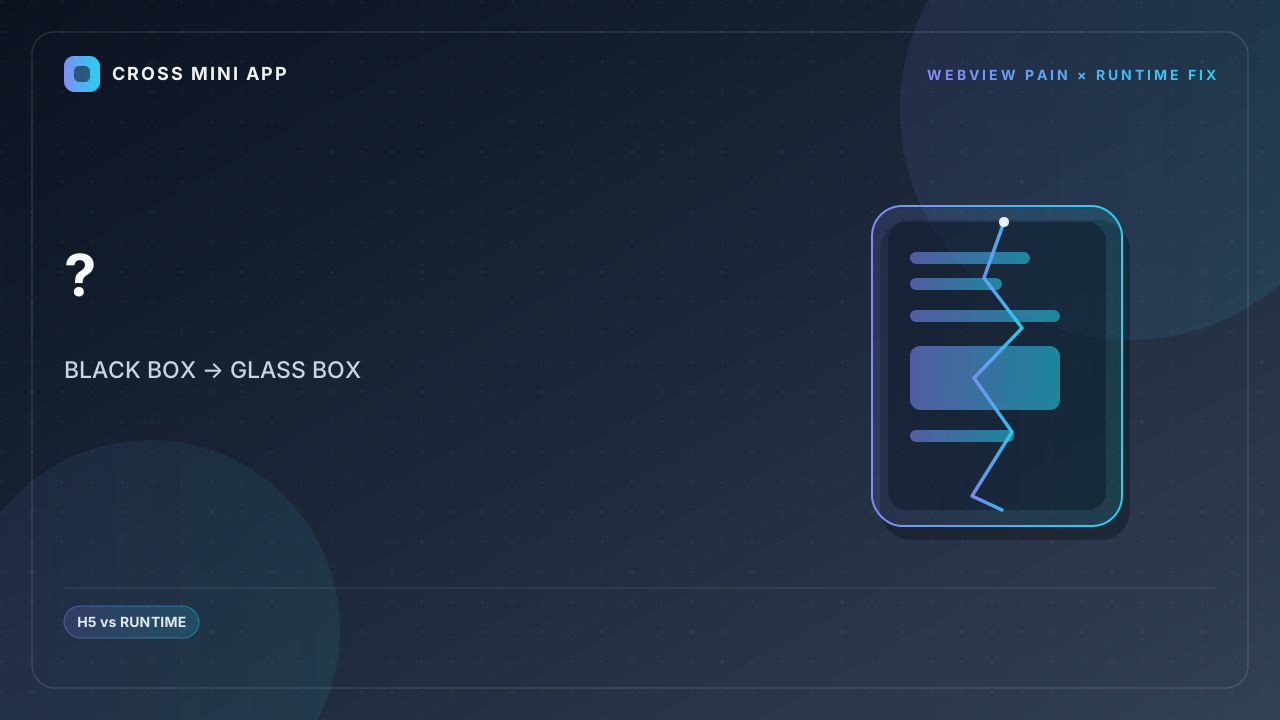
A runtime doesn't make security free. The host is still responsible for the engine, the review pipeline, and the runtime's own hardening. But it converts an opaque third-party surface into a surface you actually govern: signed packages, graded APIs, capability whitelists, and a takedown you control. The black box becomes a glass box.
The honest line: if your app touches money, health, or identity, «we embedded a web page» is not a defensible architecture. A controllable runtime is what turns that exposure from a liability you inherited into a control you own.