
Malaysia has a third of Indonesia's population, but on payments infrastructure it punches several weight classes above. DuitNow — the interoperable QR and real-time rail run by PayNet — is accepted at 3 million-plus touchpoints, and an open-banking framework lets any licensed player plug in. That is why the country is such natural soil for mini-programs: a small but wealthy, high-penetration market with a rail built for interoperability.
The opportunity is not another wallet. It is a lightweight program that opens inside Touch 'n Go or GrabPay, already logged in, already able to pay through DuitNow — and governed tightly enough that a universal runtime can plug in safely.
The six dimensions, scored on Malaysian ground
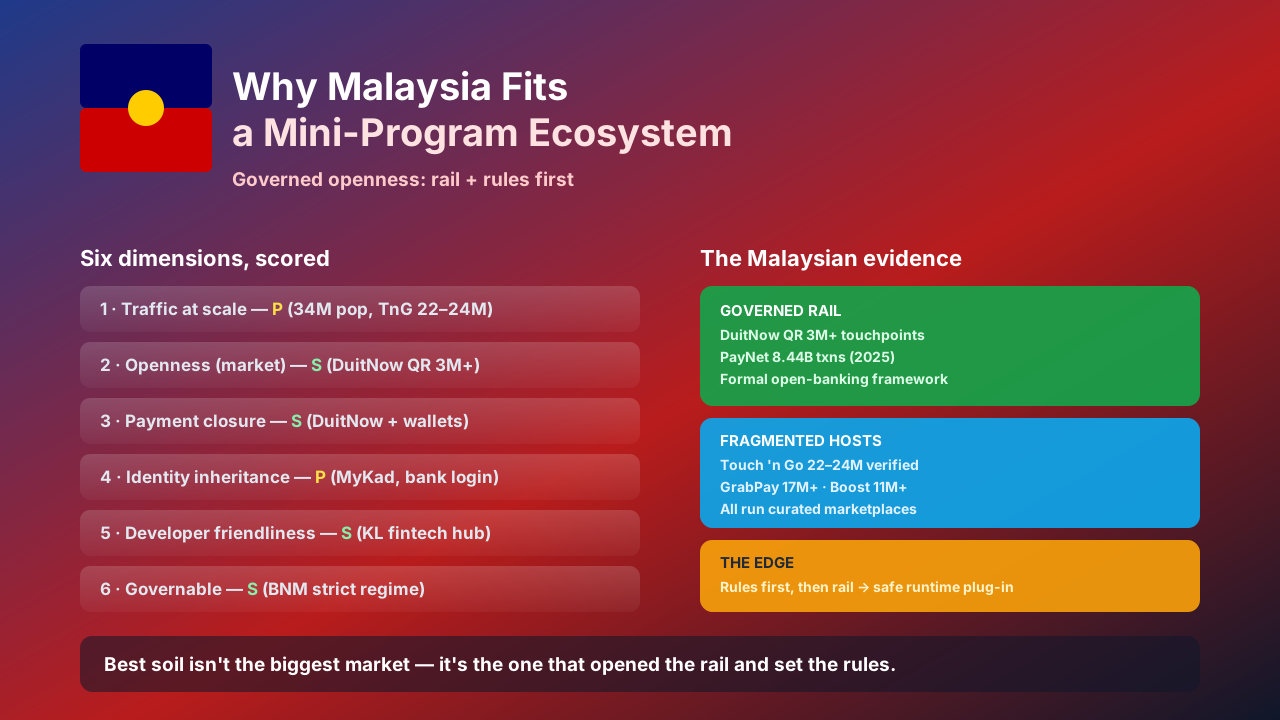
1. Traffic at scale. The population is around 34 million, but smartphone and internet penetration are among the highest in the region. Touch 'n Go eWallet serves 22–24 million verified users (used by 78% of e-wallet users), GrabPay 17 million-plus, and Boost 11 million-plus. Lower headcount, high intensity.
2. Openness, at the market level. PayNet's DuitNow QR is interoperable across every bank and wallet, and Malaysia runs a formal open-banking framework. The rail is open by design and by regulator — even though the super-apps keep their mini-app surfaces curated.
3. Payment closure. A mini-program inherits DuitNow plus Touch 'n Go, GrabPay, or Boost — all real-time and near-free. PayNet cleared 8.44 billion transactions in 2025, so settlement volume is already at scale.
4. Identity inheritance. This is the moderate link. MyKad exists as a national ID, but mini-app login still leans on bank or wallet credentials rather than a single universal handoff. Workable, not yet WeChat-class.
5. Developer friendliness. Kuala Lumpur is a genuine fintech hub with strong English-speaking engineering talent and a mature open-banking API culture. Builds are cheap and well-supported — the easiest developer environment in the SEA cohort.
6. Governable. Bank Negara Malaysia runs one of the region's strictest, most predictable e-money and open-banking regimes, with KYC, licensing, and data rules enforced rigorously. A sandboxed, takedown-capable runtime fits cleanly inside it.
| Dimension | Score | Malaysian evidence |
|---|---|---|
| Traffic | P | 34M pop, TnG 22–24M, GrabPay 17M |
| Openness | S | DuitNow QR 3M+, open banking |
| Payment | S | DuitNow + TnG / GrabPay / Boost |
| Identity | P | MyKad exists, wallet/bank login |
| Developer ease | S | KL fintech hub, open-banking APIs |
| Governance | S | BNM strict, predictable regime |
Why governed openness is the edge
Most markets open the rail and hope governance follows. Malaysia did the reverse: Bank Negara set strict rules first, then opened the rail through PayNet. For a universal runtime, that order is gold — you plug into a system that already knows how to sandbox, license, and take down bad actors.
The CrossMiniApp angle
CrossMiniApp is a universal runtime plus an open catalog. You build the mini-program once and it runs inside Touch 'n Go, GrabPay, and the wallet surfaces — inheriting each host's identity and payment, sandboxed and governable, updatable over the air. Malaysia's governed-openness structure is the argument: the rail is interoperable and the regulator is ready, so the value is in a runtime that reaches every host without renegotiating each wall.
The rule
The best mini-program soil is not the biggest market. It is the one that opened the rail and set the rules first — and Malaysia did both.