China turned government into a runtime. The e-social-security card has 1.07 billion holders (73% population coverage) and served 17.05 billion online requests in 2024; Zhejiang's 浙里办 has 120 million registered users and 3 million daily actives; the national government service platform sits inside WeChat and Alipay. Citizens do birth registration,社保, 医保 and 公积金 in a mini-program. But you cannot export a Chinese government app — and you should not try. The lesson is the architecture, never the payload.
Why government is the ultimate "pattern, not payload" case
Every other category in this series travels at least partially: games travel on a runtime, social commerce on a pattern plus a rail, mobility and food on a local operational stack. Government services are different — identity, statute and data residency make the app 100% sovereign. What crosses borders is not the content but the design: one front door for many agencies, data shared behind it, and certificates that are digital by default.
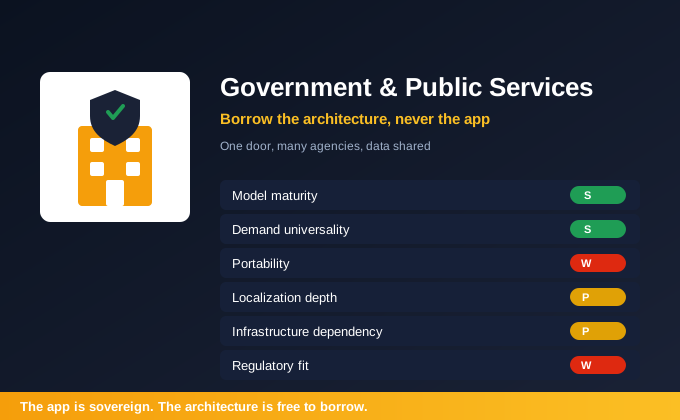
| Dimension | Rating | What the evidence says |
|---|---|---|
| Model maturity | S | 1.07B e-social-security cards, 浙里办 120M users / 3M DAU, national one-network governance is globally leading |
| Demand universality | S | Every citizen-facing government wants lower friction; the demand is universal |
| Portability | W | The app is sovereign — national ID, law and data residency make it 100% non-transferable |
| Localization depth | P | Must rebuild on the local civic identity, local statute and local agency topology |
| Infrastructure dependency | P | Requires a national ID system, inter-agency data sharing and a local government cloud |
| Regulatory fit | W | The app is the regulation; only the architecture transfers, never the content |
The three moves worth copying
- One-stop portal inside a runtime. 一网通办 puts every agency behind one mini-program UI. The runtime hosts the front door; the back-end data sharing stays local and sovereign. A government does not need to build a native app per agency — it ships services as mini-programs in one runtime.
- Data sharing & e-certificates. Once identity and certificates are digital (电子证照), ~90% of "running around" disappears. This is governance engineering any state can copy: standardize the forms, share the data, sign the certificate once. The runtime is just the surface; the reform is organizational.
- Multi-channel, same-source publishing. 浙里办 publishes the same service to app, web, self-service kiosk, Alipay and WeChat. The runtime makes a service portable across channels — not across borders. The pattern ("write once, appear everywhere locally") is exactly what a universal runtime is built for.
The CrossMiniApp angle
A universal runtime plus an open catalog lets a local government ship a citizen-services portal as mini-programs — without building native apps for every agency. The catalog carries the service pattern; the sovereign content stays home. This is the cleanest proof that "universal runtime + open catalog" is a governance primitive, not just a commerce trick. The runtime constrains what third-party code can do; the catalog distributes the proven service pattern; the state keeps its data.
The rule
The app is sovereign. The architecture is free to borrow.
Sources
- People's Daily — 浙里办 raises integrated service level (120M users, 3M DAU)
- People's Daily — What new services does the e-social-security card bring (1.07B holders)
- China Securities Journal — National Informatization Development Report 2024 (10.7B e-cards, 17.05B online services)
- Guangdong — 粤省事 digital government case (Foshan: 10.5M users, 191M cases)
- StatCounter — Platform and channel market share