Plenty of app teams come to me asking how to lift retention, and the conversation usually ends the same way: "Let's just spin up an H5 container and embed third-party services."
It sounds reasonable — fast to build, easy to tweak, any webpage plugs in. The problem is that after you do it, retention usually doesn't budge. An H5 page inside your app is, at its core, a borrowed web page. The user taps in, does the job, closes it, and goes back to their own world. Your app sees almost none of what happened in between — which is exactly the thing you can't afford when you're trying to keep people and thicken value.
Six fault lines: where mini-programs and H5 diverge
| Dimension | Mini-program (host runtime) | H5 (WebView page) |
|---|---|---|
| Login & identity | One host login, identity carries through | Re-authenticate per service, identity lost to the third party |
| Payment | Host wallet checks out directly | Bounced to a third-party checkout, money leaves |
| Re-engagement | Recall via host message center | Cut off on close; you don't even know who the user was |
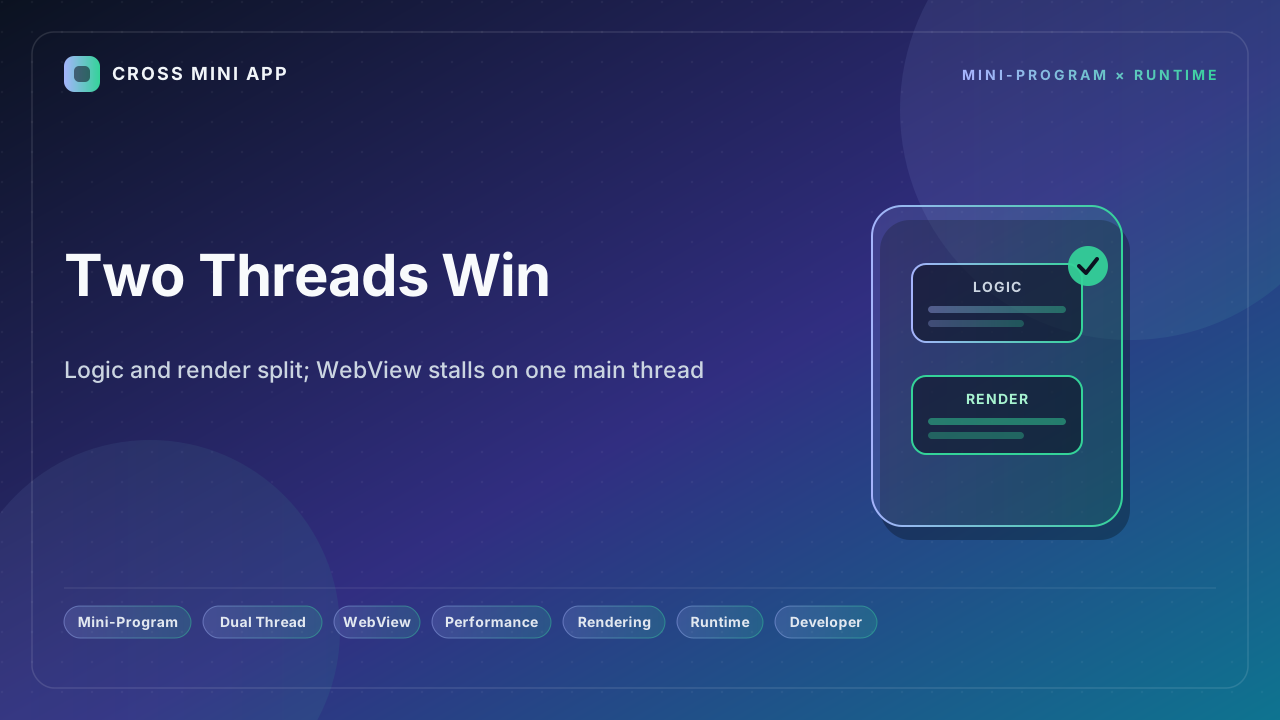
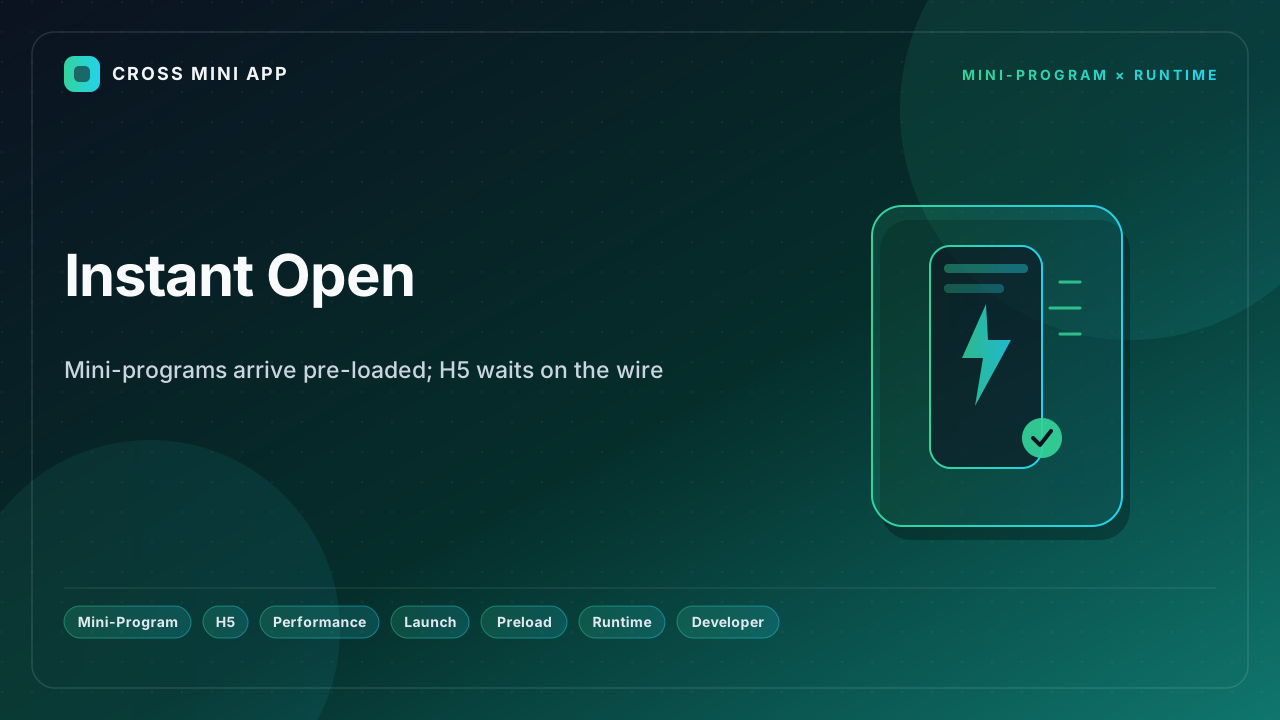
| Experience & perf | Preload + native components, near-native feel | Fetches assets and spins on every open; complex pages break layout |
| Capability ceiling | Host-graded APIs: camera, biometrics, system share | Trapped by browser security model; calls unreliable |
| Ecosystem & compounding | Open catalog + revenue share; more services = more value | Isolated links; one hundred stays one hundred |
Retention runs on a loop; H5 hands you an exit
Inside a webview, your app is just a browser frame. It can't share login with the service inside (the user re-authenticates), can't share payment (the user gets bounced to someone else's checkout), and can't push (there's no session at all). So every embedded service is a leak — value drains out to the third party.
A mini-program runs in the host's own runtime: one login, one wallet, one notification channel the host controls. The user never leaves your world. The difference is between "I used a service" and "I stayed inside your app."
The sharper edge is re-engagement. A mini-program can recall users through the host's message center — "your order is here," "your membership perk landed" — turning a single visit into a relationship you can pick back up. H5 cuts off the moment it closes; you don't even know who the user was or what they did. The reason you can't retain often isn't a bad service — it's that you never got hold of the thread.
Experience is the gate to retention
Every H5 open fetches assets, spins, and waits for scripts to run; complex pages lag and drop their styling. Users don't care whether it's a webpage or native underneath — they care whether it's smooth. Mini-programs preload, use native components, and cold-start far faster, with a near-native feel. Retention is the remainder of experience: stutter once and the user is gone, with no chance for you to recover.
The capability ceiling sets how many reasons you can give to stay
H5 is caged by the browser's security model — camera, contacts, biometrics, system-level sharing all need workarounds and all are unreliable. Mini-programs go through the host's audited, graded APIs: near-native power, but controlled. That means the services you can pack into your app are richer — local life, ticketing, light finance, government services. More reasons means less incentive for the user to uninstall you. One hundred H5 pages are still one hundred isolated links; one hundred mini-programs are a market that compounds.
How value grows: facade or muscle
H5 is a one-off embed; you can't grow an ecosystem around it — no unified catalog, no quality control, no revenue share. Mini-programs let the host build an open catalog: third parties develop, the host sets the rules, takes a cut, and polices the experience. The more services a user can reach inside your app, the higher that user's value (time, conversion, ARPU) — and it compounds. H5 shows services off; a mini-program swallows them. One is a facade, the other is muscle.
And trust
A third-party H5 page inside your app is a black box; phishing, XSS, and account-hijack risk all land on your head. A mini-program runs in a sandbox the host controls — engine isolation, no DOM/BOM, network allowlist — so users dare to use it and regulators can't pick it apart. Trust holds, retention holds.
One honest caveat
H5 isn't garbage. For a one-off campaign page or a temporary entry point you never meant to retain anyone through, it's cheap and fast, and you don't need a mini-program. But the moment your goal is "keep users around and make the app worth more," the container has to be a runtime, not a webpage.
H5 makes an app look like it can do anything. A mini-program actually keeps the users and the value inside. If you want retention and upside, grow muscle — don't just paint the facade.