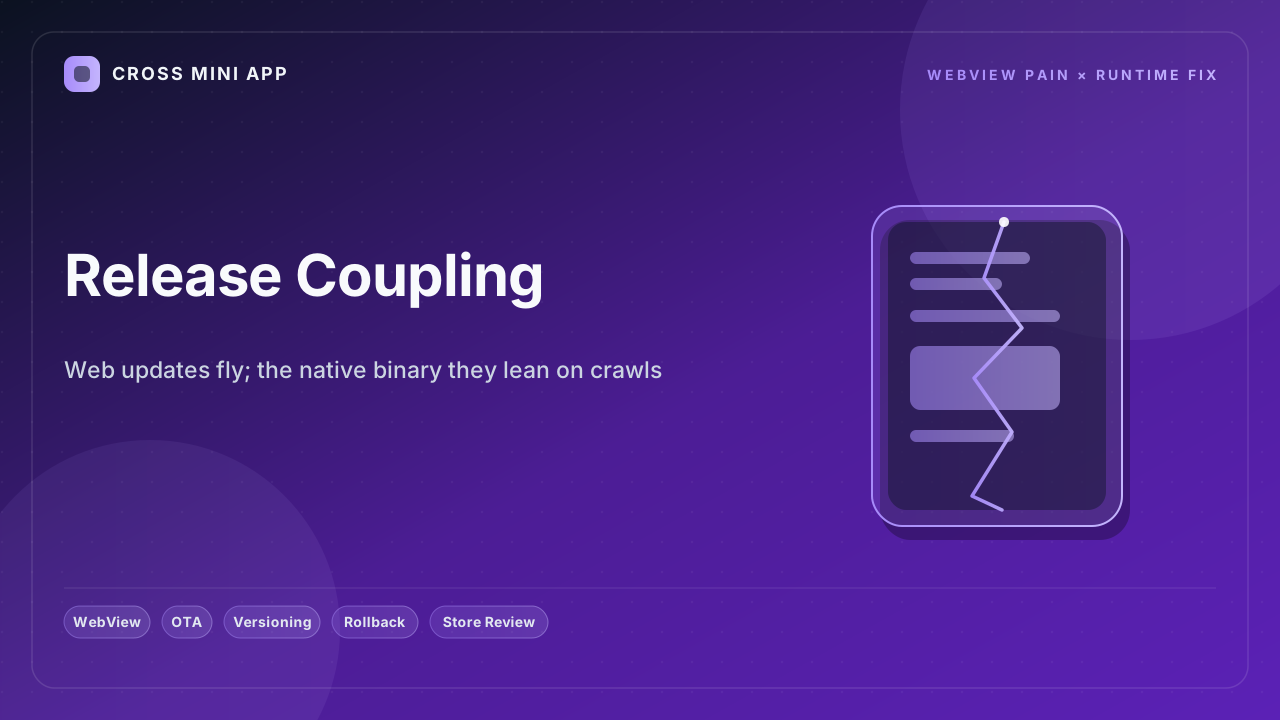
The pitch for embedding web in your app is seductive: ship a fix to the page and every user gets it in seconds, no app-store round trip. In production that speed is an illusion the moment the web layer needs something the native side does not yet provide, or when the user on an old binary cannot safely run the new page. Your fastest layer is chained to your slowest one, and you cannot steer the chain.
The fast lane and the slow lane
Native releases move at the speed of the stores. Apple's App Store review median is roughly 24 to 72 hours, but the tail is what kills you: new developer accounts, sensitive categories, holiday backlogs, and flagged builds can push a single release to weeks. Google Play is similar across its many channels. Users then sit on old versions for weeks or months if they have auto-update off. The web layer, by contrast, updates over the air instantly — the classic hybrid promise. The problem is that the two lanes are not independent. The web page calls native bridges, and those bridges are a contract that only exists in a specific native build.
Old binaries, new expectations
When you ship a new web page that depends on a native method added in version 3.2, every user still on 3.0 or 3.1 will hit a missing bridge — a blank panel, a dead button, or a hard crash if the call is unsafely wrapped. You cannot simply push the web update and move on, because the installed base of old binaries is a fact you cannot wish away. The web layer must carry compatibility shims for versions you stopped caring about, or you must gate features behind a native-version check that the web side has to infer from signals the host may or may not expose. Either way the web team is now writing code to compensate for the store's release cadence.
The rollback you cannot do
A bad web bundle is the nightmare version of this coupling. On a pure website you redeploy the previous commit and the problem is gone in minutes. Inside a hybrid app, if the broken page is served from your server, you can in theory revert server-side — but only if the old page still works against every native version currently in the field. If the bad release assumed a new native contract, reverting the web page does not help the users on the newest binary who now have no working page at all. And if the web assets are bundled inside the native app, the only rollback is a new store submission. There is no per-user, per-version, independent release channel. You are all-or-nothing, gated by the store.
Why it compounds
This is the trap that #12 (no remote kill switch) and #23 (hot-update compliance) only patch at the edges. Without a controlled release layer, every web change becomes a bet on the entire installed-base matrix: which native versions are live, which bridges they expose, which users auto-update. Teams respond by shipping less, by freezing the embedded web behind long QA cycles that defeat the original purpose of embedding it, or by quietly accepting that some users will see broken pages until they update. The hybrid advantage — speed — evaporates precisely when you need it most, like a checkout-breaking bug during a sale.
The runtime fix
A host-owned runtime decouples the two lanes with a controlled release channel. It pins which web version runs against which native version, serves the right bundle per install, and supports staged rollout and instant rollback at the runtime level — not at the mercy of the store. New native capabilities are negotiated through a versioned bridge contract the runtime enforces, so a page that needs 3.2 simply does not activate on 3.0 instead of crashing. The web layer keeps its speed; the native layer keeps its safety; and you regain the steering wheel.
| Dimension | WebView | Host-owned runtime |
|---|---|---|
| Web update | OTA in seconds | OTA in seconds |
| Native dependency | Assumes bridges may or may not exist | Versioned bridge contract enforced |
| Old binaries | Web must shim or break | Right bundle pinned per install |
| Rollback | Store submission or all-or-nothing | Runtime-level staged rollback |
| Release steering | Split, unsteerable | One controlled channel |
The through-line of this series is control. A WebView hands you two release lanes you cannot synchronize and a rollback you cannot trigger. A runtime lets you pin versions, negotiate contracts, and roll back on your terms. For a catalog of other people's pages transacting inside your app, that difference is the gap between fixing a bug in minutes and waiting on a store.
Sources
- Native release cycles: iOS review median 24–72h, but the tail can stretch to weeks — store-review friction and users stuck on old versions.
- Capgo 2026: separate the binary release from the web-layer release; ship a thin native shell — OTA for JS/HTML/CSS, store only for policy-bound native changes.
- WebView vs native: web updates are instant OTA, native needs store review and user adoption — the release-cadence gap that creates version skew.
- Users stay on old app versions for weeks or months if they disable auto-update — multiple active native versions must be supported by the web layer.
- When H5 is embedded, 'my update didn't show' is usually cache, version-check, or release-flow misalignment — why embedded H5 updates still surprise teams.