

From Checkout to Doorstep: Why Last-Mile Delivery Ships as a Mini-Program
E-commerce trained the world to expect a parcel at the door in two days. The final leg is won or lost inside the app the customer already opens — and a governed mini-program is the unit that delivers it.
Cross Mini App Team
September 19, 2026 · 4 min read
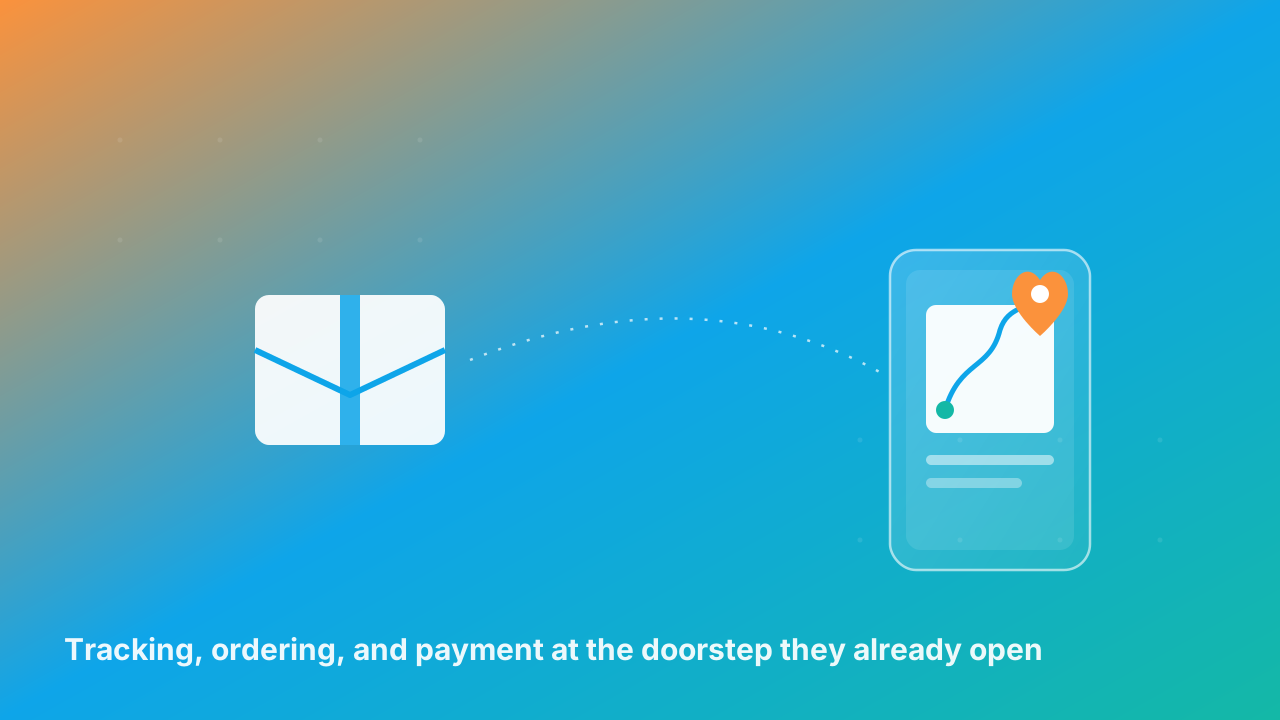
The final leg is where loyalty is won or lost
A customer in a dense city watches a dot crawl across a map, waiting for the parcel that decides whether she shops here again. The warehouse, the courier network, the brand — all of it comes down to this last screen. The world's logistics industry has spent decades optimizing everything except the moment that actually belongs to the customer: the moment inside the app she already has open. And the governed mini-program is the unit that lets a host deliver that moment.
The scale is enormous
The numbers describe a machine too big to ignore:
- The last-mile delivery market reached about US$179 billion in 2024 and is on track for roughly US$201 billion in 2025, a double-digit climb (The Business Research Company). The broader last-mile services market was already worth US$223 billion in 2025 and is projected to pass US$629 billion by 2032 (pmarketresearch).
- Global parcel volume hit 22.37 billion shipments in 2024 — about 710 parcels every second — and is projected toward 225 billion by 2028 (Pitney Bowes Parcel Shipping Index).
- In the United States alone, 22.4 billion parcels moved in 2024, up 3.4%, with Amazon Logistics handling 6.3 billion of them — a 28% share, second only to USPS.
- E-commerce is the engine, with online sales projected near US$6 trillion in 2025, each order a fresh last-mile job.
Why the gap persists
The old model asks the customer to install yet another app — the courier's, the marketplace's, the retailer's — and then prays she opens it at the right moment. It fails at the final leg:
- Acquisition is a losing battle. A standalone delivery app will never win a home-screen slot against the map, the wallet, or the super-app the customer already opens a dozen times a day.
- Fragmentation multiplies friction. Merchant, courier, and marketplace each ship their own app; the customer is forced to juggle ten logins, ten trackers, ten payment flows.
- Trust breaks at the door. Identity, payment, and returns handled outside the trusted host become a fraud and refund risk exactly where the customer is most exposed.
Real programs already run
- Super-apps already do this. Grab and Gojek in Southeast Asia, Meituan and Ele.me in China — merchants and logistics run as mini-programs inside the host, reaching the user where she already is.
- WeChat and Alipay host parcel-tracking, courier-ordering, and returns mini-programs used by hundreds of millions without a separate install.
- Maps apps (Amap, Google Maps) now embed ordering and live ETAs, turning the navigation surface into a transaction surface.
These are not pilots. They are the distribution backbone of the next decade of commerce.
The delivery problem nobody talks about
Embedding ordering, tracking, and payment inside a host app sounds easy until compliance arrives. A telco, a wallet, or a super-app will not accept a full native app with deep device access and an unaudited data scope. What it will accept — across regions, languages, and currencies — is a bounded, sandboxed, compliant mini-program that inherits the host's identity, payment, and consent flow.
Why a mini-program, not another app
The governed mini-program is the natural delivery unit for last-mile services:
- It inherits the host's trust. Login, KYC, and consent already happened in the host. The merchant or courier rides them — no new account, no new trust decision.
- It is instant and lightweight. No install funnel, no app-store review, no storage tax on a cheap Android. The tracking dot or the reorder button appears in-context, one tap away.
- It is provably compliant. An audited sandbox with explicit scope and consent flows is exactly what a telco, a bank, or a marketplace will approve across markets.
What this means for merchants and hosts
If your 2026 plan assumes customers will find and install your delivery app, reconsider:
- Meet the customer inside the app they already open — a maps app, a food-delivery super-app, a wallet, a marketplace — instead of fighting for a home-screen slot you will never win.
- Ship a governed unit the host will embed. A sandboxed, compliant mini-program — not a native app — is the unit a Grab, a GCash, or a Meituan will actually accept across regions.
- Design for the real-time, multi-currency, multilingual reality. The next billion parcels are tracked on patchy networks, paid in local wallets, read in local languages. Lightweight, instant, localized services are the only ones that reach them.
Where Cross Mini App fits
Cross Mini App is the runtime and the open catalog for the post-install era of commerce. You build a governed delivery mini-program once and drop it into every trusted host — a maps app, a wallet, a super-app, a marketplace. Pre-compliant, sandboxed, and localized, these experiences deliver ordering, tracking, and payment inside the app the customer already trusts, without asking her to install anything. Hosts get vetted services they can embed in a single line; merchants stop rebuilding per store and per country; customers get the parcel status at the moment it matters. For logistics — where cross-border data, payment licensing, and local regulation make sandboxing non-negotiable — a governed cross-app runtime is the only safe unit to distribute at scale.
The package follows the doorstep, not the store
For decades the default was "build a delivery app, acquire cold, hope they return." In 2026 the growth is on the in-app surface, delivered as a governed mini-program through a cross-app runtime. Cross Mini App is building the shelf so the next reorder, the next live ETA, the next doorstep confirmation reaches the customer at the moment it matters — inside the app already open.
Related Posts
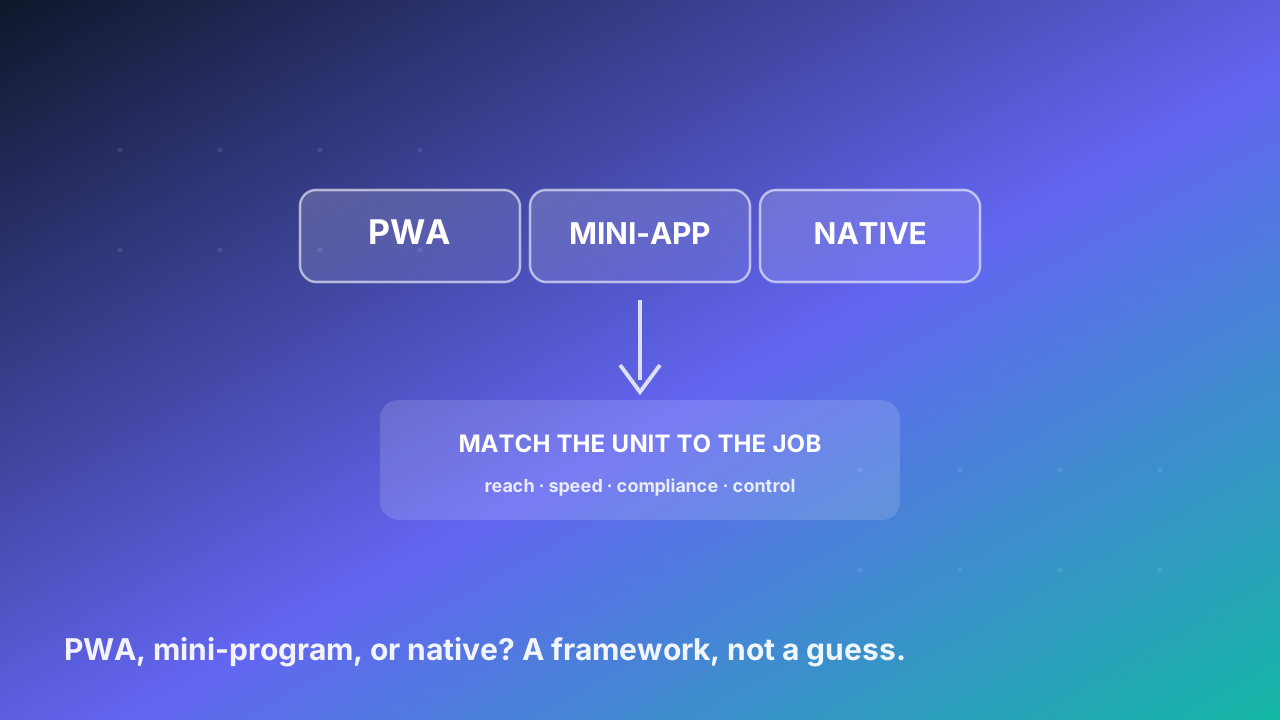
Stop guessing which app form to build. A practical 2026 framework maps your real constraints — reach, time-to-market, compliance, payment, control — to the right unit: PWA, native, or a governed mini-program.
Generosity is a moment — a story, a disaster, a friend's fundraiser. The gift is won or lost inside the app the donor already trusts, and a governed mini-program delivers it with proof.
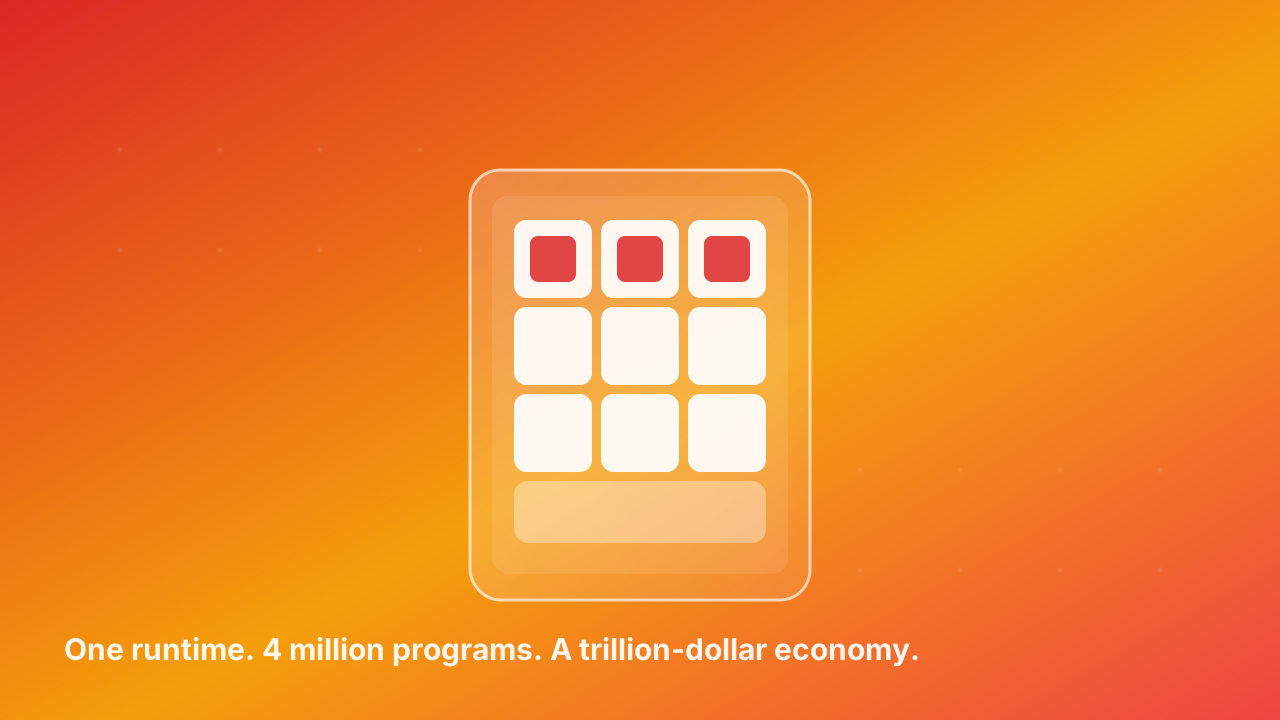
China didn't adopt mini-programs — it built an alternative internet on top of them. WeChat alone runs ~4.3 million programs with ~945M monthly users and over ¥8 trillion in 2024 GMV. Here's how the model works and why it scales.