

The Corner Store Goes Digital: Why Merchants Belong Inside a Trusted Host
Micro, small and medium enterprises are 90% of the world's businesses yet most still lack an online presence. The governed mini-program — dropped into the super-app, wallet, or messenger a merchant's customers already trust — is the unit that finally brings the corner store online.
Cross Mini App Team
September 16, 2026 · 4 min read
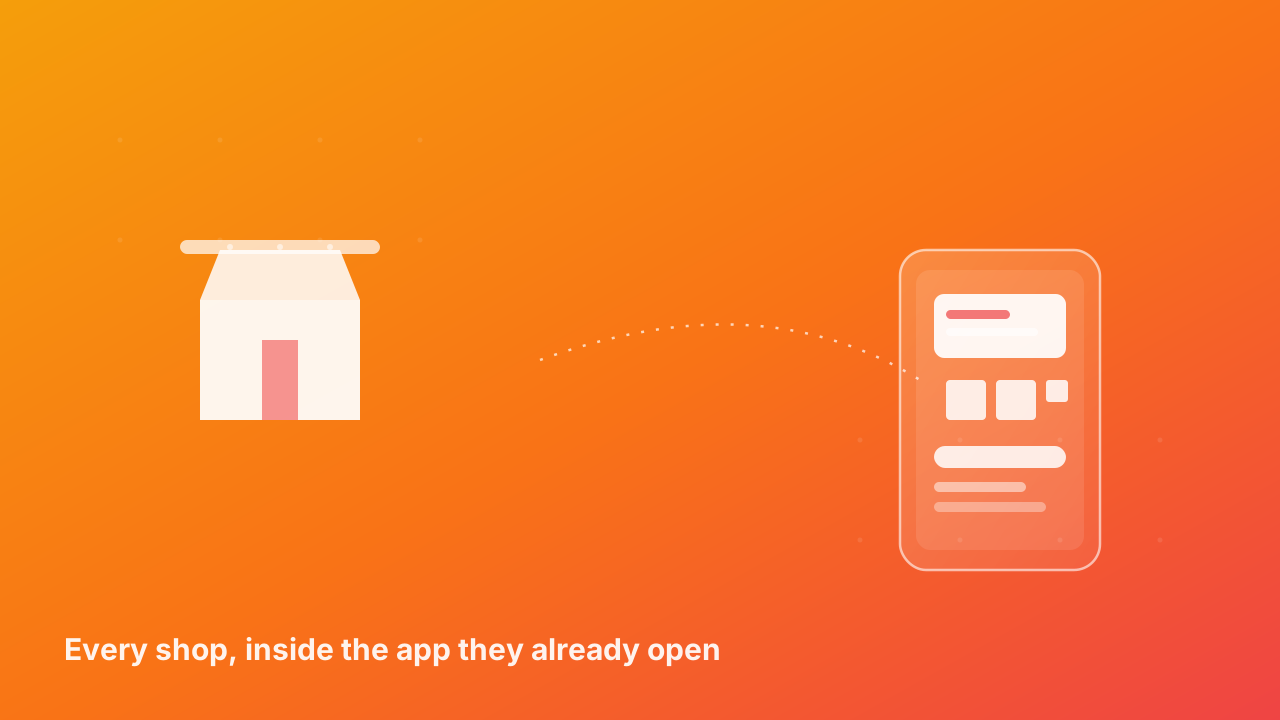
The shop is there. The front door isn't.
Walk any market in Jakarta, Manila, São Paulo, or Lagos and the energy is undeniable — millions of micro, small and medium enterprises (MSMEs) feeding local economies. Yet for most of them, the "open" sign is physical only. Their customers have moved online; the storefront has not. The merchant does not need another app to build. What they need is a governed mini-program that lands inside the super-app, wallet, or messenger their customers already open every day.
The numbers behind the missing front door
The scale is hard to overstate:
- MSMEs are 90%+ of all businesses worldwide, provide roughly 70% of employment, and account for about 50% of global GDP [UNCTAD].
- In Southeast Asia they are 97% of enterprises, 85% of the labour force, and 45% of regional GDP; in the Philippines they are 99.59% of establishments and roughly 65% of jobs.
- And yet the digital gap is the story: before the pandemic only about 34% of Southeast Asian SMEs had any online presence, and 76% wanted more online visibility. In the Philippines 77% of MSMEs want to use more digital tools — but only ~16% actually do, citing skills and complexity.
- The constraint is not only tech. The IFC estimates 65 million firms — 40% of formal MSMEs in developing countries — face a US$5.2 trillion annual unmet financing gap.
The merchant is willing. The friction is the build.
What already works: the super-app as the bridge
Southeast Asia proved the pattern. During COVID, Grab digitalised over 100,000 SMEs, and its GrabMerchant app offered self-onboarding that got a food business running in 24 hours. Grab's "for Good" goals target 5 million traditional businesses and merchants brought online. In 2025 its Grab Asenso program pushed merchant tools — cashless acceptance on any NFC phone, logistics, and an AI co-pilot — directly inside the GrabMerchant app, pairing skills with plug-and-play infrastructure.
The merchants who came online did not regret it. In Grab's platform-economy research, 80%+ of MSMEs said platforms are critical to their future success, 85% said platforms give them reach to a larger customer base, and 73% said selling through platforms is more profitable than offline. The host supplied the demand, the payments, the logistics, and the trust. The merchant supplied the goods.
Why a mini-program, not a merchant app
The lesson is the same one commerce already learned: the merchant should not be forced to become a software company. A governed mini-program dropped inside a trusted host is the delivery unit:
- The host brings the customers. A super-app, wallet, messenger, or bank already has the daily audience. The merchant's storefront appears where demand already lives — no home-screen slot to win.
- Trust and payments travel with the surface. Login, KYC, and settlement are the host's. The merchant inherits them instead of rebuilding a payments stack and a fraud program.
- It is bounded and compliant. A sandboxed mini-program with audited scope is exactly what a Grab, a GCash, a telco, or a municipal portal will accept across jurisdictions — far safer than handing a third party a full native app.
What this means for merchants and the platforms that serve them
If your 2026 plan assumes the corner store will download, install, and learn your merchant app, reconsider:
- Meet the merchant inside the host their customers already trust — a super-app, a wallet, a messenger, a bank — rather than asking them to bootstrap a storefront from zero.
- Ship a governed unit the host will embed. A sandboxed, compliant mini-program — not a native app — is the unit a Grab, a GCash, or a marketplace will actually accept across markets.
- Design for low-bandwidth, low-storage, mobile-first reality. The next hundred million merchants are on cheap Android with patchy data. Lightweight, instant, localized storefronts are the only ones they will use.
Where Cross Mini App fits
Cross Mini App is the runtime and the open catalog for the post-install era of the merchant. You build a governed merchant mini-program once — storefront, catalogue, payments, loyalty, logistics hook — and drop it into every trusted host: a super-app, a wallet, a bank, a telco, a municipal portal. Pre-compliant, sandboxed, and localized, these experiences bring the corner store online without asking the merchant to become a developer. Hosts get vetted merchant services they can embed in a single line; merchants stop rebuilding per store and per country; customers shop the local store inside the app already open. For small business — where trust, payments, and local regulation make sandboxing non-negotiable — a governed cross-app runtime is the only safe unit to distribute at scale.
The corner store, finally online
For two decades the default was "build a merchant app, localize it, ship it to every store." In 2026 the growth is on the in-app surface, delivered as a governed mini-program through a cross-app runtime. Cross Mini App is building the shelf so the next corner store opens its door inside the app its customers already trust.
Related Posts
Loyalty is shifting from a separate app to a reward embedded at the moment of payment. The governed mini-program is the unit that delivers points, tiers, and perks inside the host the customer already trusts — no install, no second login.
Telemedicine is a $152B market growing 20% a year, yet billions still cannot reach a clinician. The bottleneck is not technology — it is distribution. Here is why the mini-program, not the native app, is how care crosses the last mile.
App downloads stalled in 2025 while in-app spending climbed. Attention is concentrated, the install barrier is high — and the next billion users are not in the app store at all. Here is why install-free mini-program distribution is the growth market.