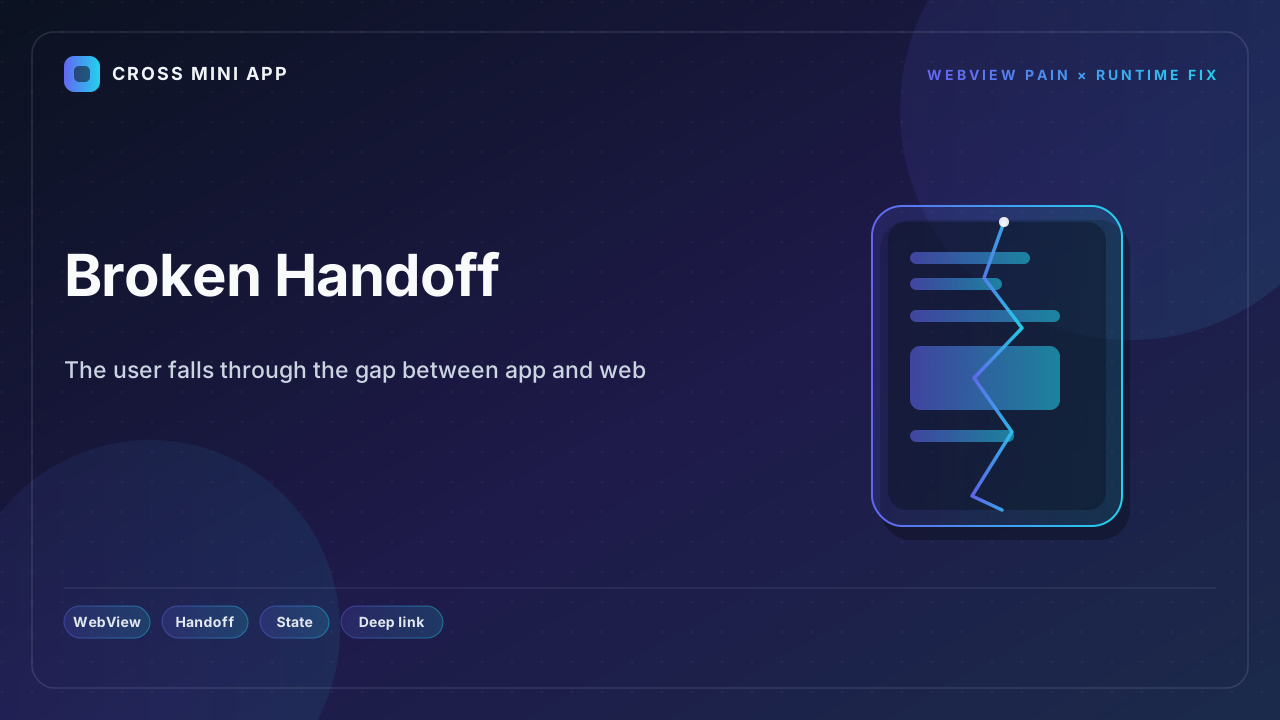
You bought the click. A user tapped your ad, your push, or a friend's share link, landed on the right product, read the right article. Then they hit «Open in app» — and arrive on your home feed. The article they were reading, the item they were about to buy, the campaign that paid for the tap: gone. That is the broken handoff, and it is the most expensive leak in a traffic app's funnel, because it happens at the finish line.
The handoff is where funnels break. The web-to-app journey has five steps — prompt, tap, route, install, restore context — and every one crosses a boundary where context is discarded by default rather than preserved (deeplinkly). Step 3 sends users who already have the app to the store anyway; step 4 (install) is the single largest drop; step 5 (restore context) dumps a fresh install on a generic home screen. A user who installed to read one specific article and lands on a feed has to find it again — and most will not. Branch and Apptimize measured deferred deep linking at 1.8x the signups, 1.9x the retention, and 2x the engagement of a generic landing. In a direct-to-consumer test, a deferred deep link lifted install-to-purchase from 4.1% to 11.7% and cut cost-per-purchase from $42 to $15 (coinis). Branch's 2024 Mobile Growth Handbook puts deep-linked campaigns at 2x–4x the conversion of non-deep-linked ones, with a 40% lift in 7-day retention. The difference between landing on the right screen and landing on the home screen is not a rounding error — it is the campaign.
WebView makes the handoff worse, not better. When your destination screens are served as documents inside an in-app WebView, two failures stack. First, the WebView screen has no first-class native route, so «open in app» often means «open the store, or reload the same document» — the app-native destination never receives the parameters. Second, the same content rendered in a social in-app browser arrives signed out, with partitioned storage and a stripped referrer; users abandon before converting because signing in and paying are harder there (openup). You paid for the visit, then routed it into the one environment where it is hardest to finish.
You are also now dependent on a third party for the fix. Deferred deep linking that actually preserves context needs a platform that owns the install-to-destination mapping — historically Branch, AppsFlyer, or Firebase Dynamic Links. Firebase Dynamic Links was shut down on 25 August 2025 (coinis, Firebase support). Teams that built their handoff on it woke up to links that simply stopped resolving. Every external deep-link dependency is a date on the calendar when your funnel can break.
A runtime closes the gap by definition. A host-owned runtime runs your mini-program as a first-party, signed component of the app. The same link that routes a web or social visitor can open the exact runtime screen when the app is installed, and — because the destination is a packaged, versioned unit rather than a freshly fetched document — carry the campaign and item parameters through install and land the user on the right screen on first open. No third-party link service to expire, no document to re-fetch and lose context. The handoff stops leaking because the boundary it crosses is yours.
WebView document vs host-owned runtime
| Dimension | WebView document | Host-owned runtime |
|---|---|---|
| «Open in app» result | Store page or same document reloaded | Exact in-app screen opens |
| Context across install | Lost on home screen | Carried to the right screen |
| Deferred deep link | Needs external SaaS | Native to the packaged unit |
| Dependency risk | Firebase Dynamic Links expired 2025-08-25 | No third-party link service |
| Where the leak is | Steps 4–5 of the funnel | Closed at the boundary |
Sources
- Branch — The Role of Deep Linking in Mobile Marketing Campaigns
- Branch + Apptimize — deferred deep linking 1.8x signups, 1.9x retention, 2x engagement
- deeplinkly — Web-to-app conversion: the five-step funnel and where it leaks
- coinis — deferred deep link DTC case: 11.7% vs 4.1% install-to-purchase, $15 vs $42 CPA
- Firebase support — Dynamic Links shutdown on 25 August 2025