
A universal runtime that executes code written by anyone, on anyone's phone, with access to payments and identity, is not a technical problem first — it is a trust problem. Ten years ago China faced it head-on: WeChat and Alipay opened their super-apps to millions of outside developers, and the code now runs on roughly a billion devices, moving real money. The fact that this did not become a daily breach headline is the real story.
The lesson is not "build a sandbox." It is "build a stack of trust," where each layer removes one class of disaster.
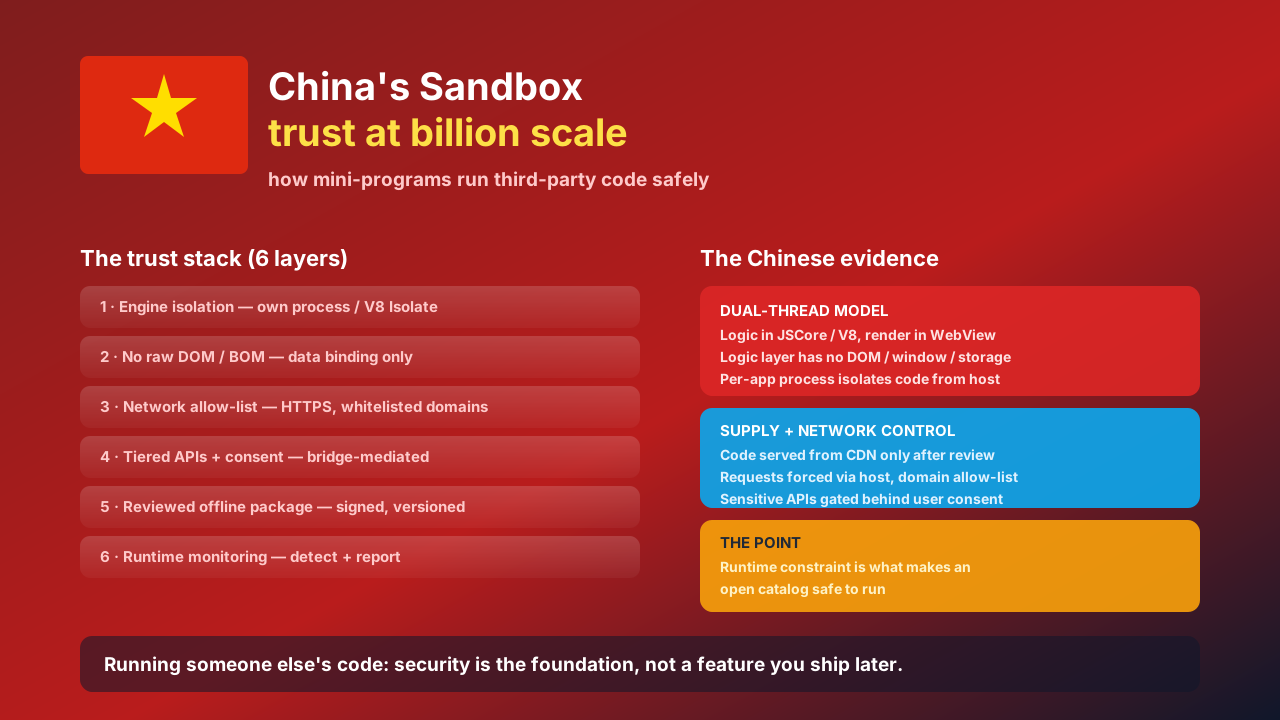
The trust stack China actually shipped
| Layer | What the platforms do | Risk it removes | Portable to a universal runtime |
|---|---|---|---|
| 1. Engine isolation | Logic runs in a separate JS engine (JSCore / V8), render in a WebView; each mini-program gets its own process or V8 Isolate | Code escaping into the host app, cross-app data theft | Yes — engine-level |
| 2. No raw DOM / BOM | The logic layer has no document, window or localStorage; UI changes only via data binding | Post-review UI injection, XSS, silent page mutation | Yes |
| 3. Network allow-list | Every request is routed through the host and HTTPS-only to whitelisted domains | Data exfiltration to attacker servers, phishing | Yes — policy-level |
| 4. Tiered APIs + consent | Sensitive calls (camera, location, contacts) go through a host bridge and need explicit user authorization | Silent PII harvesting | Yes |
| 5. Reviewed offline package | Code is served from a CDN only after platform review, signed and versioned | Tampered or injected payloads, supply-chain abuse | Partial — needs a catalog review pipeline |
| 6. Runtime monitoring | Anomaly detection plus a user report channel | Post-publish abuse | Yes — telemetry |
The first four layers are pure runtime engineering and travel cleanly to any host. Layer 5 depends on having a catalog — a curated, reviewed distribution surface — which is precisely the open-catalog half of the CrossMiniApp thesis. Layer 6 is operational discipline.
Why this matters for a universal runtime
CrossMiniApp's promise is "write once, run on any host's rail." That promise is only worth anything if the runtime itself enforces the trust stack. A plain WebView that loads third-party code is not a runtime — it is an attack surface. The actual IP is the sandboxed execution: isolate the engine, forbid raw DOM, force every network call through a policy, and gate sensitive APIs behind consent.
Notice the second-order insight: this is why an open catalog works. Because the runtime constrains what code can do, you can afford to let many developers publish. Constraint at the runtime is what makes openness at the catalog safe.
The rule
When you run someone else's code, security is not a feature you add later. It is the foundation you ship on day one — engine isolation, no raw DOM, network allow-lists, gated APIs, reviewed code, runtime monitoring. The Chinese platforms proved this scales to a billion users. So can a universal runtime.