
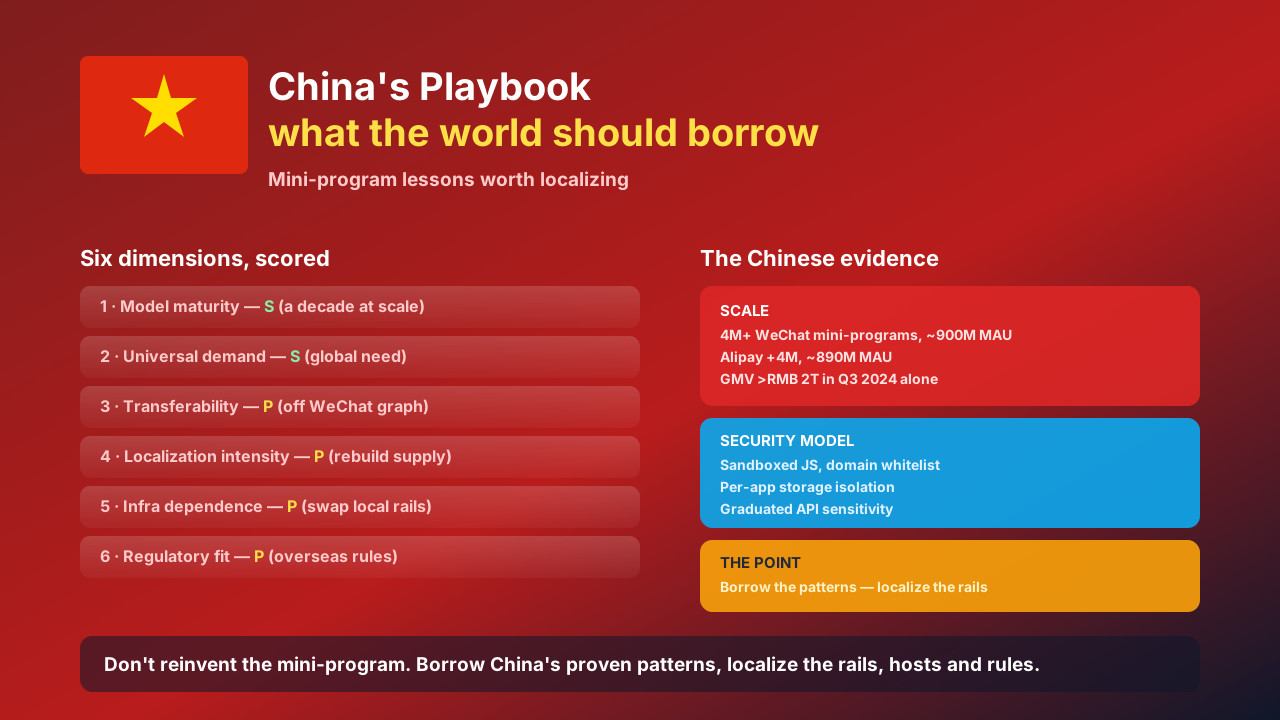
China did not invent the app. But it did invent the post-app — the lightweight program that opens inside a super-app, no install, no app-store wall. A decade in, China's mini-program ecosystem is the largest and most mature laboratory on earth: 4 million+ mini-programs on WeChat alone, ~900 million monthly active users, and WeChat mini-program GMV running into the trillions of RMB (Tencent reported over RMB 2 trillion in Q3 2024 alone). Alipay adds another 4 million+ mini-programs and ~890 million MAU.
The rest of the world — including the eleven markets we profiled — is still figuring this out. The smart move is not to copy China's apps. It is to borrow its proven patterns, and adapt them to local rails, local hosts and local rules. This is a scorecard of what transfers, and what to localize.
Six dimensions for judging reference value
When we say a China-proven pattern is "worth borrowing," we score it on six axes:
- Model maturity — how long and at what scale it has been proven in China.
- Universal demand — does the underlying need exist in every market, or only in China's context?
- Transferability — can the pattern travel without WeChat/Alipay's specific graph and rails?
- Localization intensity — how much must be rebuilt for a new market (merchants, logistics, language)?
- Infrastructure dependence — does it lean on China-specific rails (WeChat Pay, the social graph) that must be swapped?
- Regulatory fit — does it clash with overseas licensing and data regimes?
The category scorecard
| Category | Borrow rating | Key localization | Chinese evidence |
|---|---|---|---|
| Scan-to-use (no install) | S | Local QR/scheme + local host | Core WeChat pattern since 2017 |
| Mini-games | S | Minimal — logic + render | RMB 27B+ in-app revenue (2024) |
| Social commerce | S | Local social host + local pay | WeChat social graph + WeChat Pay |
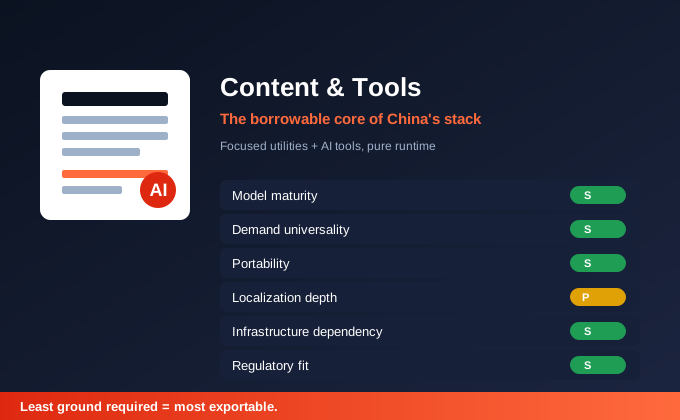
| Content & utility tools | S | Language + local APIs | Scanners, transit, utilities |
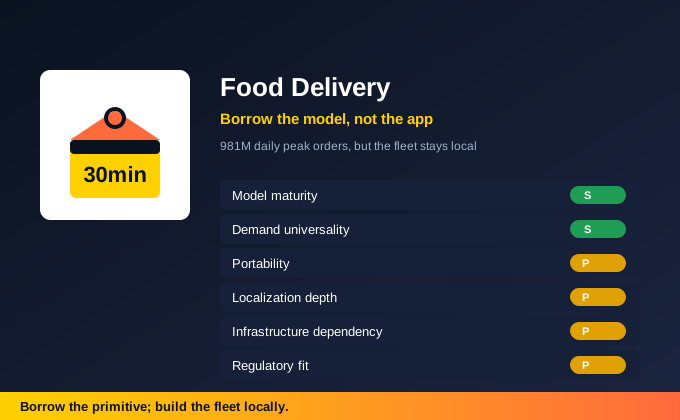
| Food delivery / instant retail | P | Local merchants, logistics, pay | Meituan/Ele.me inside WeChat |
| Mobility / transit | P | Local maps, pay, licensing | Transit QR, ride-hail |
| Gov & utility services | P | State infrastructure differs | WeChat/Alipay "Citizen Center" |
| Finance / lending | W | Heaviest licensing & data rules | Most advanced, least portable |
What the ratings mean
The instantly portable (S). Scan-to-use is the meta-lesson: a program that opens from a code or link, runs in a sandbox, and disappears when done, is a pattern any market can adopt. Mini-games prove it — pure logic and rendering, almost no local infrastructure, and a massive market in China (over RMB 27 billion in in-app purchase revenue in 2024 alone). Social commerce and content/utility tools travel well once you swap in a local social host and a local payment rail.
The localize-heavy (P). Food delivery, mobility and government services are wildly successful in China, but they are glued to Chinese merchant networks, logistics, maps and state systems. The lesson to borrow is the aggregator model — a super-app that bundles daily services — not the specific apps. Expect to rebuild the local supply side from scratch.
The borrow-with-caution (W). Finance and lending are where China is most advanced and least portable. The pattern to take is the sandbox-plus-compliance engineering (sandboxed execution, domain-whitelisted networking, per-app storage isolation, graduated API sensitivity), not the financial products themselves, which face the heaviest licensing and data-protection regimes overseas.
The security lesson worth copying first
If there is one piece of Chinese experience the whole world should adopt immediately, it is the runtime security model. Mini-program code runs in a sandboxed JavaScript context, cannot touch the real DOM or other apps, must route network calls through a platform-reviewed domain whitelist, and stores data in isolated namespaces. Sensitive APIs (payments, biometrics) require extra verification. This is how a host can safely run untrusted third-party code at scale — exactly the problem a universal runtime like CrossMiniApp solves.
The CrossMiniApp angle
CrossMiniApp is a universal runtime plus an open catalog. The catalog is not a random pile of apps — it is a curated, portability-scored set of patterns borrowed from the world's most advanced mini-program lab, adapted to each market's rails and hosts. China proved the model works at scale; the open catalog is how the rest of the world gets the benefit without rebuilding the lab.
The rule
The world doesn't need to reinvent the mini-program. It needs to borrow China's proven patterns — and localize the rails, the hosts and the rules.